AI Search Audit: 13 Checks and Their Sources

AI Search Audit: 13 Checks and Their Sources

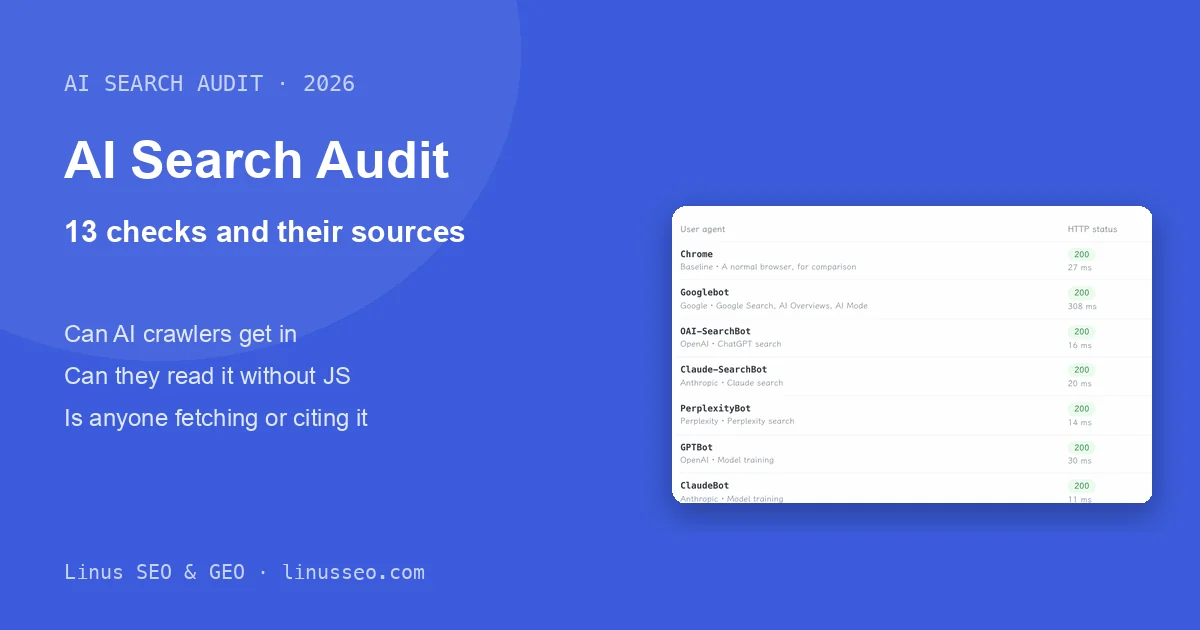
Your site ranks fine on Google, yet ChatGPT and Perplexity never cite it when they answer questions in your niche. Before blaming the content, rule out the technical causes: AI crawlers may not get in at all, or they may get in and find an empty page. This checklist splits the work into 13 checks in 4 layers, notes how much official backing each one has, and runs 7 of them on linusseo.com with this site’s free tools.

Read more
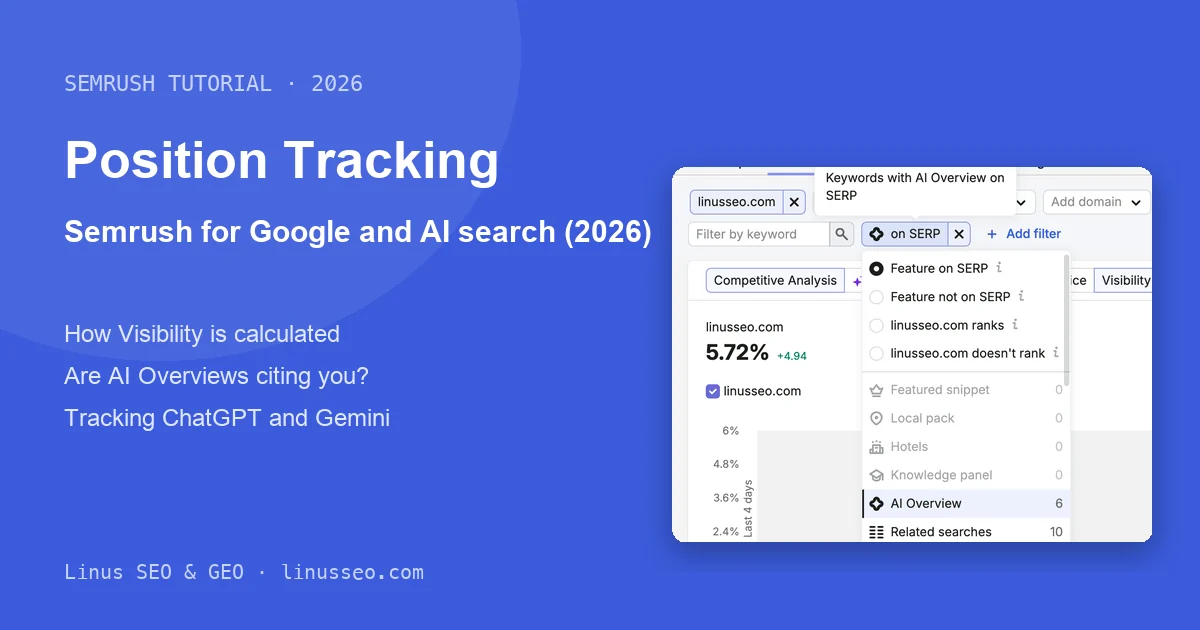
How to Use Semrush Position Tracking (2026)

How to Use Semrush Position Tracking (2026)

It is Monday morning and your boss asks where your core keywords rank this week. You search on your laptop and see position 5. A colleague in another city sees 9. Search Console says the average position is 8.3, and Semrush shows yet another number. None of these is wrong; each is measured under different conditions. Position Tracking checks the same keywords every day from a fixed location, device and time, so you can compare this week with last week and last month.

Read more
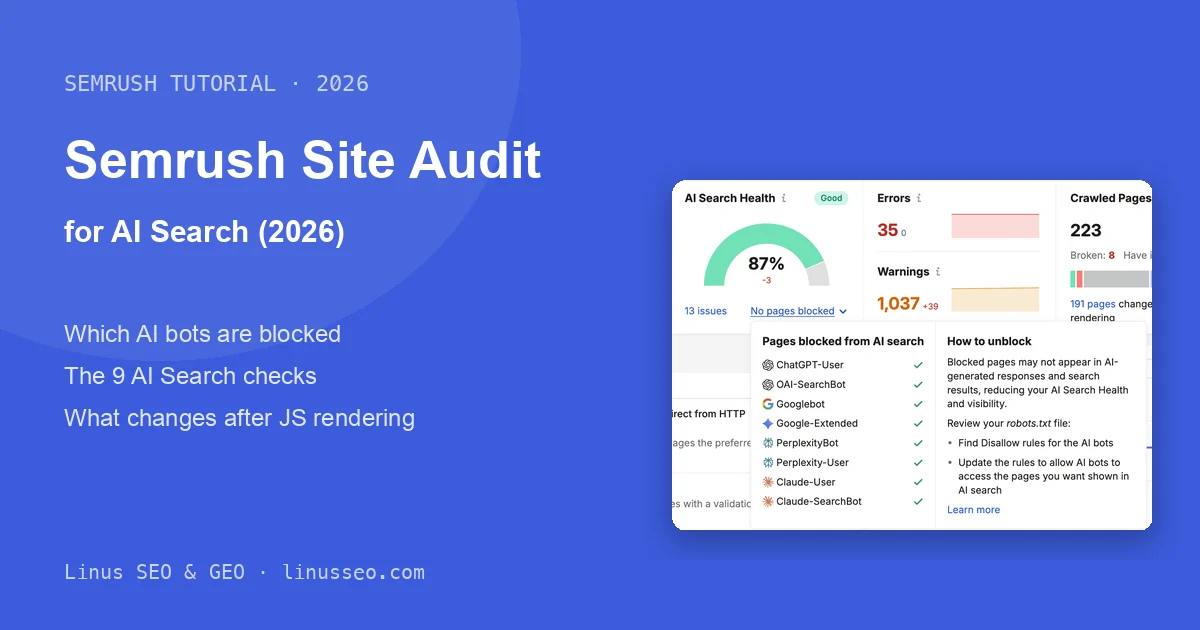
How to Use Semrush Site Audit: Technical & AI SEO (2026)

How to Use Semrush Site Audit: Technical & AI SEO (2026)

Your redesigned site has just gone live, or you have just taken over an online store. You run Semrush Site Audit and get back a health score, thousands of issues and a few dozen red “errors”. The hard part is deciding what to fix first, because fixing some of those errors achieves nothing.

Read more
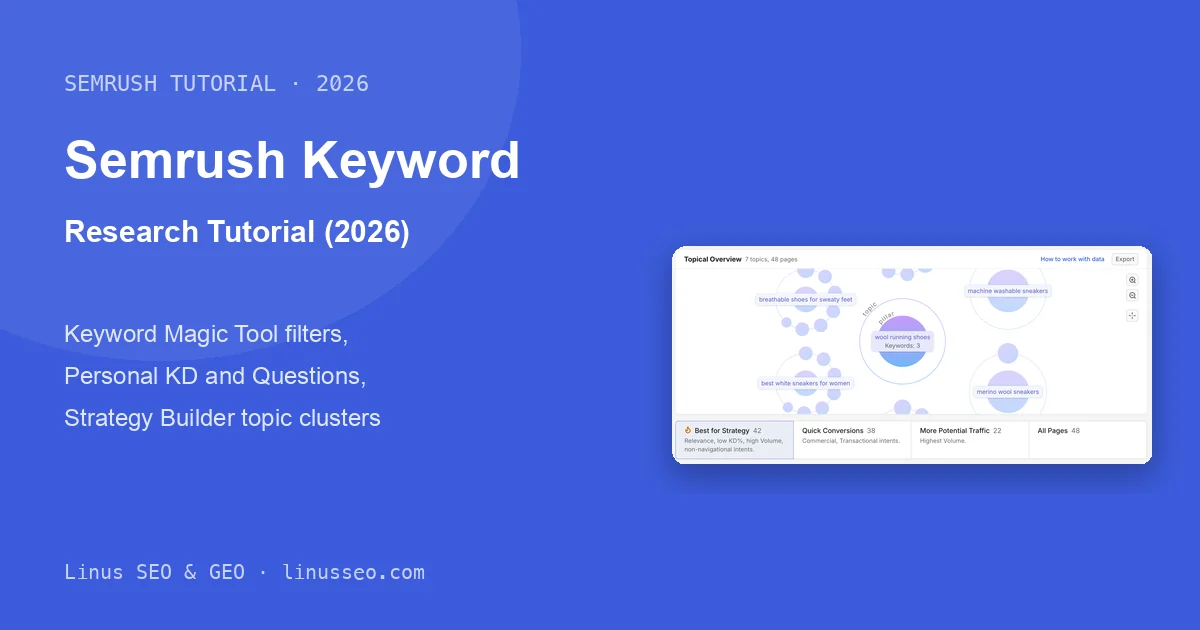
How to Use Semrush for Keyword Research (2026)

How to Use Semrush for Keyword Research (2026)

If you’ve done keyword research for an online store, you know the routine. You’re about to launch a new category, or want to rework the keywords for an existing one. You type one seed into the Keyword Magic Tool and get more than a hundred thousand results, with no clear idea which to keep. Once you’ve picked a batch, you still have to decide how many pages they need, and the list ends up parked in a spreadsheet.

Read more
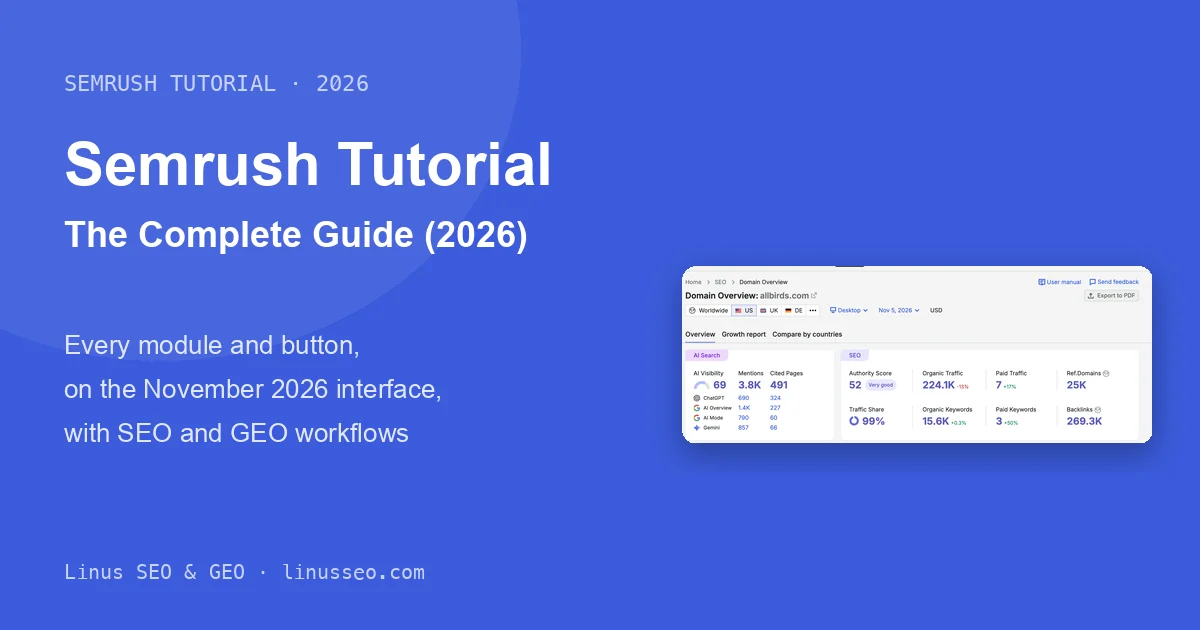
Semrush Tutorial: The Complete Guide (2026)

Semrush Tutorial: The Complete Guide (2026)

Your boss drops a competitor URL into your chat and asks where their traffic is coming from, or you open Semrush for the first time and stare at dozens of modules with no idea where to click. This guide walks you through the core tools you actually need for everyday SEO and GEO work, what each number tells you, and where the estimates need a reality check.

Read more
Shopify Opened Checkout to Any Agent. Four Things SEO Must Now Watch

Shopify Opened Checkout to Any Agent. Four Things SEO Must Now Watch

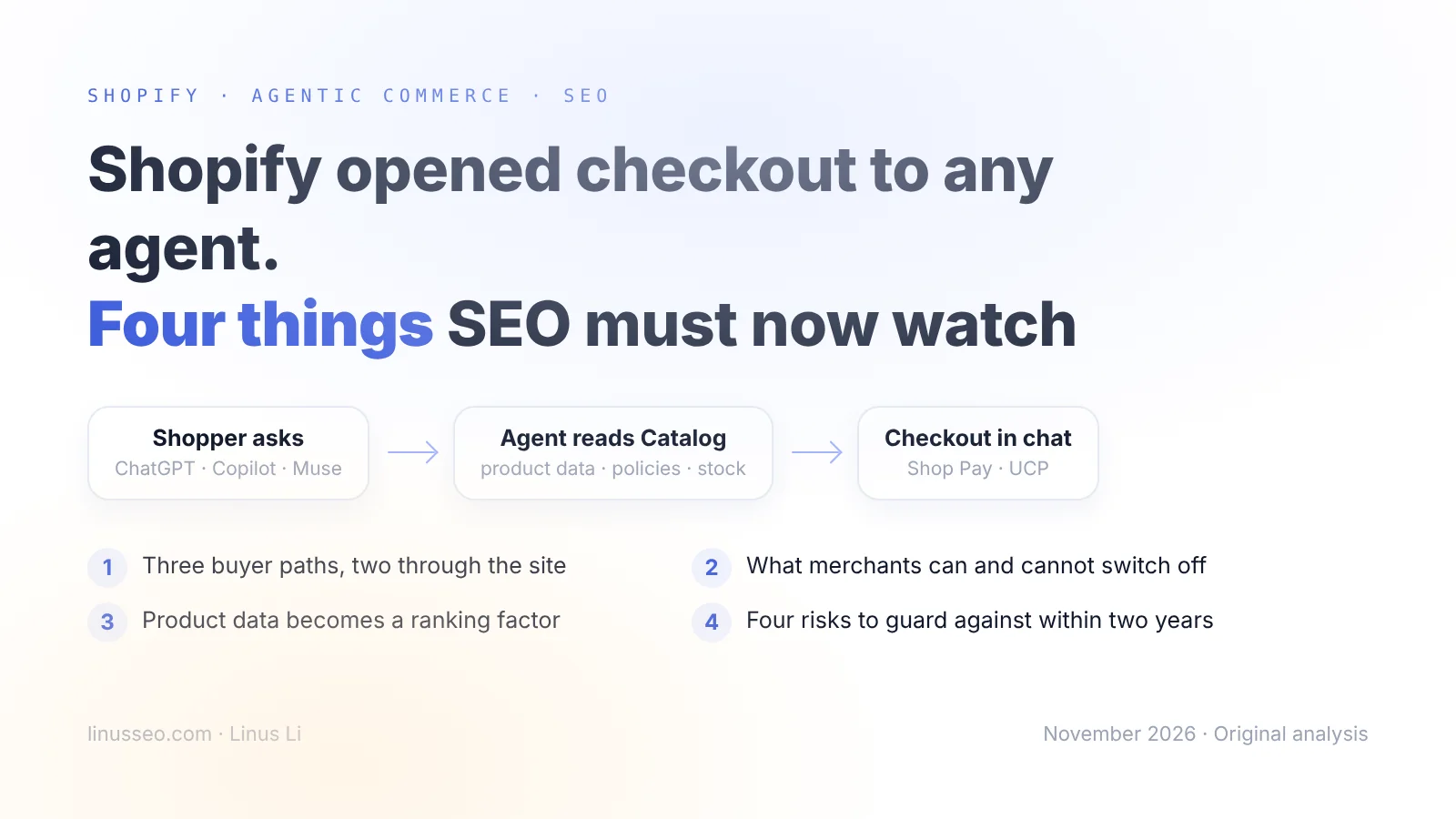
Suppose a Shopify merchant selling outdoor gear asks: after Fall ‘26, a customer asks ChatGPT, Copilot or Meta’s Muse for “waterproof hiking shoes under $200”, the agent lists products, adds one to the cart and pays with Shop Pay, and my website is never opened during the whole process. What is my SEO still for?

My conclusion is this: the object of SEO has changed, from “getting the web page ranked by a search engine” to “getting the product data read correctly, selected and bought by an agent”. The web page has not lost its purpose, because the Catalog’s data comes from the web page, ChatGPT’s checkout still returns to the store site, and the third-party reviews in AI answers also come from web pages. But the center of gravity for ranking has moved to product data, policy pages and platform settings, and these three items rarely appeared on an SEO checklist before.

Read more
Connecting AI Coding Agents to Google Search: Claude Code, Codex, and DeepSeek Harness

Connecting AI Coding Agents to Google Search: Claude Code, Codex, and DeepSeek Harness

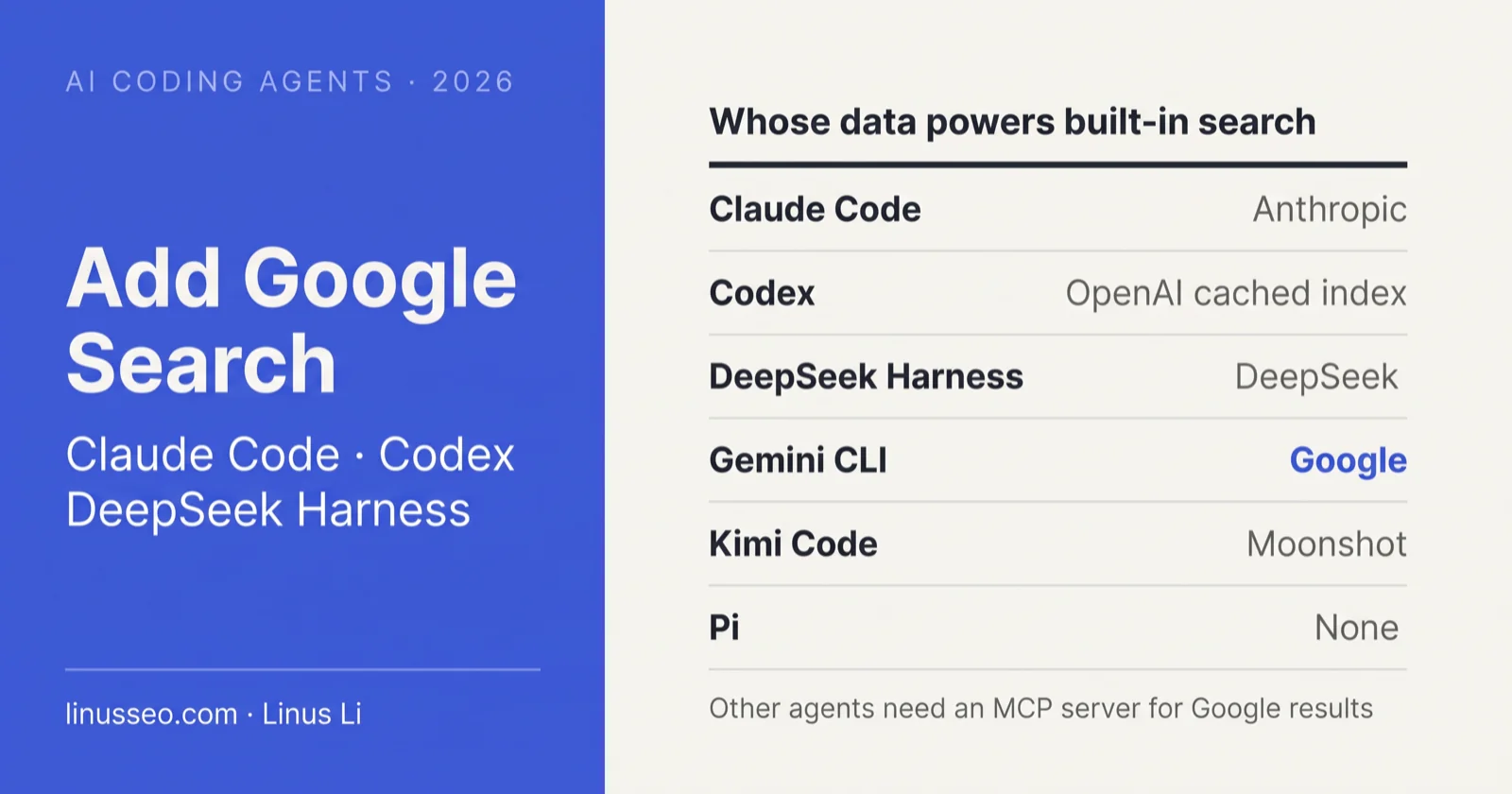
When you ask an AI inside Claude Code to “search the web,” it accesses the internet, but rarely retrieves actual Google search results. Codex, DeepSeek Harness, and Kimi Code operate similarly, each querying proprietary or partner search backends.

As of October 31, 2026, across the six common AI coding tools, only Gemini CLI uses Google search data out of the box. To retrieve real Google results in other tools, you must connect a Model Context Protocol (MCP) server or a dedicated plugin. The most direct setup is connecting SerpApi’s official remote MCP server, which requires a single terminal command in Claude Code and Codex.

Read more
Google Search API Alternatives: How to Get Google Search Results

Google Search API Alternatives: How to Get Google Search Results

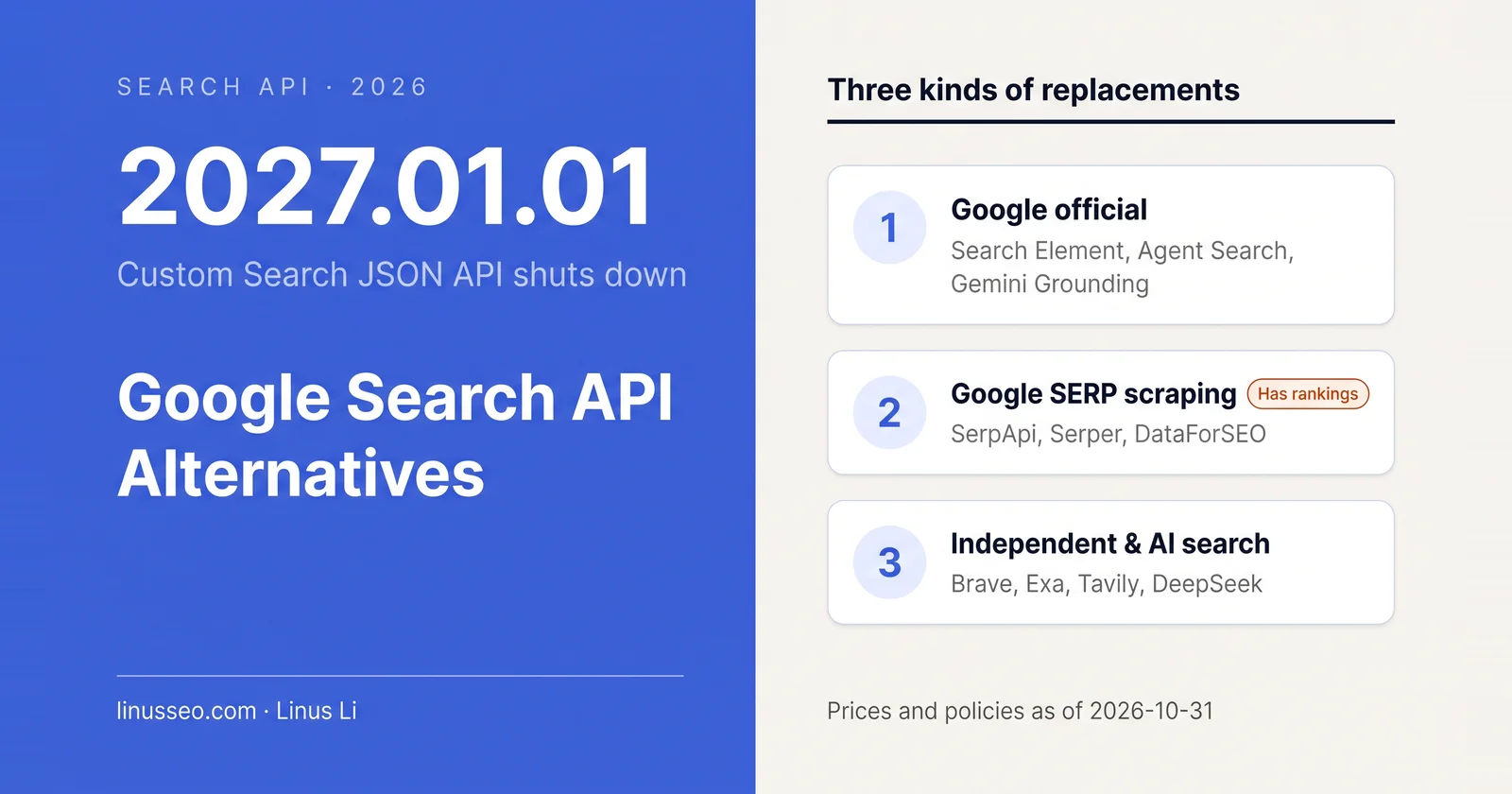
Years ago during my NeverSec days, I wrote a technical note explaining how to query Google’s Custom Search JSON API. That interface is now closed to new customers and will permanently shut down on January 1, 2027. Recently, developers building SEO tooling, scrapers, and AI applications have been asking the same question: once it shuts down, how do you continue retrieving Google search results?

As of October 31, 2026, Google offers no self-service official API that returns full-web search rankings. Many teams only realized after the deprecation notice that while it was named Custom Search, it was widely used as a lightweight SERP interface. Now that Google has closed that door, you face a single architectural fork: do you need real Google SERP rankings, or do you simply need usable web pages?

If you need the former (rank tracking, SERP feature monitoring, competitive share-of-voice), official grounding APIs cannot help. You must use third-party SERP scraping APIs. If you need the latter (AI agent web access, RAG retrieval), independent search indexes are cheaper, faster, and free of scraping-related legal risks.

If you just need to connect an API immediately, skip to the prompt in the next section.
Read more
Someone Copied Your Store? How to Take the Copycat Down

Someone Copied Your Store? How to Take the Copycat Down

You find a site using your product photos, your product copy, sometimes your whole layout and logo. Then you notice it’s running Meta and TikTok ads under your brand name.

Most people start with a Google removal request. Google can drop the pages from its search results, but it can’t delete the site from the server it runs on. If the copycat gets its traffic from paid social, a Google removal barely touches it. What works is figuring out which companies keep the site online and reporting it to each of them: the store platform or host, the CDN, the domain registrar, the ad platforms and the marketplaces.

Read more
What I Shared at the Yiguo SEO × GEO Conference: Making Content Rank on Google and Get Cited by AI

What I Shared at the Yiguo SEO × GEO Conference: Making Content Rank on Google and Get Cited by AI

On August 12, 2026, we hosted the 2026 Google SEO × Overseas GEO Technical Conference in Shenzhen. I gave a 45-minute talk titled One Piece of Content, Two Wins: Ranking on Google and Getting Cited by AI. More than 300 cross-border e-commerce owners and content leads were in the room, and many of them asked the same question afterward: now that AI can draft a 2,000-word blog post in a few minutes, where should a content team actually spend its time so the same body of work both ranks on Google and gets cited in ChatGPT, Perplexity, and Google AI Overviews?

This post walks through all 30 slides from my talk. Instead of handing out a template for “what AI likes to read,” I will go through our team’s actual delivery workflow: how we map user questions, fill evidence gaps, keep dozens of pages aligned to one source of truth, run five pre-publish checks, and ship a reusable Topic Pack across ten roles.

Read more
Scan with WeChat to follow my official account (in Chinese)

Scan with WeChat to follow my official account (in Chinese)