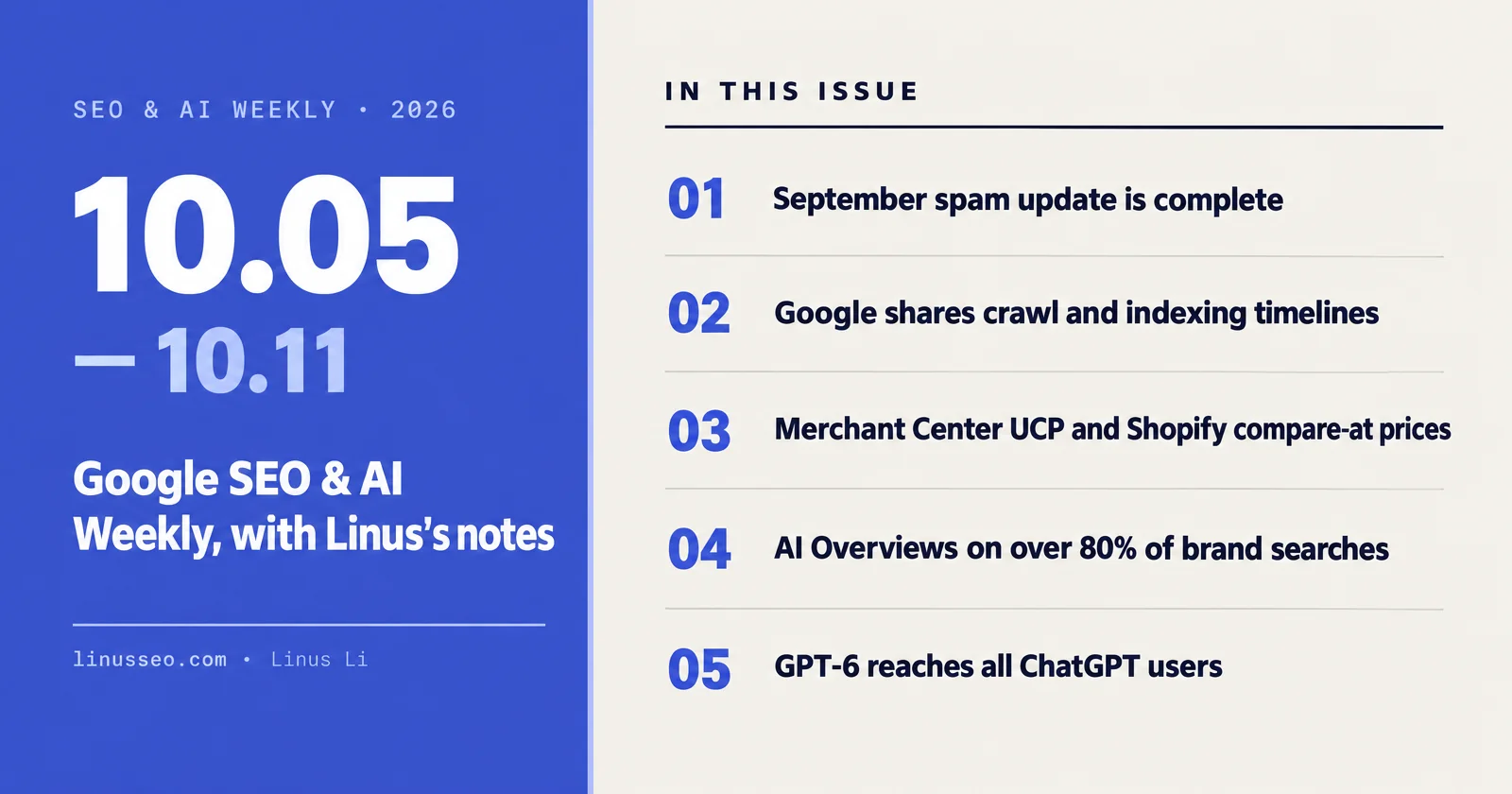
Google SEO & AI Weekly Roundup and Linus's Notes 261011


From October 5 to 11, 2026, Google’s September spam update completed on October 8, about two weeks after it began. In the same week, Google shared typical timelines for crawling, indexing, and ranking changes at a developer event, and published documentation for its UGC Fresh Data Program. On the commerce side, Merchant Center started rolling out a UCP integration hub in the US, and Shopify began passing compare-at prices to AI shopping agents. OpenAI brought GPT-6 and a new visual interface to all ChatGPT users.
This week’s changes point in two directions. With the spam update finished, site owners can now compare complete time windows to measure its impact. AI shopping channels are also asking for more detailed product data: prices, discounts, stock, and checkout options all need to be machine-readable.
Key points
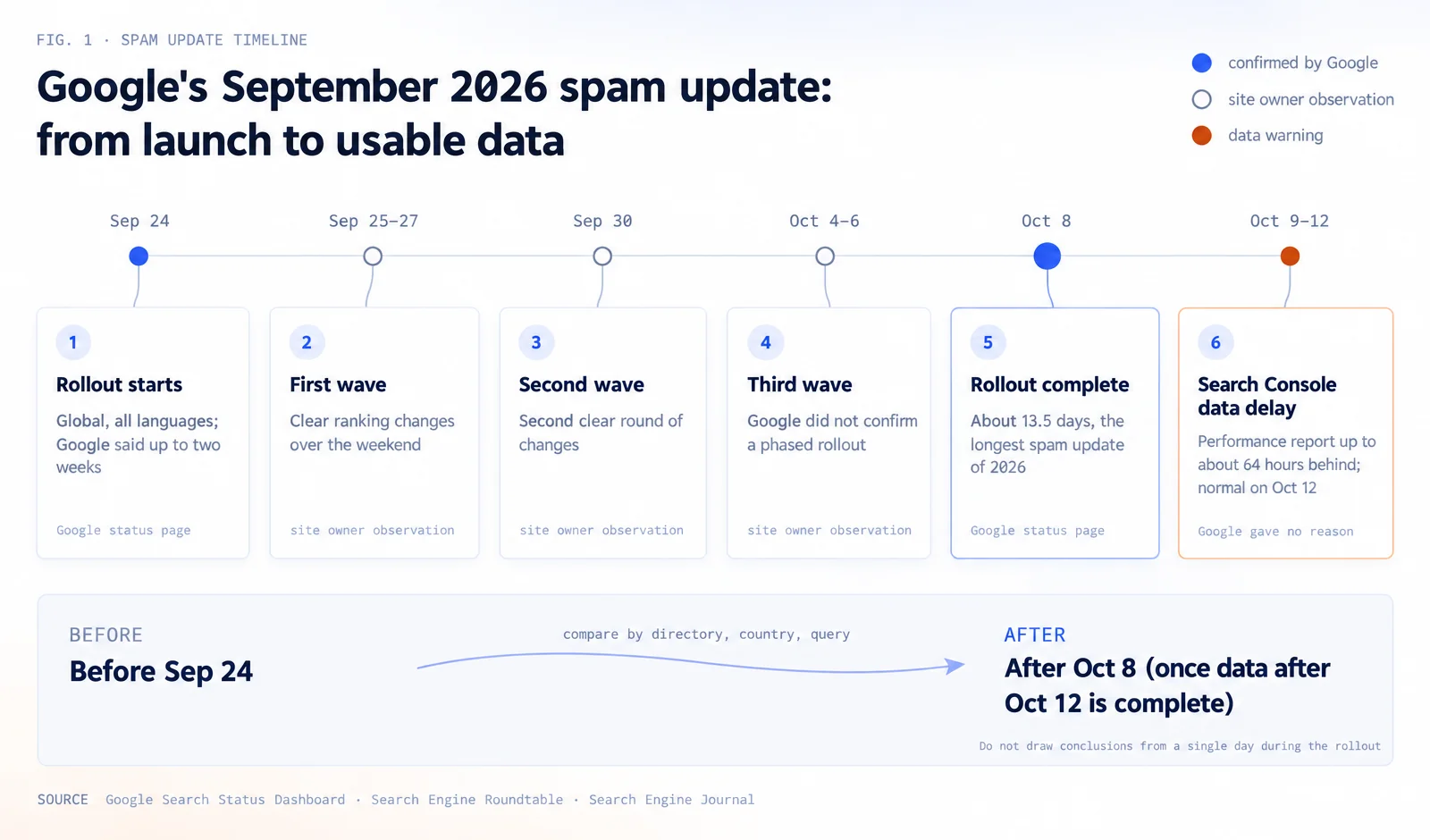
- Google’s status page confirmed that the September spam update completed on October 8, about 13.5 days after it started on September 24. It was the longest spam update of 2026.
- At Search Central Live in Barcelona, Gary Illyes shared typical timelines for crawling, indexing, and ranking changes. A new URL is discovered in about 20 hours on average, spam update effects usually show within 1–2 weeks, and recovery after a core update usually takes 3–6 months.
- Google published documentation for the UGC Fresh Data Program, which lets large forums and social platforms apply to send content and engagement data to Google through a dedicated pipeline.
- Merchant Center launched a UCP integration hub in the US. Separately, a Google help page warned that products whose price or availability changes more than once a day may be disapproved when the data does not match.
- From October 9, Shopify passes compare-at prices to AI shopping agents through Shopify Catalog. Merchants can turn this off in the admin.
- Several datasets show that more than 80% of branded searches displayed an AI Overview by late September.
- OpenAI launched GPT-6 and Intelligent UI in ChatGPT on October 7. Separately, a site owner observed ChatGPT testing “best for” labels on product results.
Google’s September spam update is complete
Google’s status page confirmed that the September spam update completed on October 8, 2026. The update started on September 24 and applied globally to all languages. Google did not say which spam tactics it targeted and did not publish new policy text. Search Engine Journal noted that the three earlier spam updates in 2026 took less than a day, about two days, and about two and a half days. This one took about 13.5 days.
The volatility came in several waves. The changes on September 25–27 and September 30 were covered in the previous issue. On October 6, Search Engine Roundtable reported a third wave on October 4–6. This is an observation from site owners; Google did not confirm a phased rollout. On October 8, the same site reported that more sites had received manual action notices in recent weeks. This is also industry feedback without official data.
Data delays also affect the analysis. On October 11, Search Engine Roundtable reported that the Search Console performance report was more than 64 hours behind. It returned to normal on October 12, and Google did not explain the cause. To measure the update’s impact, wait until data after October 12 is complete, then compare the period before September 24 with the period after October 8. Data from a single day during the rollout is not enough to draw conclusions.
For independent online stores, if the comparison shows a sustained drop in a directory or page type, start by checking scaled content, doorway pages, and scraped content against Google’s spam policies. At the Barcelona event, Google said that the volume of new content is growing quickly and that it is using AI to detect more spam, so spam updates may become more frequent. This comes from a third-party event recap, not a written Google announcement.
Google shares timelines for crawling, indexing, and ranking changes
On October 2, Gary Illyes presented internal Google figures at Search Central Live in Barcelona on how long crawling, indexing, and ranking changes usually take. We Are Roast’s event recap lists the full tables. The figures became widely discussed after Search Engine Roundtable covered them on October 5. The event itself took place before this issue’s date range, but the data spread during this week.
Several items matter most for day-to-day work. A new URL is discovered in about 20 hours on average, and a known URL is recrawled about every 30 days. A sitemap is usually processed in about 24 hours, at most 14 days, and possibly never if quality is insufficient. Indexing after crawling takes about 1.5 hours on average, but can take months or not happen at all. Title and snippet changes usually show in search results within 1–2 days. A site move usually takes 1–3 months, and up to 6 months to over a year in slow cases.
For ranking changes, spam update effects usually appear within 1–2 weeks, or after months when they depend on batch refreshes. Recovery after a core update usually takes 3–6 months, and slow cases wait until the next core update. Removing a manual action usually takes 1–2 weeks. Google also noted that these steps are connected, so a delay in one step delays the next. The many “never” entries in the tables are mostly tied to page quality.
For independent online stores, these figures help set realistic expectations. Waiting two days to check a title change is reasonable, but judging a ranking change the day after a content edit is too early. If a new site or directory is indexed slowly, check quality and internal links first. Resubmitting the sitemap repeatedly does not speed up processing.
Google publishes UGC Fresh Data Program documentation
On October 8, Google added documentation for the UGC Fresh Data Program to its Search Central update log. The program is for large platforms built mainly on user-generated content, such as forums and social networks. Approved platforms can send post content and engagement data directly to Google through a dedicated pipeline, separate from the Indexing API and regular crawling. Google states that participation does not guarantee that content appears in Search.
The eligibility criteria include high content volume and a large user base; public pages that Googlebot can access; posts attributable to creators with public profiles; support for OAuth 2.0 and validated JSON-LD, using structured data such as SocialMediaPosting or DiscussionForumPosting; active moderation and a reporting mechanism; and fast submission, ideally within minutes, with engagement counts updated within 72 hours of posting. Google usually responds to applications within 6–8 weeks.
Most independent stores are far below this scale and do not need to apply. The program does show that Google values fresh discussion on forums and social platforms. How a brand and its products are discussed on those platforms affects what appears in search results and AI answers.
Merchant Center adds a UCP integration hub and warns about frequent price changes
On October 7, Search Engine Roundtable reported that Merchant Center is gradually rolling out a UCP integration hub in the US. Google’s help page describes UCP (Universal Commerce Protocol) as an open standard for agentic commerce. Merchants can onboard directly in Merchant Center. Once integrated, eligible products can show a checkout button in AI Mode and Gemini, and carts can be transferred to the merchant’s own site. Google said merchants in Australia and Canada will get access next year.
In the same week, Google’s help page on automatic product updates drew attention. It warns that automatic updates may not keep up with products whose price or availability changes more than once a day. When Google detects a mismatch between the site and the feed, the product may be disapproved instead of updated, and Google may stop automatic updates altogether if the total number of detected mismatches becomes too large. PPC News Feed noted that this text was added on September 27; it gained attention after Search Engine Roundtable reported it on October 8.
Taken together, these two items show that AI shopping raises the bar for data consistency. When a user checks out inside AI Mode, price and stock must be accurate at that moment. Stores that run frequent flash sales or adjust prices based on stock should check that their feed update frequency matches their pricing changes.
Shopify passes compare-at prices to AI shopping agents
Shopify’s changelog says that from October 9, Shopify Catalog passes compare-at prices to AI shopping agents. Before this change, agents saw only the current price, so discounts shown on the storefront were invisible to them. Merchants can decide whether to share compare-at prices with a toggle in the “Compare-at” section of the catalog mapping settings in the admin.
Shopify released two related updates in the same week. On October 5, Shop began verifying shoppers while they browse and syncing carts across devices to shorten checkout. On October 8, Shopify began generating store policy pages automatically and updating them as settings change; Shopify says this helps when entering new markets.
Sharing compare-at prices with agents cuts both ways for sellers. A genuine discount can help an agent decide that a product is worth recommending. A compare-at price that is permanently inflated, or that does not match the actual price history, will be shown to more people through AI channels. Before turning on sharing, check that compare-at prices are genuine and consistent across markets.
Search Console: multi-country filter and preferred source emails
On October 6, Google announced on LinkedIn that the country filter in Search Console performance reports now supports multiple selections. Sites that serve several markets can view combined data for a group of countries, such as the US and Canada, without exporting each one and adding them up.
On the same day, Search Engine Roundtable reported that some site owners received a Search Console email showing how many users had chosen their site as a “preferred source” as of October 5. The email said that preferred sources may appear more often in Top Stories, AI Overviews, and AI Mode, and encouraged sites to add Google’s preferred source button. For now the count appears only in the email, not in a Search Console report.
The multi-country filter is directly useful for cross-border sellers. For example, they can group North American or EU markets to compare performance before and after the spam update. Preferred sources currently matter mostly to news and content publishers; the effect on ecommerce sites is unclear.
More than 80% of branded searches show an AI Overview
On October 6, Semrush published a summary of several datasets on AI Overviews for branded queries. DemandSphere’s data shows about 26% of branded searches with an AI Overview on September 1 and about 82% on September 29. Ahrefs’ US desktop data, published October 2, shows the share rising from an August average of about 65% to about 83% on September 29. Chris Long of Nectiv tested 100 enterprise brands and found AI Overviews for 93 of them.
These datasets use different samples and methods, so the size of the increase differs, but all of them show the share above 80% at the end of September. Google has not announced a change. Ahrefs also found that among branded AI Overviews with source lists, about 72% cited Wikipedia, followed by YouTube and LinkedIn, and competitor websites rarely appeared.
For independent stores, this means a user searching for the brand name may first see an AI-written brand summary. That summary cites third-party pages, so the accuracy of brand information on Wikipedia, YouTube, LinkedIn, and similar platforms, and its consistency with the official site, directly affects how branded searches look. If branded click-through rates dropped in late September, check whether those queries started showing AI Overviews before attributing the drop to the spam update.
GPT-6 and Intelligent UI arrive in ChatGPT
According to TechCrunch, OpenAI rolled out GPT-6 and Intelligent UI to Plus, Pro, Business, and Enterprise users on October 7, and to Free and Go users on October 8. Intelligent UI generates interactive charts, editable graphs, customized calculators, tappable buttons, and diagrams based on the question, and users can reduce the amount of visual content. OpenAI had earlier released the GPT-6 Sol and Luna models for ChatGPT Work, Codex, and the API on September 22; this week’s rollout brought GPT-6 and Intelligent UI into everyday chat for all ChatGPT users.
On the shopping side, Search Engine Roundtable reported on October 6 that Brodie Clark observed ChatGPT testing labels on product results, such as a green “best all-rounder” label and gray “best for beginners” and “best cushioning” labels. OpenAI has not confirmed the test.
This is a hypothesis that needs testing: if ChatGPT compares products more often with visual cards and labels, users may open product pages less often. The labels likely draw on product descriptions, reviews, and user feedback, so product pages should state clearly who the product suits and in which situations. That gives AI systems a basis for “best for” judgments.
Linus’s notes
The September spam update ran for 13.5 days and was immediately followed by a 64-hour delay in Search Console performance data. When we audited traffic anomalies across independent stores in our recent review, our first rule was to strip out the incomplete tail days in Search Console before comparing periods, so a reporting lag would not be mistaken for a penalty. Once we separated branded from non-branded queries and broke performance down by directory, most site-wide traffic drops turned out to be either external demand shifts (ad spend cuts or seasonal transitions pulling down branded queries) or self-inflicted technical issues—such as two SEO plugins outputting both index and noindex on the same page, URL changes launched without 301 redirects, or a newly installed cookie consent banner blocking default GA4 tracking while Search Console clicks stayed flat. The sites that genuinely lost impressions during the spam update almost all shared one of two patterns: collection and product pages using the same templated title and meta description across hundreds of URLs, or AI-generated blog posts that fabricated product specifications, certifications, and features the store never actually carried. Gary Illyes’s timeline table from Barcelona explains why the aftermath looks uneven: the continuous part of a spam update shows up in one to two weeks, while the batch-refresh component can take months. If a directory lost rankings during this rollout, repeatedly clicking “Request indexing” in Search Console will not fix it; you have to remove the templated duplication or unverified claims first and then wait for the next recrawl cycle.
Merchant Center’s warning about products that change price more than once a day and Shopify’s decision to pass compare-at prices to AI shopping agents both point to the same operational failure mode on independent stores: writing volatile numbers into static HTML. When teams build collection copy, buying guides, or FAQ blocks, they often hardcode lines like “starting at $49,” “20% off sitewide,” or “in stock and ships today” directly into rich-text metafields or blog HTML. Two weeks later, when operations adjusts the price in Shopify admin or a SKU sells out, the product feed and Liquid price component update automatically, while the static prose and hardcoded FAQ schema still show the old price. For human shoppers, that looks sloppy; under Merchant Center’s automatic item updates and UCP checkout rules, a mismatch between page text, structured data, and the feed can trigger item disapproval or cause Google to pause automatic updates altogether. In our internal playbook for collection and blog copy, we require a strict separation between dynamic and static fields: prices, compare-at discounts, and stock status must always come from Liquid templates or the product feed, while body copy and FAQs stick to stable attributes such as use cases, materials, sizing rules, and selection criteria. If an SEO team plans to edit product titles, descriptions, or URLs on a store running Shopping ads, they also need to coordinate with the paid media team beforehand, because Shopify syncs those edits straight into Merchant Center and can reset ad learning if changed unannounced.
With AI Overviews now appearing on more than 80% of branded searches and citing third-party platforms like Wikipedia, YouTube, and LinkedIn in roughly three out of four cases, sellers often ask whether they should spend their budget on off-site placements first. In practice, you should spend a week fixing your own site’s ground truth before touching third-party channels, and then clean up existing third-party pages before paying for new ones. If your About page, product specs, and return policies are vague—or if key parameters are locked inside images instead of plain HTML text and <table> elements—updating off-site profiles just leaves AI systems with conflicting facts across sources. Once the official site has a clear one-sentence entity definition, plain-text specifications, and explicit “best for” use cases on product and collection pages, run your brand name and core product lines through Google AI Overviews, ChatGPT, and Perplexity to record the exact third-party URLs they cite. Most independent stores do not qualify for a Wikipedia article, and trying to force one usually ends in deletion; the third-party sources you can actually control are your own YouTube video descriptions, LinkedIn company page, Reddit threads, and the older review or listicle articles that already rank for your brand. Asking those publishers to update discontinued models, old pricing, and outdated positioning fixes branded AI answers much faster than buying a batch of new guest posts.
What this means for you
- Wait until Search Console data after October 12 is complete, then compare the period before September 24 with the period after October 8 by directory, country, and query. If you serve several markets, use the new multi-country filter to group a region.
- Use the timelines Gary Illyes shared to set observation periods: two days for title and snippet changes, 1–2 weeks for spam update effects, and 3–6 months for recovery after a core update. Do not judge results the next day.
- Check how often you change prices. For products whose price or stock changes several times a day, confirm that the feed keeps up, or they risk disapproval in Merchant Center.
- Shopify merchants should confirm that compare-at prices are genuine and consistent across markets before letting AI agents read them.
- Search for your brand name, record which pages the AI Overview cites, and check that brand information on Wikipedia, YouTube, LinkedIn, and other third-party platforms is accurate.
- State the intended users and use cases clearly on product pages, so AI shopping results in ChatGPT and elsewhere have a basis for “best for” labels.
Google SEO & AI Weekly Roundup and Linus's Notes 261011
https://www.linusseo.com/en/google-seo-and-ai-newsletter-linus-thoughts-261011/