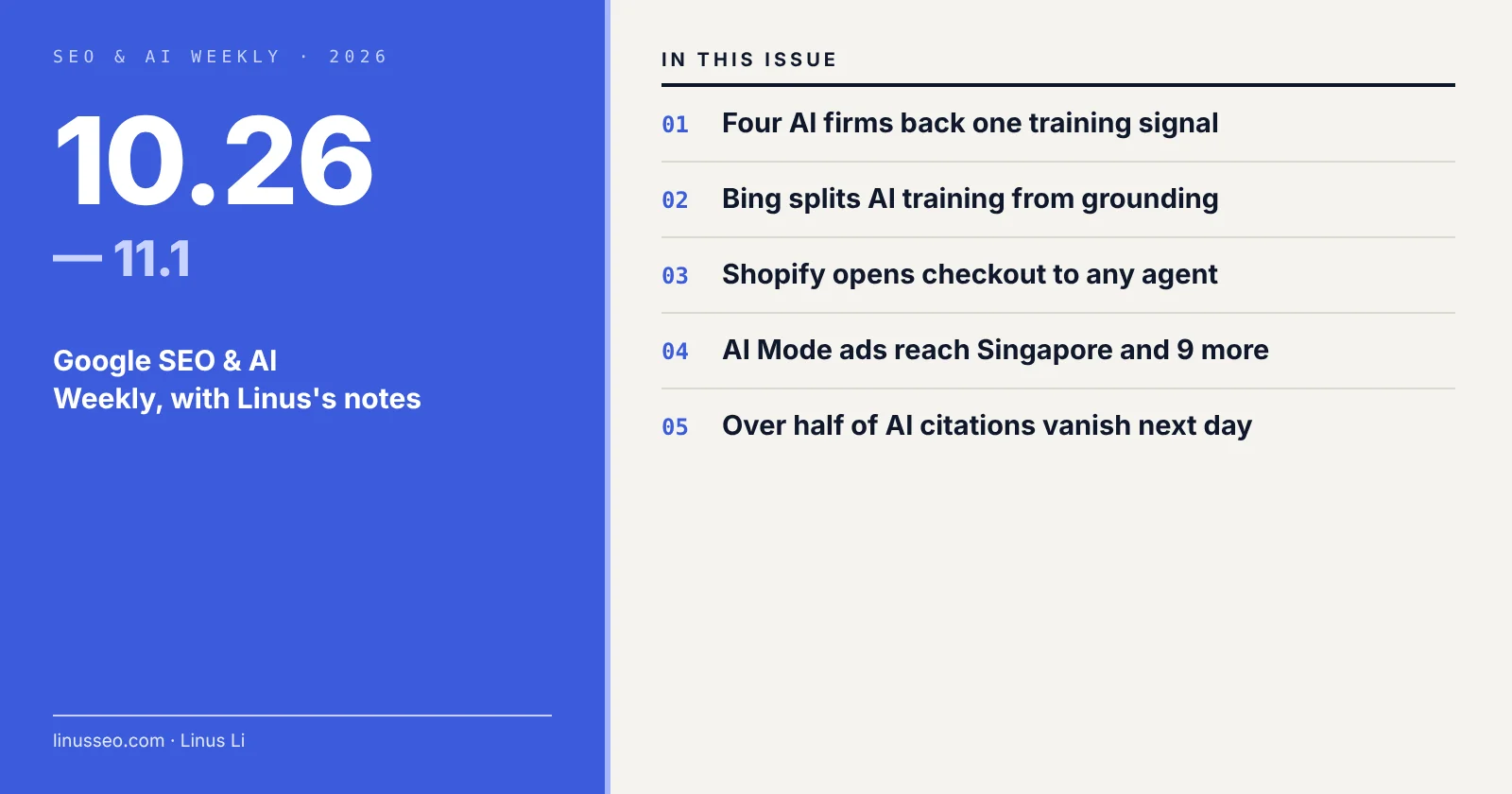
SEO & AI Weekly, Oct 26–Nov 1: One AI Training Signal & Shopify Opens to Agents


From October 26 to November 1, 2026, Google’s status page showed no new core update or spam update, and there was a round of unconfirmed ranking volatility around October 27. The most important change this week was at the level of rules. On October 30, Google, OpenAI, and Microsoft each announced plans to support the same robots.txt training preference signal; Anthropic standards lead Kevin Kelley submitted an IETF Internet-Draft that day and said Anthropic had started implementing it. The rollout timelines differ, so websites do not need to change robots.txt because of this proposal yet. Microsoft also separated training from grounding, so the two uses of AI are now controlled independently.
The other main thread is agent shopping. In its Fall ‘26 Edition on October 28, Shopify opened its product catalog, cart, and checkout to any agent or app, and moved the Knowledge Base, where merchants review AI-facing facts, into the admin. Google expanded ads in AI Mode to 10 countries including Singapore, Malaysia, and the Philippines, and a Google executive said that monetization inside AI Mode is currently lower, without disclosing a specific comparison or amount. Meta’s personal agent “Muse” launched in Singapore with direct connections to Shopee, Lazada, and Grab.
On the data side, Ahrefs tracked 37,500 AI citations and found that more than half disappear the next day, but most come back. Adobe’s retail data show that revenue per visit from AI sources is 83% higher. Findrix measured that 57% of links in Google AI Mode product answers point to Google Shopping. The problem of fake results in rank trackers continues, and this week Semrush acknowledged it officially for the first time.
Key points
Each point is labeled by urgency: Act now means affected sites should take action this week, Watch means there is a deadline or the situation is still changing, and For reference covers research and documentation updates.
- Act now: Shopify moved the Knowledge Base into the admin under “Sales channels > Agentic.” Shopify automatically drafts agent-ready facts from store pages, and they take effect only after the merchant reviews and publishes them. The standalone Knowledge Base app shuts down on January 15, 2027, and stores with more than 1,000 facts must migrate manually.
- Act now: On October 28, WordPress released 7.1.4, which fixes a vulnerability in the core update process that allows remote code execution without logging in. Wordfence has already seen large volumes of probing. Self-hosted sites should upgrade this week.
- Watch: Google, OpenAI, Microsoft, and Anthropic support the shared
__usage_ai-trainingsignal in robots.txt. Anthropic has started implementing it, OpenAI says within a few months, Microsoft on February 1, 2027, and Google in early 2027. The signal only covers training and does not affect search indexing. - Watch: Bing split AI training and AI grounding into two independent controls, and from March 1, 2027,
noarchiveandnocachewill no longer be treated as AI preferences. Sites that rely on these two tags to block AI must switch to the new directives before then. - Watch: Shopify opened its product catalog, cart, and checkout to any agent. Liquid storefronts provide WebMCP by default, while Hydrogen storefronts need the Hydrogen 2026-10 setup and Shopify Scripts. The Fall ‘26 announcement does not provide one switch to close every agent channel; the help center now documents channel-level Catalog access and direct checkout controls.
- Watch: Google AI Mode ads expanded to 10 countries including Singapore, and multi-turn follow-up ads launched in the US. Alphabet said on its earnings call that AI Mode monetizes at a lower rate than traditional search, Google is expanding and testing ad inventory in AI Mode, while the exact formats are still changing.
- For reference: Ahrefs tracked 37,500 AI citations for 20 days. The share that disappeared the next day ranged from 50% to 83% depending on the platform, and about 75% of those came back within 20 days. A single screenshot cannot serve as a GEO metric.
- For reference: Findrix measured that 57% of links in AI Mode product answers point to Google Shopping, and Adobe measured that revenue per visit from AI-sourced traffic is 83% higher than from non-AI traffic. Both are vendor data.
Google, OpenAI, and Microsoft back one shared AI training signal on the same day
On October 30, Google, OpenAI, and Microsoft each announced plans to support the same robots.txt training preference signal. That day, Anthropic’s Kevin Kelley submitted the draft draft-kelley-aipref-training-preference-signal-00 to the IETF AIPREF working group and said Anthropic “has already started implementing support” it. Google announced on the Search Central blog that it plans to support the signal, with the goal of launching in 2027 together with other AI companies. OpenAI said it will implement the signal “in the coming months.” Microsoft gave the most specific timeline on the Bing blog, which is covered in the next section.
The syntax is only two lines and needs no new grammar:
1 | User-Agent: __usage_ai-training |
This __usage_ai-training is not the name of a crawler. It is a “policy token.” Any company that has signed on to the draft treats this group of rules as “the site does not allow its content to be used for training generative models.” The draft states three things explicitly: User-agent: * does not count as a training preference, and a site that has not written this group has not expressed a preference; the signal expresses a preference about “usage” and does not restrict crawling, so the crawler can keep crawling but cannot use the content for training; and a privately signed content licensing agreement can override it.
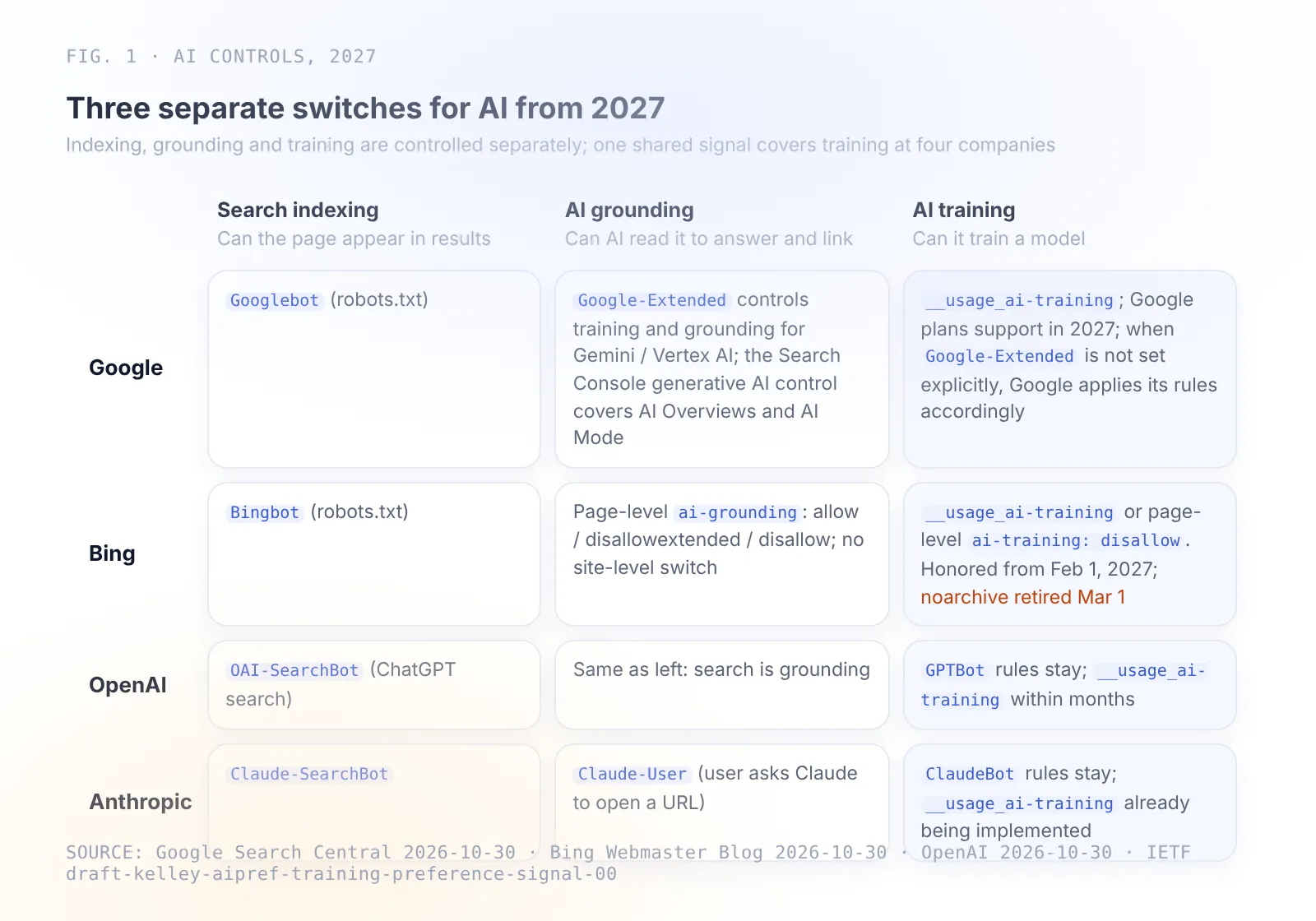
The companies describe the relationship to existing crawler rules in slightly different words, but the conclusion is the same: the new signal does not replace existing crawler controls. Google’s approach is that if a site uses the signal to refuse training and has no separate Google-Extended rule, Google treats it as disallowing Google-Extended; if the site has a separate rule, the separate rule wins. OpenAI said the GPTBot rules remain in effect. Anthropic said the new signal “complements” rather than replaces the ClaudeBot control.
More importantly, this signal does not affect search. Google restated in its announcement that Google-Extended only governs how content is used for generative AI and does not affect a site’s indexing or ranking in Google Search, and that only sites that explicitly allow Google-Extended are eligible to be cited and receive clicks in answers in the Gemini app. OpenAI’s documentation also keeps its existing distinction: OAI-SearchBot decides whether a site can appear in ChatGPT search results, GPTBot decides whether content goes into training, and one can be allowed while the other is blocked.
It should be noted that the draft is currently an Internet-Draft submitted by Kelley as an individual. The IETF working group has not adopted it, it has no RFC number, and it expires on May 3, 2027. The four companies support it voluntarily, not as a legal obligation. So there is no need to change robots.txt this week. But this is a good opportunity to go through the existing rules and confirm whether each crawler rule governs search, grounding, or training, because the Bing migration in the next section needs the same list.
Bing splits AI training from AI grounding, and noarchive stops working on March 1, 2027
Microsoft’s announcement on October 30 goes further than the other three companies. It splits AI’s two uses of a web page into two independent preferences: AI Training controls whether content can be used to train models, and AI Grounding controls whether real-time products such as Copilot and Bing’s AI answers can read the page to generate an answer and show a link. The two preferences do not affect each other, and neither affects crawling, indexing, or ranking in traditional Bing search.
The two preferences are written differently. The training preference can go in robots.txt (the shared signal from the previous section) or on an individual page:
1 | <meta name="Bingbot" content="ai-training:disallow"> |
The grounding preference can only be set at page level, and there is no site-level switch:
1 | <meta name="Bingbot" content="ai-grounding:disallow"> |
Both can also be sent as an X-Robots-Tag response header. The grounding preference has three values: allow (the default), disallowextended, and disallow. disallowextended means Microsoft’s own products may use the page for grounding, but the grounding services Microsoft provides to third-party developers (such as Web IQ and the Foundry API) may not. Microsoft’s help documentation states that if you choose disallow or disallowextended, “you will see reduced brand visibility in AI experiences.”
The biggest impact on existing sites comes from how the old tags are handled. Many sites have used noarchive or nocache to stop Bing’s AI from using their content, and Microsoft is now returning these two tags to their traditional search meaning. The timeline is as follows:
- December 15, 2026: Bing Webmaster Tools opens a temporary grounding preference setting, available only to sites that are already using
noarchiveornocacheon that day. There is no temporary setting for training. - February 1, 2027: Bing starts enforcing the new training and grounding directives when crawling.
- March 1, 2027: Migration deadline. After this date,
noarchiveandnocacheare no longer treated as training or grounding preferences. A site that uses the old tags and has neither written the new directives on its pages nor registered in Webmaster Tools defaults to allowing grounding until Bing recrawls and finds the new directives. - September 30, 2027: The temporary setting expires.
Microsoft also states that once it detects a new training or grounding directive on a site, the remaining noarchive and nocache tags on that site are ignored. So old and new directives cannot be mixed. If you switch, switch the whole site.
Online stores that use noarchive to block AI must add the ai-grounding directive to their pages before March 1, 2027, and register a temporary preference in Webmaster Tools after December 15. Sites that have never used these two tags do not need to do anything. As for whether to turn off grounding, Microsoft itself says that turning it off reduces exposure in AI, so for export stores that want to be recommended by AI, leaving the default on makes more sense.
Shopify opens its catalog and checkout to any agent, and the Knowledge Base moves into the admin
On October 28, Shopify released the Fall ‘26 Edition. The first sentence of the developer announcement is that it opens “Shopify’s catalog, cart, and checkout to any agent or app.” Compared with the spring release, the change this time is from “Shopify partners with a few AI companies” to “any developer can connect.”
The developer announcement has four items that directly concern sellers. First, Shop.dev provides a single connection to the Shopify Catalog, Shop sign-in, cart, checkout, and Shop Pay, so developers can use the same catalog and checkout that sit behind ChatGPT, Copilot, and Meta’s Muse “with no key required.” Second, shop.md is a skill file for agents; once installed, an agent can search and recommend from more than 1 billion products. Third, every Liquid and Hydrogen store and checkout page ships WebMCP tools, so an agent in the browser can search products, change the cart, and complete checkout after the buyer confirms. In Shopify’s words, “Every Shopify store is agent-ready by default.” Fourth, Universal Checkout lets third parties put products from multiple brands into one cart and check out once, while each merchant’s rules and orders still run through Shopify.
The Editions page also lists Shop Pay connections to Claude Duet, Grok Bot, Instinct, and Muse; Shopify-powered checkout inside Google Search, AI Mode, and Gemini; Catalog eligibility checks (merchants can see in the admin whether their store meets the conditions to enter the Catalog, and what to fix if not); and compare-at prices being passed directly to AI shopping agents. The UCP protocol gained a new /ask endpoint that “answers questions about a store, grounded in facts published by the business.”
After reading both announcements, I did not find any instruction for merchants to opt out of agent channels as a whole. Two controls are known. Direct checkout inside Google AI Mode and Gemini can be turned off under “Sales channels > Agentic,” and after it is turned off products are still shown, but buyers are sent back to the store website to order. Facts in the Knowledge Base can be unpublished one by one. Whether WebMCP tools can be turned off and whether a store can leave the Catalog are not covered in the announcements, so this needs to be checked in the admin.
The Knowledge Base is another change. From October 26, it moved from a standalone app into the admin under “Sales channels > Agentic > Knowledge base.” Shopify automatically drafts facts such as contact details, gift services, and return policies from the store’s published pages, and each fact links back to the page it came from. Drafts are not given to any agent until the merchant publishes them. In Shopify’s words, “Nothing Shopify drafted reaches AI agents until you publish it.” The migration rule is that stores with fewer than 1,000 facts in the original app have been moved over and published automatically, while stores with more than 1,000 facts have not been moved. Shopify has emailed those merchants separately, and they must complete the migration manually before the app shuts down on January 15, 2027.
In the same week, OpenAI updated its Shopping with ChatGPT Search help page. The documentation says ChatGPT’s product results consider structured metadata (price, description), third-party content, the user’s question and context, product availability and quality, and whether the seller is the manufacturer or a primary seller. It states that Shopify merchants’ products are already connected through the Shopify Catalog and usually need no extra action, and that merchants can also apply to submit a product feed directly so that prices and inventory are more current. This is a documentation update, not a new feature launch.
Shopify sellers should do two things this week: open the Knowledge Base in the admin, check each automatically drafted policy and contact detail, correct any errors, and then publish; and look under the Agentic channel in the admin to see which agent entry points are currently on, and then decide whether to turn off direct checkout. Return, shipping, and warranty pages used to be written for customers and for Google, but now Shopify extracts them into facts and feeds them to agents, so these pages themselves need to be made accurate first.
Google AI Mode ads reach 10 countries including Singapore, and AI Mode monetizes at a lower rate than traditional search
On October 28, Google announced that ads in AI Mode are expanding to Australia, Canada, India, Kenya, Malaysia, New Zealand, Nigeria, Pakistan, the Philippines, and Singapore, with Brazil, Mexico, and the UK to follow in the fourth quarter. The US also gained “multi-turn ads,” which can appear in answers to follow-up questions rather than only the first question. The announcement cites two sets of internal data: AI Mode queries are on average 3 times longer than traditional searches, and in US data from August 20 to September 3, the click-through rates of sponsored product listings and organic product listings inside AI Mode were “already similar.” Existing Search, Shopping, and Performance Max campaigns enter AI Mode automatically, and advertisers have no separate opt-out.
The background to this expansion is Alphabet’s third-quarter earnings on October 28. Search revenue grew 12% year over year to $63.35 billion, but growth slowed compared with the previous quarter. On the call, Chief Business Officer Philipp Schindler said AI Mode queries are growing fast, and “because of the lower monetization we were seeing in AI Mode,” this affects the growth rate of search revenue; at the same time, he attributed the slowdown mainly to currency, retail, and media industry factors (as reported by Search Engine Journal). In his letter to shareholders, Sundar Pichai said year-over-year growth in search queries was the highest in five years, that one in five AI Mode searches worldwide uses voice, images, or documents, and that Google will next bring agent features that book tables, fill forms, make appointments, and buy things into Search.
Taken together, ad slots in AI Mode will only increase. On October 29, Search Engine Roundtable also reported that Google is testing blending sponsored products into the organic product results in AI Mode, with labels that are hard to tell apart; Search Engine Land reported the same day that Google is testing clearer labels. It is not yet clear which version will stay.
The data most directly relevant to online stores come from Findrix. From October 14 to 17, the company tested 18,400 buyer questions across 35 US markets and collected 55,198 answers from ChatGPT, Gemini, and Google AI Mode (as reported by Search Engine Land). In AI Mode product answers, 57% of links pointed to Google Shopping product pages, and 46.5% of answers linked only to Google’s own pages. The share of Google-owned pages was higher in fashion and beauty, while local services had only 5.1% and software only 1.1%. None of Gemini’s links pointed to google.com; ChatGPT averaged 25 links per answer, and AI Mode only 3. This study measured links, not clicks or purchases, and each question was tested only once, so it cannot be treated as traffic share. But it shows that for selling physical products in AI Mode, Merchant Center product data is closer to the user than the web page itself. E-commerce sellers should also check that their products’ prices, inventory, and images in Google Shopping are accurate, not only their website rankings.
Google opens the Connected Apps platform, and Meta Muse connects to Shopee and Grab in Singapore
Agent entry points are multiplying, and this week there were two moves that directly concern sellers in Southeast Asia.
On October 28, Google opened a preview of the Connected Apps platform, which lets third parties connect their apps to AI Mode in Google Search and the Gemini app, so users can complete actions inside a conversation, for example making a poster with Canva or ordering with Instacart. Developers connect through a cloud MCP server or Android AppFunctions, register, test, and submit in the Google Connected Console, choose Search only, Gemini only, or both, and after launch can see traffic, latency, and error rates. Gemini already has more than 50 apps, including Adobe, Experian, and Peloton; Search has fewer so far, with Instacart, Canva, and YouTube Music. The platform currently has a waitlist open only to US developers.
On October 27, Meta announced that its personal agent Muse is now available in Singapore, connected to Shopee, Lazada, Grab, Singapore Airlines, Agoda, Klook, Trip.com, and ShopBack. Users can ask Muse to look up products and compare prices on Shopee and Lazada, and to buy groceries and order meals with GrabMart and Grab Dine Out. Meta says sensitive actions “such as sending an email or making a purchase” ask the user first, and that account passwords and payment methods live on a separate cloud virtual machine that the agent itself cannot see. Muse is free, heavy use requires a subscription, and the connections are rolling out in batches.
These two developments show that agents do not only read web pages; they also call platforms directly. In Singapore, where Muse is already available, when a user asks Muse “which X is the best deal,” it looks at product pages on Shopee and Lazada, not the brand’s own website. Brands that run both an official site and marketplace stores in Southeast Asia should treat the product names, prices, inventory, and reviews in their marketplace stores as part of GEO. An English official site alone is not enough.
AI citations are unstable and AI traffic is worth more: how to read this week’s three studies
Three vendor studies this week are worth reading together. Each has sample limitations, but their directions support each other.
First, AI citations change from day to day. On October 29, Ahrefs published a 20-day tracking study of about 37,500 citations across Google AI Overviews, Google AI Mode, ChatGPT, Gemini, and Copilot. Of the citations that appeared on day one, the share that disappeared on day two was, by platform: AI Overviews 50%, AI Mode 58%, ChatGPT 59%, Gemini 81%, and Copilot 83%. The high shares for Gemini and Copilot are partly because they often give no sources at all for an entire answer; after excluding empty answers, all five platforms fall between 50% and 60%. About 75% of the citations that disappeared came back within 20 days, and half came back within 3 days. Only 6.8% of sites in AI Mode and 0.2% in Gemini were cited on all 20 consecutive days. Ahrefs therefore recommends not judging AI visibility from a single check, but instead to “count how many of the last seven days you were cited,” and considers brand mentions a better metric than citations because they are more stable.
Second, traffic from AI sources converts better, but the sample is US retail. On October 29, Adobe published data covering more than 1 trillion visits to US retail sites. In September 2026, traffic from AI sources grew 71% year over year and has grown 1,772% cumulatively since tracking began in October 2024. Compared with non-AI traffic, AI-sourced traffic had a 90% higher conversion rate, 83% higher revenue per visit, 73% longer time on site, and a 53% higher add-to-cart rate. Adobe expects AI traffic to grow 130% year over year during the holiday season and 159% on Thanksgiving Day. These data come from Adobe Analytics customers, skew toward retail, and compare AI traffic with “non-AI traffic” as a whole rather than with Google organic search alone. Marie Haynes’s GA4 sample in last week’s issue showed that AI traffic is only 0.73% of Google organic search by volume. The two sets of data do not contradict each other: AI traffic is small, but each visit is worth more.
Third, when one site opted out of AI features, its organic clicks fell too. Cyrus Shepard used the generative AI opt-out control in Search Console to remove one of his sites from AI Overviews and AI Mode, and compared impressions and clicks before and after (as reported by Search Engine Roundtable). Before opting out, AI impressions were about 8% of the site’s total impressions; based on the difference in clicks before and after, the click-through rate of AI impressions was about 0.9%. To his surprise, the site’s regular organic clicks also fell after opting out, and he guesses that appearing in AI answers drives other clicks to the same page. This is a small sample of one site, and during the opt-out period AI Overviews still appeared on the results pages but no longer cited his site, so the test cannot measure the difference between “with AI Overviews” and “without.” Greg Sterling of Near Media added that their research found AI Overviews sometimes lead to follow-up brand searches and clicks, but not consistently.
What the three studies have in common is that GEO metrics should move from “did this one answer cite me” to continuous weekly metrics: the number of days cited in 7 days, the number of brand mentions, and orders and revenue from AI-sourced sessions. One related item: in its October 30 earnings coverage, Reddit said search-referred visits in October fell by more than 1 million per week on average; CEO Steve Huffman listed AI Overviews and AI Mode as a leading hypothesis and said AI Mode “does not drive traffic,” as far as he knew, and Reddit will test a “login-only” mode in some markets outside the US in the fourth quarter (as reported by Search Engine Journal). Reddit is one of the most frequently cited sources in AI answers, so closing its doors would change where the third-party reviews in AI answers come from.
Semrush acknowledges the fake results problem and will stop tracking Copilot on November 9
The fake results problem in rank trackers, covered in the last two issues, received an official statement from Semrush this week. On October 27, Semrush confirmed that some automated requests receive result pages that look normal but differ from what ordinary users see, and called it an industry problem that affects multiple data providers. There are two kinds of anomaly: the whole page is unrelated to the query; or the first page is normal and later results are only weakly related because they share a word, for example a query for a baby stroller model in Brazil returned dental equipment pages because both contain the Portuguese word “carrinho.” Semrush now automatically excludes obviously invalid results during collection and has added validation and recollection. In a separate statement to Nick LeRoy, Semrush said the situation has been happening “since late summer.” Google still has not responded publicly.
Separately, Semrush notified customers that from November 9 it will stop tracking Microsoft Copilot in its enterprise AI visibility product, because changes to Copilot’s access requirements prevent the platform from collecting data (as reported by PPC Land). Which AI platforms third-party tools can measure depends on whether the platforms allow it, and this list will keep changing.
On ranking volatility, Search Engine Roundtable reported a new round of unconfirmed volatility on October 27 and said on October 29 that it was “continues to get more heated by the day.” Google has not confirmed any update, and the most recent update on the status page is still the September 2026 spam update, which ended on October 8. Until the fake results problem is resolved, treat volatility in tools as a data problem first, and check Search Console before drawing conclusions.
Google technical updates
Among Google’s documentation changes and statements this week, four directly concern day-to-day maintenance of online stores:
- The user-generated content guidance now says “only index content meant for search”. On October 26, Google updated the Preventing abuse on your site and platform documentation to explicitly include “tools that let users create shareable pages, generate content, or web apps.” A new section recommends that if pages exist for direct sharing, collaboration, or tool use rather than public search, they should carry
noindexby default or be disallowed in robots.txt, and that site owners should use Search Console to monitor for unusual growth in indexed pages. This targets sites such as AI conversation share pages and online tool result pages, and has little to do with ordinary e-commerce stores. Note that once robots.txt blocks crawling, Google cannot read thenoindexon the page, so do not use both methods on the same set of pages. - Googlebot must be able to follow redirects to the favicon. The favicon documentation updated on October 27 states that the redirect from the homepage to the favicon must not be blocked by robots.txt. Stores that have changed the favicon path through a CDN or an app should check that the
/favicon.icoredirect chain is crawlable. - Gary Illyes: AI has increased the number of crawlers impersonating Googlebot. Asked on the Odys podcast why crawler impersonation has become a big problem, he answered “I think it is AI,” because more and more companies are looking for training data and “you can say you are Googlebot and they will let you in.” Googlebot visits in server logs should be verified with reverse DNS or Google’s published IP ranges, not by user-agent alone.
- Merchant API October update. According to Search Engine Roundtable, the update includes YouTube Shopping and AI commerce reports, a UCP agentic performance report (v1alpha), video and warranty attributes, and better disapproval diagnostics. The warranty attribute mainly addresses disclosure requirements in Quebec, Canada, and filling it in is optional.
The rest is for reference. In an interview with David Iwanow, John Mueller said listicles themselves are not spam, but using thousands of listicles as an entire content strategy is risky, and shortcuts “will eventually be recognized by the systems and devalued” (as reported by Search Engine Roundtable). Google explained in a Non-Canonical Cabinet video that 404s are not a problem. The links report in Search Console only shows a sample and does not include all spam links. Brodie Clark found that the num=100 parameter has partly returned, and Barry Schwartz could not reproduce it. Google is testing removing the citation cards at the bottom of desktop AI Overviews, and is also testing follow-up bubbles at the top of AI Overviews that jump straight to AI Mode.
Security briefs: WordPress core vulnerability and an OpenAI agent access block
WordPress 7.1.4 fixes an unauthenticated RCE risk in the core update process. The exploitation window is narrow, but probing has started; self-hosted sites should upgrade and check wp-content/upgrade, server logs, and admin accounts rather than waiting for firewall rules.
Search Engine Journal reported one case in which OpenAI’s safety pre-check blocked a site; GPTBot and OAI-SearchBot still returned 200 in that case. OpenAI has not published the full rule, so this should remain an observation rather than a confirmed general mechanism.
Other industry news
- AI Overviews coverage: On October 26, Search Engine Roundtable combined data from Semrush, SE Ranking, and seoClarity: more than 80% of Google searches in the US now show AI Overviews, and 82.5% of branded queries, up again from about 50% a year ago.
- Bing/Copilot AI answers show Sponsored Results: Screenshots from October 30 show ads inside Copilot-powered Bing AI answers. Microsoft has made no announcement.
- Google Business Profile: Restaurants can now turn off third-party ordering links in their profile, either all of them or some. Some businesses are being asked for a tax ID and a privacy policy link when updating their profile.
- Discover: Google is testing disabling clicks on the “source” button in Discover cards, and is hiring machine learning engineers for Discover, with generative retrieval among the areas.
- News site layouts: Search Engine Land, citing Trisolute data, says that from October 2025 to August 2026 the share of US results pages with “only a news box” fell from 75% to 34%, and when both appear, AI Overviews rank above the news box 96% of the time on desktop. This is industry analysis, not a Google statement.
Linus’s notes
What stood out to me this week is that search indexing, AI grounding, model training, and direct commerce are starting to use different control layers. The shared training signal is still a proposal, so there is no need to change robots.txt because of it yet. The first step is to map existing rules by purpose and keep search, grounding, and training separate.
Once Shopify opens its Catalog, cart, and checkout to agents, SEO checks become more concrete. Product titles, specifications, inventory, prices, policies, and the Knowledge Base need to stay consistent. The official site still provides facts and brand trust; these data sources should become part of everyday Shopify SEO work.
This week’s data also makes measurement worth checking first. AI citations change from day to day, rank trackers can receive abnormal results, and direct checkout may not trigger GA4. Reports should combine Search Console, platform order data, and repeated prompt sets over time instead of relying on one screenshot.
What this means for you
- Shopify sellers should open “Sales channels > Agentic > Knowledge base” in the admin, check each automatically drafted contact detail, gift service, and return policy, correct them, and then publish. Stores that had the Knowledge Base app installed with more than 1,000 facts must migrate manually before January 15, 2027.
- On the same page, see which agent channels are currently on. If you do not want buyers to check out directly inside Google AI Mode and Gemini, turn off direct checkout here; products are still shown.
- Self-hosted WordPress or WooCommerce sites should upgrade to 7.1.4 or the patched release for their branch this week, then check
wp-content/upgrade, server logs, admin accounts, and plugins. - Put the crawler rules in your current robots.txt into a table and mark whether each one governs search indexing, AI grounding, or model training. Focus on
Googlebot,Google-Extended,OAI-SearchBot,GPTBot,ClaudeBot, andBingbot. There is no need to change anything this week; follow the official documentation before each company’s rules take effect in early 2027. - Sites that use
noarchiveornocacheto block AI should note two dates: register a temporary preference in Bing Webmaster Tools on December 15, 2026, and add theai-groundingandai-trainingdirectives to pages before March 1, 2027. - Merchants running Google Ads in the 10 countries including Singapore, Australia, Malaysia, and the Philippines already have their Search and Shopping campaigns in AI Mode automatically. Use the standard Google Ads reports to watch overall changes; AI Mode data is currently aggregated into existing campaign and search-term reports rather than exposed as a reliable standalone segment.
- Sellers of physical products should check every week that prices, inventory, and images in Merchant Center match the website, because AI Mode product answers mainly link to Google Shopping.
- Change GEO reporting to weekly: fix a set of 20 to 50 buyer questions, record the number of days cited in 7 days and the number of brand mentions, and use Shopify and other platform order attribution as the source of truth for transactions, while using GA4 for visible sessions and trends; do not add the two datasets together. Do not draw conclusions from a single screenshot.
- Brands that also run marketplace stores in Southeast Asia should maintain the product names, prices, inventory, and reviews in their Shopee and Lazada stores as part of GEO.
- Verify visits in server logs that claim to be Googlebot with reverse DNS, and block the impostors.
SEO & AI Weekly, Oct 26–Nov 1: One AI Training Signal & Shopify Opens to Agents
https://www.linusseo.com/en/google-seo-and-ai-newsletter-linus-thoughts-261101/