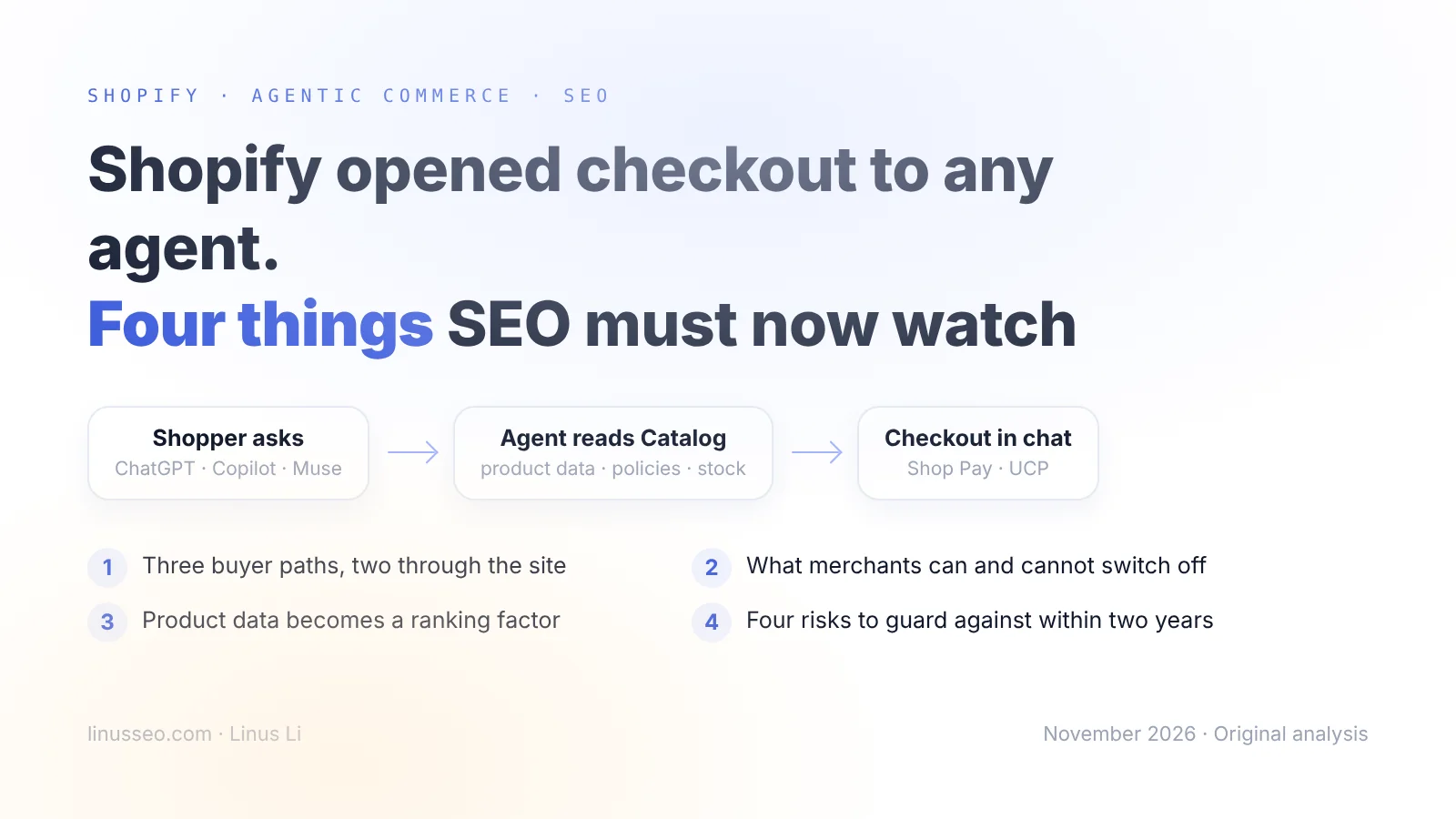
Shopify Opened Checkout to Any Agent. Four Things SEO Must Now Watch


Suppose a Shopify merchant selling outdoor gear asks: after Fall ‘26, a customer asks ChatGPT, Copilot or Meta’s Muse for “waterproof hiking shoes under $200”, the agent lists products, adds one to the cart and pays with Shop Pay, and my website is never opened during the whole process. What is my SEO still for?
My conclusion is this: the object of SEO has changed, from “getting the web page ranked by a search engine” to “getting the product data read correctly, selected and bought by an agent”. The web page has not lost its purpose, because the Catalog’s data comes from the web page, ChatGPT’s checkout still returns to the store site, and the third-party reviews in AI answers also come from web pages. But the center of gravity for ranking has moved to product data, policy pages and platform settings, and these three items rarely appeared on an SEO checklist before.
Key points
- Shopify’s Fall ‘26 Edition on October 28 opened the Catalog, cart and checkout to any agent or app, and every Liquid and Hydrogen store ships with WebMCP tools by default. In Shopify’s words, “Every Shopify store is agent-ready by default”.
- The buyer path has split into three: the agent reads the Catalog and checks out inside the conversation (Copilot, Google, Meta); the agent reads the Catalog and sends the buyer back to the store site to check out (ChatGPT); a browser agent operates directly on the store’s pages (WebMCP). The three paths read different data, so SEO has to check each one separately.
- Merchants can turn off Catalog access and direct checkout per channel. They cannot turn off the WebMCP tools on a Liquid store or catalog access for the Google channel. The only way to keep a product out of AI entirely is to set it to Unlisted, and the cost is that it disappears from Google and on-site search at the same time.
- Product data is the new ranking factor. Shopify infers attributes such as color and material from titles, descriptions, categories, variants and images, and the thinner the description, the less accurate the inference. Agents then rank by price, inventory, shipping and trust signals.
- Four things to guard against over the next two years: the entry point being captured by platforms, identity verification becoming a gate to entry, data inconsistency becoming a compliance problem, and existing traffic analytics not seeing agent orders.
What Fall ‘26 actually opened
Shopify released the Fall ‘26 Edition on October 28, 2026. The first sentence of the developer announcement is that it “opens Shopify’s catalog, cart, and checkout to any agent or app”. Compared with the spring edition, the change is that it is no longer limited to partners. Previously only ChatGPT, Copilot, Google and Meta were connected; now any developer can connect.
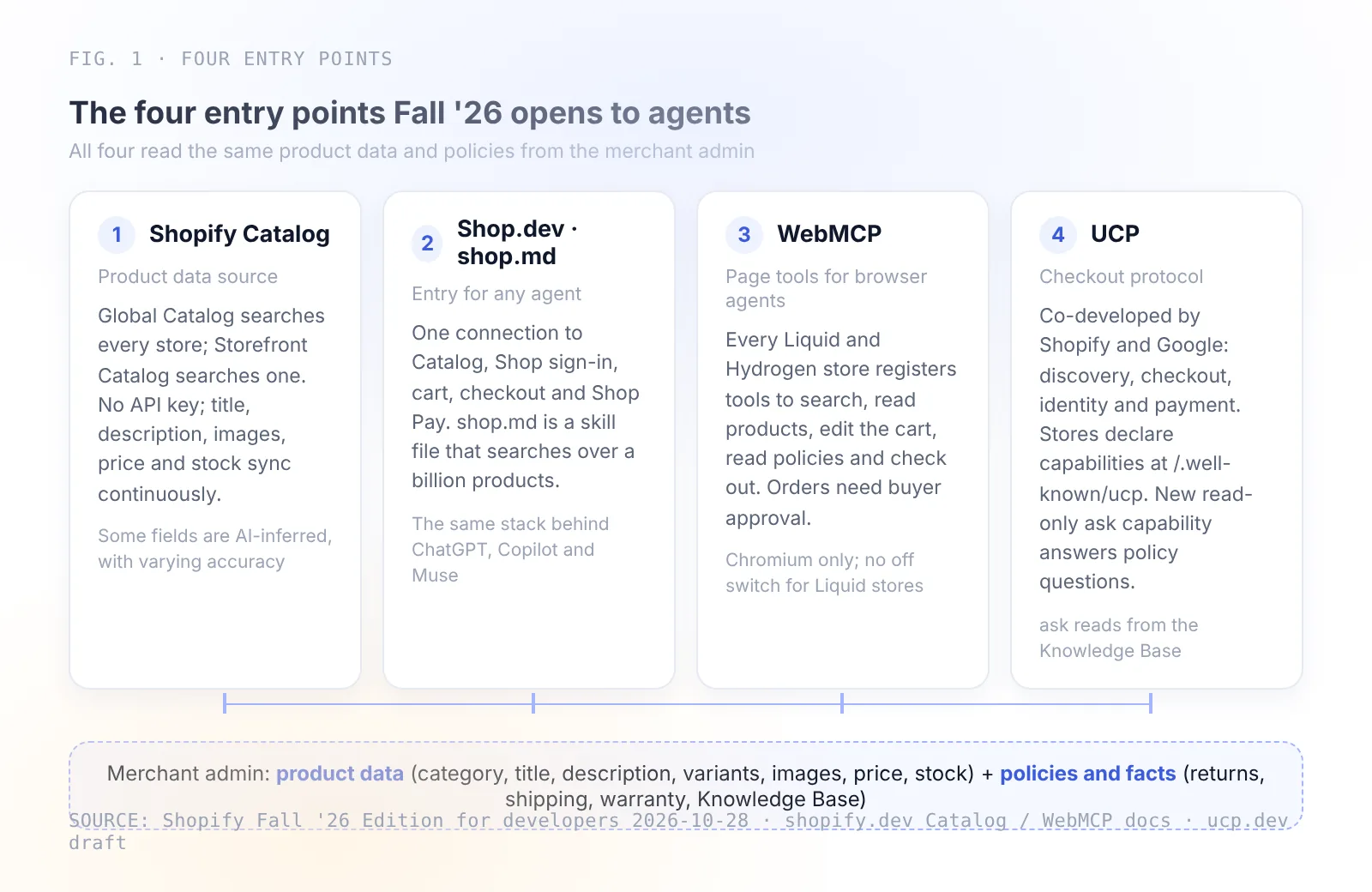
What was opened can be understood as four layers, and each layer corresponds to one entry point for reading data.
The first layer is the Shopify Catalog, which is the data source every agent reads products from. There are two kinds of Catalog: the Global Catalog searches across all Shopify merchants, with its endpoint at catalog.shopify.com; the Storefront Catalog searches a single store, with its endpoint under the store domain at /api/ucp/mcp. Neither requires an API key, and any agent can query them with an “agent profile”. The Catalog syncs titles, descriptions, options, images, prices and inventory by default, and keeps them updated.
The second layer is Shop.dev and shop.md. Shop.dev provides a single connection to the Catalog, Shop sign-in, cart, checkout and Shop Pay. shop.md is a skill file for agents; once installed, an agent can search and recommend across more than 1 billion products. Shopify says developers get the same catalog and checkout that sit behind ChatGPT, Copilot and Muse.
The third layer is WebMCP. Every Liquid store and every Hydrogen 2026-10 store registers a set of tools on its pages that a browser agent can call directly, including searching products, reading product details, changing the cart, entering checkout, and reading policies and FAQs. The checkout page has four more tools that can fill in the address, choose shipping, apply a discount code, and place the order after the buyer confirms. At present only Chromium-based browsers support this.
The fourth layer is the checkout protocol UCP. It was written jointly by Shopify and Google and defines how an agent and a merchant discover each other, how a checkout is created and completed, and how identity and payment are verified. A Shopify store declares its supported capabilities in its /.well-known/ucp file. This release added an ask capability to UCP, which the specification defines as “Answers natural-language questions about a business’s resources, policies, and services; read-only”. Its data comes from the Knowledge Base, the page of “merchant-reviewed AI facts” that moved into the admin on October 26.
For experts: endpoints and documentation for each layer
- Catalog:
shopify.dev/docs/agents/catalog. Global Catalog endpointcatalog.shopify.com/api/ucp/mcp, Storefront Catalog endpoint{storeDomain}/api/ucp/mcp, toolssearch_catalog,lookup_catalog(up to 50 IDs per call on Global, 10 on Storefront) andget_product. The documentation states that some fields are inferred by Shopify’s AI, marked “Inferred”, and that “accuracy varies”. The Global Catalog supports paid promoted placements that developers can apply for. - Shop MCP: developer changelog of October 13, server
mcp.shop.com, skill filemcp.shop.com/skill.md. Search needs no credentials; Shop Pay checkout and order lookup require the buyer to sign in with Shop; there are no webhooks, so checkout status has to be polled withget_checkout. - WebMCP:
shopify.dev/docs/api/web-mcp. Storefront toolssearch_catalog,browse_store,get_product,show_variant,get_cart,add_to_cart,update_cart_lines,cancel_cart,proceed_to_checkout,manage_orders,search_shop_policies_and_faqs,get_ucp_profile; checkout toolsget_checkout,update_checkout,complete_checkout,navigate_to_storefront. The documentation requires the agent to show the buyer the order and total and obtain permission before callingcomplete_checkout, and to reconfirm if the total changes. Hydrogen can disable it withwebMcp: false; no way to disable it is documented for Liquid. - UCP:
ucp.dev/draft/specification/overview. Thedev.ucp.*namespace is managed by the UCP governance body; identity verification supports API key, OAuth 2.0, mTLS and HTTP Message Signatures (RFC 9421), with Web Bot Auth as an optional additional layer.dev.ucp.common.askis declared as a draft version in the Shopify-hosted sample profile.
The buyer path has split into three
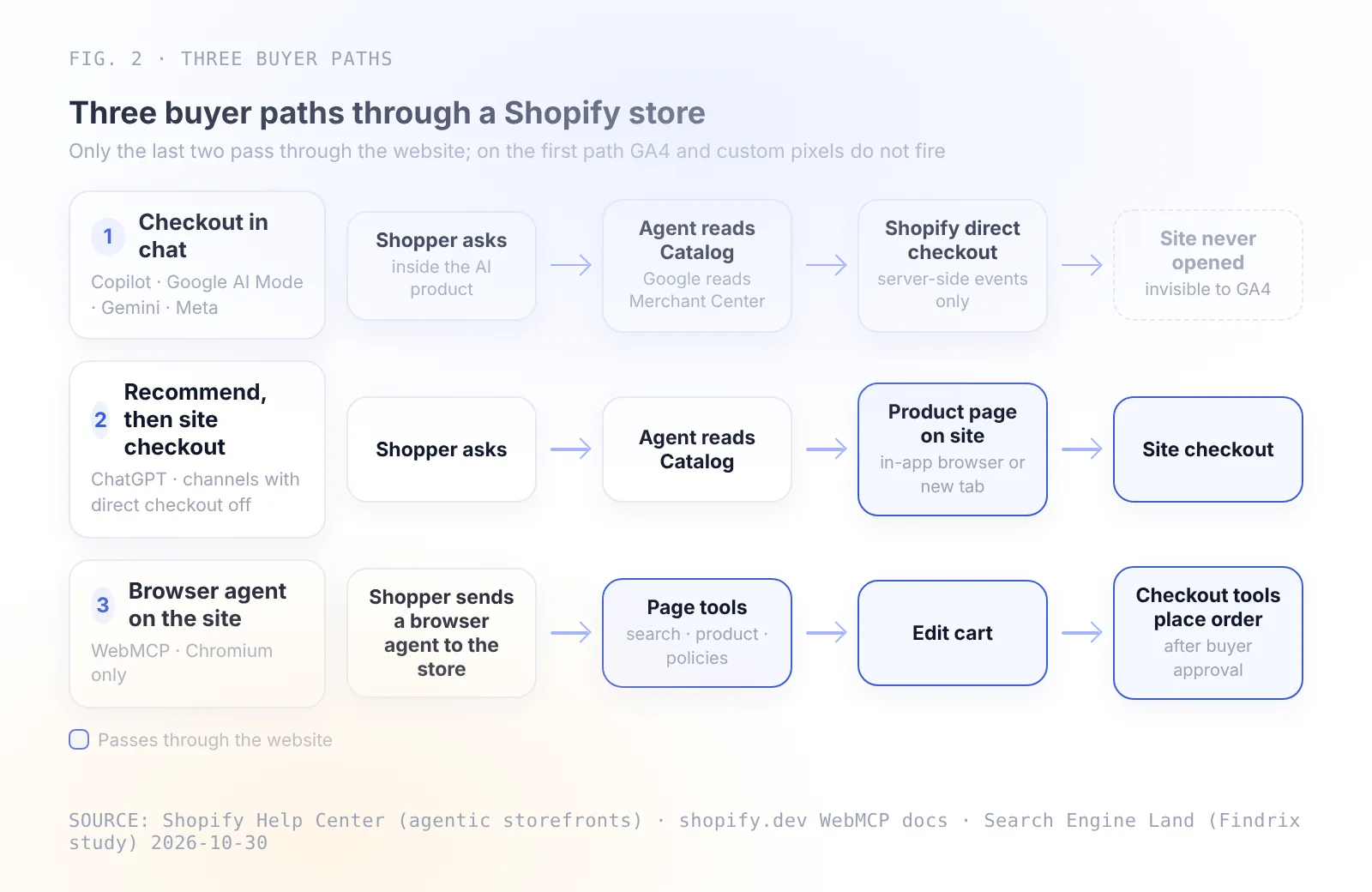
There used to be one path: the buyer searches, clicks through to the product page, adds to cart and checks out. All SEO work revolved around “getting the product page ranked”. Now there are at least three paths, and each reads different data.
Path one: the agent completes the purchase inside the conversation. The buyer asks a question in Copilot, Google AI Mode, Gemini or a Meta product, the agent pulls products from the Catalog, the buyer taps “Buy”, and fills in the address and payment in a checkout provided by Shopify. Shopify’s help documentation states that on this path Google Analytics and custom pixels do not fire, and only two server-side events exist, “started” and “completed”. Subscription products, bundles, customizable products, in-store pickup, and stores that require sign-in before checkout are not supported. Orders arrive in the admin with channel attribution, and the merchant remains the merchant of record.
Path two: the agent recommends, and the store site handles checkout. This is how ChatGPT works today: the buyer sees the product in ChatGPT, clicks through to the store’s own checkout page, and completes the purchase in an in-app browser or a new tab. Turning off direct checkout for the Copilot and Google channels also turns them into this path. The store site still carries the conversion on this path, so product page speed, inventory display, shipping information and the checkout flow matter as much as before.
Path three: a browser agent operates on the store site. The buyer asks the agent in Chrome to open the store, and the agent searches, adds to cart and checks out through the WebMCP tools, without going through the Catalog. This path reads the structured data returned by the tools registered on the page, plus the policies and FAQs that search_shop_policies_and_faqs reads.
One point is easy to confuse and needs its own paragraph. Google AI Mode and Gemini do not read products from the Catalog. They go through the Google & YouTube sales channel, which means Merchant Center data. That is why the Shopify admin has no switch to turn off catalog access for the Google channel; for Google, only the checkout method can be adjusted. Findrix’s October study tested 55,198 AI answers and found that 57% of the links in AI Mode product answers pointed to Google Shopping product pages, and 46.5% of answers linked only to Google’s own pages (reported by Search Engine Land). The study measured links rather than clicks, but it shows that for physical products in Google’s AI, Merchant Center data is closer to the buyer than the web page is.
What merchants can and cannot control
The Fall ‘26 announcement does not say how a merchant opts out of agent channels as a whole. I have compiled the controls from the help documentation into one table.
| Channel | Catalog access | Direct checkout | Data source |
|---|---|---|---|
| ChatGPT | Can be turned off | No switch; the buyer returns to the store site to check out | Shopify Catalog |
| Microsoft Copilot | Can be turned off, takes up to 7 days to take effect | Can be turned off; on by default for eligible stores | Shopify Catalog |
| Google AI Mode, Gemini | Cannot be turned off here | Can be turned off | Google & YouTube channel / Merchant Center |
| Meta | Set per channel | Can be turned off | Facebook and Instagram channel |
| Personal agents such as Muse and Claude | Follows the Catalog settings | Shop Pay, no separate activation needed | Shopify Catalog / Shop |
| Browser agents (WebMCP) | No switch on Liquid stores; Hydrogen can set webMcp: false |
Order placed after the buyer confirms | Store pages |
The settings are under “Sales channels > Agentic” in the admin. The default state is “Allow Shopify to manage for me”, and you have to turn off this master switch before you can adjust each channel.
There are three limits to know about. First, if you turn off Catalog access for a channel, products may still appear in that channel through web crawling. The help documentation is direct about this: “Blocking AI crawlers at the robots.txt or network layer affects only open-web discoverability”, and the reverse is also true, because robots.txt cannot block the Catalog. Second, the only way to keep a product out of AI channels entirely is to change its status to Unlisted, but that also removes it from the sitemap, from Google and from on-site search. Third, products sold only to business customers are excluded automatically, provided Shopify can recognize them. B2B pricing built with third-party apps or theme modifications may not be recognized, and those products will enter agents at retail prices.
For experts: eligibility for direct checkout and unsupported features
Eligibility for Copilot direct checkout: the store sells to customers in the United States (the store itself can be located anywhere); products meet the Catalog requirements; the merchant accepts the Shopify Agentic Storefronts Supplemental Terms of Service; the terms of service, privacy policy and return and refund policy are filled in under Settings > Policies. Google AI Mode and Gemini are currently open only to some US stores. Direct checkout carries no extra fee, only the standard payment processing fee.
Not supported: subscription-only products, bundles, customizable products, B2B-only products; local delivery, in-store pickup, pickup points; stores that require customers to sign in before checkout; Google Analytics and custom pixels do not fire; some checkout blocks such as custom fields and upsell recommendations may not display. Legal disclosures must be placed within the first 6,000 characters of the product description. Shopify Functions (shipping, discounts, validation), automatic discounts and discount codes are available.
Why the focus of SEO has to move to product data
In a June article, Shopify explained how the Catalog processes products: it maps products to the Shopify standard taxonomy; infers color, material, pattern, size type and age group from titles, descriptions, variants and images; clusters the same product within one store and across stores; and then generates structured fields such as key features, technical specifications and value propositions. Merchants cannot edit the inferred attributes one by one; they can only influence them through the source data. In Shopify’s words, “The higher quality your titles, descriptions, categories, variants, and images, the better information Shopify has to work with”.
What this sentence means is that the quality of product data directly determines what product the agent sees. If the description does not mention the material, the inference may be wrong; if the wrong category is chosen, the product will not appear in the matching search; if variant options are named inconsistently, the agent cannot tell size 42 from size 42 wide. As for ranking, Shopify says each agent decides its own display and ordering, based on factors including the buyer’s request, data quality, inventory, price, shipping and trust signals, and the Catalog does not guarantee that a product will appear in any given answer.
So I suggest rewriting the Shopify SEO checklist into four blocks, in this order.
Block one: product data. Choose the category down to the most specific level; include brand, model and key specifications in the title; state material, dimensions, use cases and legal disclosures within the first 6,000 characters of the description; use consistent naming for variant options; fill in GTIN, brand and model completely; keep price and inventory consistent with the website; and when running promotions with a compare-at price, know that this price is passed straight to agents. The Channel mapping page can map metafields and metaobjects into the Catalog, so stores that keep their specification tables in metafields need to do this step.
Block two: policies and facts. Return, shipping, warranty and payment policies are an eligibility condition for direct checkout, the source the Knowledge Base drafts from, and the data behind the search_shop_policies_and_faqs tool in WebMCP. If these pages are vague, the agent’s answers to customers will be vague too. The facts Shopify drafts in the Knowledge Base need to be checked line by line before publishing, because a wrong fact will be repeated by every agent to every person who asks.
Block three: the web page itself. Two of the three paths pass through the store site, and the Catalog’s data, the Knowledge Base drafts and the third-party reviews in AI answers all come from web pages. Product descriptions and specifications must be in the HTML rather than rendered by client-side JavaScript; /agents.md and /llms.txt can be customized with Liquid templates to hold context such as the store name, policies and sitemap; structured data continues as before. This block is traditional SEO, but its priority has dropped from first to third.
Block four: the agent’s identity. Since May, Shopify has applied tiered rate limits to bots accessing storefront pages and the Storefront API. Requests signed with Web Bot Auth get a higher quota, and unsigned requests get the lowest. The checkout WebMCP documentation also states that Shopify only verifies registered Web Bot Auth keys, and that otherwise “bot detection may deprioritize or block requests”. Merchants do not need to sign anything themselves, but they should know that agent visits in server logs will keep growing, that compliant agents carry a signature, and that those without one are either old crawlers or impostors.
For experts: inferred Catalog fields and Channel mapping
shopify.dev/docs/agents/catalog states that some fields are inferred by Shopify’s AI and marked Inferred, that they “might not always be present”, and that they have “varying accuracy depending on available product data”. Merchant-filled metafields override inferred values (this is a third-party analysis; Shopify’s documentation only says inferred fields depend on source data quality). The help page agentic-storefronts/products states that Channel mapping can map metafields, metaobjects, tag prefixes and title separators, can merge variants into a single listing, and can choose price or compare-at price as the listed price. Global Catalog search results are clustered by Universal Product ID, so when several stores sell the same product they are grouped together for comparison, and at that point price, shipping and trust decide who gets recommended.
Four things to guard against over the next two years
The above is what can be done now. Looking two years ahead, four trends already have evidence behind them, but their effects have not fully appeared.
First, the entry point will be captured by platforms. 57% of the links in Google AI Mode product answers go to Google Shopping; Shopify’s Universal Checkout lets third parties put products from several brands into one cart and check out once; the Global Catalog opens paid promoted placements to developers. These three facts point in the same direction: an extra layer of aggregators will appear between buyers and merchants, and it will decide both the display order and the checkout. The “independent” in independent store will increasingly mean data and brand rather than the traffic entry point. The matching action is to write the brand name, model and unique selling points into the product data, so buyers can still recognize you inside an aggregated interface.
Second, identity verification will become a gate to entry. Shopify already tiers bots with Web Bot Auth, the UCP specification has written RFC 9421 signatures into its identity layer, and Google is also experimenting with Web Bot Auth. Within two years, unsigned agents will be rate limited or refused, and signed ones will receive higher quotas. The effect on merchants cuts both ways. On one side, crawlers impersonating Googlebot will be easier to block (Gary Illyes said on October 30 that AI has made the Googlebot impersonation problem worse). On the other side, a merchant’s own monitoring tools will also be rate limited if they do not sign their requests.
Third, data inconsistency will become a compliance problem, not only a conversion problem. The Catalog keeps syncing price and inventory, the compare-at price is passed straight to agents, and Knowledge Base facts are repeated by agents. If the website says 30-day returns and the Knowledge Base says 14 days, whichever one the agent answers with is the one the customer will hold you to. Both the EU and the US have consumer protection rules on price display and return terms, and when an agent repeats a merchant’s data to a customer, the responsibility for errors still sits with the merchant. A monthly check of prices and policies across four places, the website, the Catalog, Merchant Center and the Knowledge Base, will become routine work.
Fourth, existing traffic analytics cannot see agent orders. GA4 does not fire on the direct checkout path, where only server-side events exist; ChatGPT’s links lost their UTM parameters in mid-October; and Gemini stopped adding UTM parameters to citation links at the end of September. Channel attribution in the Shopify admin is currently the most reliable data source, and “direct” traffic in GA4 will keep absorbing AI sources. When building reports, treat the channel field on admin orders as the source of truth, and use GA4 only for trends.
What this means for you
- Open “Sales channels > Agentic” in the admin and check which channels currently have Catalog access and direct checkout turned on. Catalog access for the Google channel cannot be turned off, so the only way to opt out there is to turn off checkout.
- Check every fact Shopify drafted automatically in the Knowledge Base, correct it, then publish. If you had the Knowledge Base app installed with more than 1,000 facts, migrate manually before January 15, 2027.
- Treat product data as a ranking factor: choose the most specific category, include brand and model in the title, state material, dimensions and legal disclosures within the first 6,000 characters of the description, name variants consistently, and fill in GTINs. If specifications live in metafields, map them into the Catalog on the Channel mapping page.
- Write the return, shipping, warranty and payment policy pages as facts that can be quoted line by line, because they are at once an eligibility condition for direct checkout, the source for the Knowledge Base, and the data behind the WebMCP policy tool.
- If your store builds B2B pricing with third-party apps or theme modifications, check whether those products have entered the Catalog at retail prices. For products sold only to business customers, switch to Shopify B2B or set them to Unlisted.
- If you sell physical products, check prices, inventory and images in Merchant Center every week, because Google AI Mode and Gemini read Merchant Center rather than the Catalog.
- Open a product page with JavaScript turned off and confirm that the description, specifications and reviews are in the HTML. Use a Liquid template to turn
/agents.mdinto a version that includes the store name, policy links and the sitemap. - Base reports on channel attribution from Shopify admin orders. In GA4, create a separate channel group for AI sources and use it only for trends, not absolute numbers.
- Once a month, check that prices and policies are consistent across the website, the Catalog, Merchant Center and the Knowledge Base.
- Before March 1, 2027, replace apps that still use script tags with theme app extensions or web pixels, because those scripts will stop running after that date.
Appendix: evidence list
| Claim | Source | Date |
|---|---|---|
| Fall ‘26 opens the Catalog, cart and checkout to any agent or app; every Liquid and Hydrogen store ships with WebMCP tools by default; shop.md can search more than 1 billion products | Shopify developer announcement | 2026-10-28 |
| The Catalog comes in Global and Storefront forms, both accessed with an agent profile and no API key; some fields are AI-inferred with varying accuracy; the Global Catalog has paid promoted placements | shopify.dev Catalog documentation | Current version |
| Shop MCP search needs no credentials; Shop Pay checkout and order lookup require the buyer to sign in with Shop | Shopify developer changelog | 2026-10-13 |
WebMCP has 12 storefront tools and 4 checkout tools; the agent must show the buyer the order and total and obtain permission before placing it; Hydrogen can disable it with webMcp: false, no method is documented for Liquid; only Chromium browsers are supported |
shopify.dev WebMCP documentation | Current version |
UCP adds an ask capability: “Answers natural-language questions about a business’s resources, policies, and services; read-only” |
ucp.dev draft specification | 2026-10 |
| The Knowledge Base moved into the admin; Shopify drafts facts from store pages and does not give them to agents before publishing; the standalone app shuts down on 2027-01-15, and stores with more than 1,000 facts must migrate manually | Shopify merchant changelog | 2026-10-26 |
| On the direct checkout path, GA4 and custom pixels do not fire, only server-side started / completed events; subscription, bundle, customizable and B2B-only products and in-store pickup are not supported; eligibility requires selling to the US and completing three policies | Shopify Help Center | Current version |
| ChatGPT sends the buyer back to the store to check out; Google, Copilot and Meta support Shopify-powered direct checkout | Shopify Help Center, Agentic storefronts overview | Current version |
| Google AI Mode and Gemini pull products through the Google & YouTube channel, and the admin has no option to turn off their Catalog access; turning off Copilot’s Catalog access takes up to 7 days; robots.txt only affects open-web discoverability; the only way to hide a product completely is Unlisted; B2B-only products are excluded automatically, but custom B2B setups may not be recognized | Shopify Help Center, products page | Current version |
| The Catalog infers color, material, pattern, size type and age group; merchants can only influence inference through source data; each agent decides its own display and ranking | Shopify blog, What is Shopify Catalog | 2026-06-16 |
| 57% of links in AI Mode product answers point to Google Shopping, and 46.5% of answers link only to Google pages; the study measured links, not clicks | Findrix study, reported by Search Engine Land | 2026-10-30 |
| Unsigned bots accessing storefront pages and the Storefront API get the strictest rate limits; signing with Web Bot Auth earns a higher quota | Shopify developer changelog | 2026-05-07 |
| Gary Illyes: AI has made Googlebot impersonation worse, “you can say you are Googlebot and they will let you in” | Odys podcast, reported by Search Engine Roundtable | 2026-10-30 |
| Gemini stopped adding UTM parameters to citation links around September 28; ChatGPT lost UTM parameters in mid-October, later confirmed as a bug | Search Engine Roundtable; Search Engine Land | 2026-10-30; 2026-10-20 |
| App script tags stop running on 2027-03-01 | Shopify developer changelog | 2026-10 |
References
- Shopify: Bringing shopping into the future: The Fall ‘26 Edition for developers
- Shopify: Fall ‘26 Edition
- shopify.dev: About Catalogs
- shopify.dev: WebMCP tools, Checkout WebMCP
- Shopify developer changelog: Add shopping and Shop Pay checkout to any agent with Shop MCP, Bots and agents should identify themselves via Web Bot Auth
- Shopify merchant changelog: Knowledge base is now available in your admin
- Shopify Help Center: Agentic storefronts, Products and Shopify Catalog, AI channels with built-in checkout
- Shopify blog: What Is Shopify Catalog?, How agentic commerce works
- UCP: Specification overview (draft)
- Search Engine Land: Google AI Mode sends 57% of product links to Google Shopping: Study
- Search Engine Roundtable: Google’s Gary Illyes: AI Made Bot Impersonation Worse
Shopify Opened Checkout to Any Agent. Four Things SEO Must Now Watch
https://www.linusseo.com/en/shopify-agentic-commerce-seo-outlook/