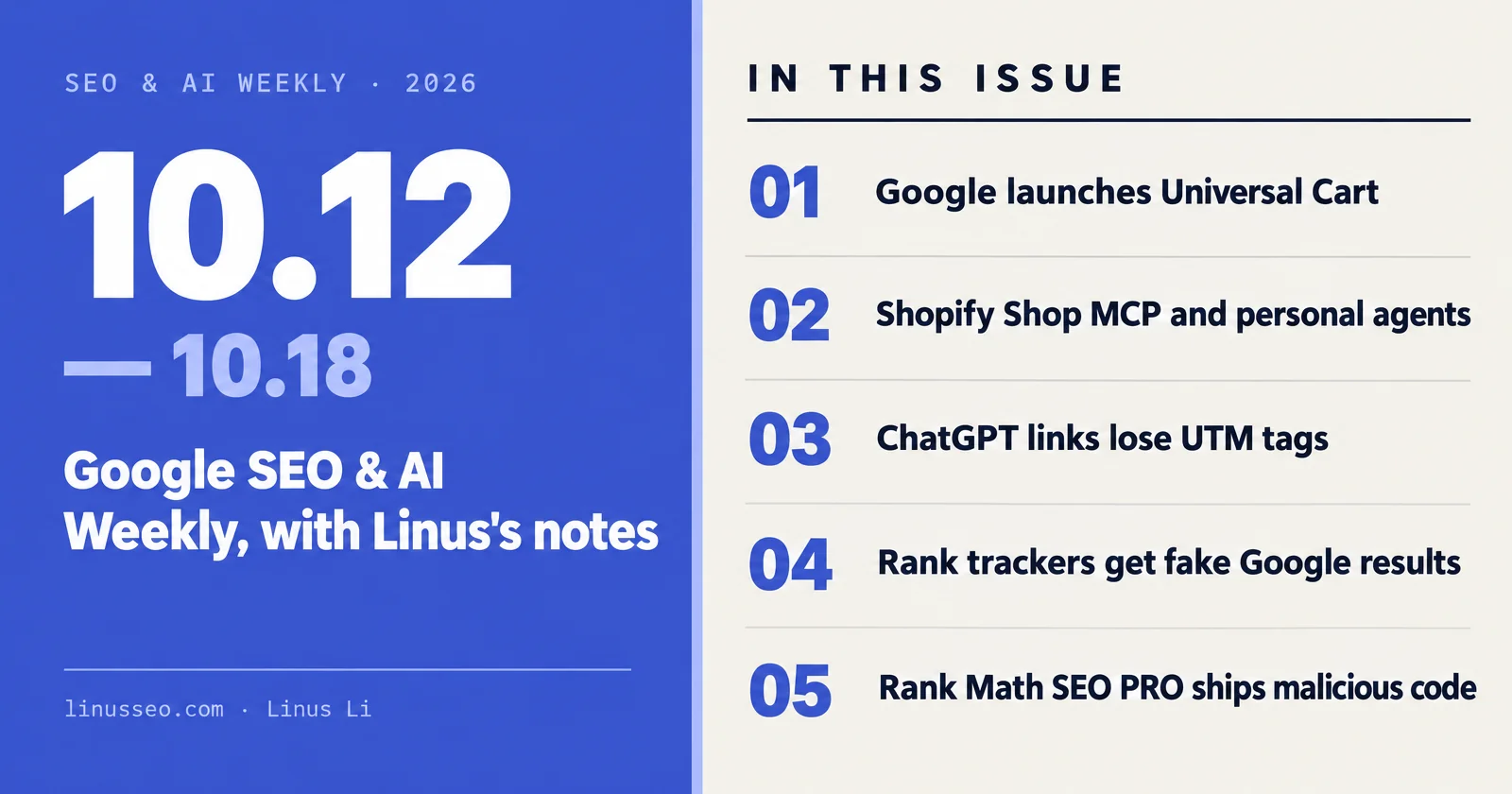
Google SEO & AI Weekly Roundup and Linus's Notes 261018


From October 12 to 18, 2026, Google launched Universal Cart in the US, which lets shoppers put products from several retailers into one cart in Search and Gemini. In the same week, Shopify released Shop MCP, which lets any MCP-compatible agent search Shopify Catalog and place orders with Shop Pay after the buyer confirms. Third-party media also reported that buyers can connect their own AI agents to a Shop account. Google’s status page shows no core update and no spam update this week.
This week’s changes center on two things. First, there are more entrances where AI shopping agents can place orders directly, and some of them are on by default for US stores. Second, several data sources were distorted at the same time: outbound links from ChatGPT lost their UTM parameters, Google returned fake results to third-party rank trackers, and the Search Console date picker broke. For this reason, check the data itself before acting on any traffic or ranking change you saw this week.
Key points
- On October 15, Google launched Universal Cart in the US. The cart syncs across Search, AI Mode, and Gemini, and checkout is built on UCP (Universal Commerce Protocol).
- On October 13, Shopify released Shop MCP, and Hydrogen 2026-10 supports WebMCP. Third-party reports say Shopify is opening Catalog and Shop Pay to buyers’ own AI agents.
- Google is placing links more prominently in AI Mode and AI Overviews, and said Preferred Sources usage has grown more than 7x since the start of the year.
- Nozzle reported that about 8.0% of the Google results pages it checked had been replaced with fake results. Several rank trackers were affected, and Google has not commented.
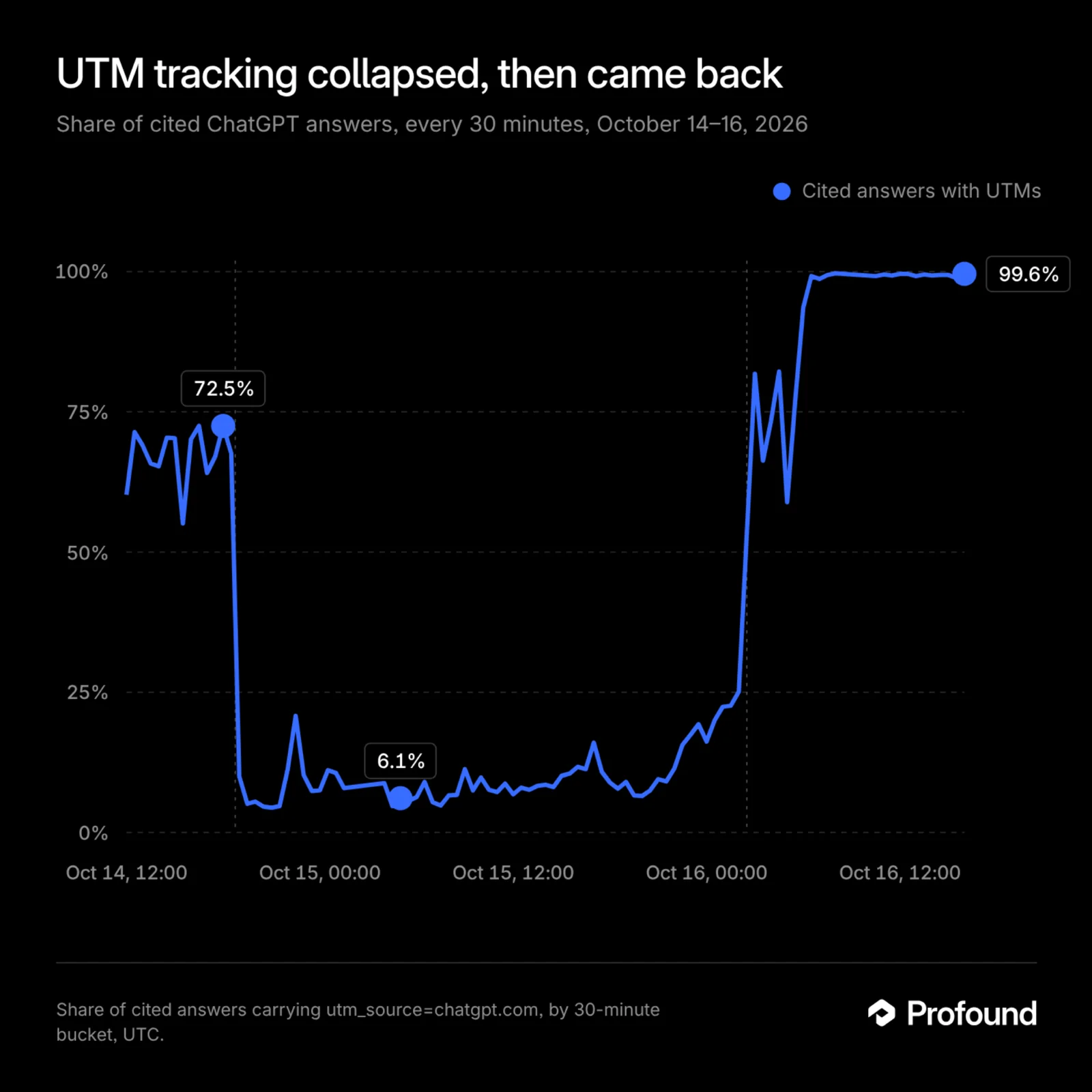
- From around October 9, outbound links from ChatGPT stopped carrying UTM parameters, so GA4 recorded these visits as direct traffic. Third parties measured that tagging had largely returned by October 16.
- Bing Webmaster Tools launched Topics Portfolio (beta) in its AI Performance report. It groups by topic the queries for which a site is cited in AI answers.
- Rank Math SEO PRO 3.0.123 contained malicious code for about 11 hours on October 15–16. Version 3.0.124 is clean.
Google launches Universal Cart, and Shopify opens Shop MCP and personal agent access
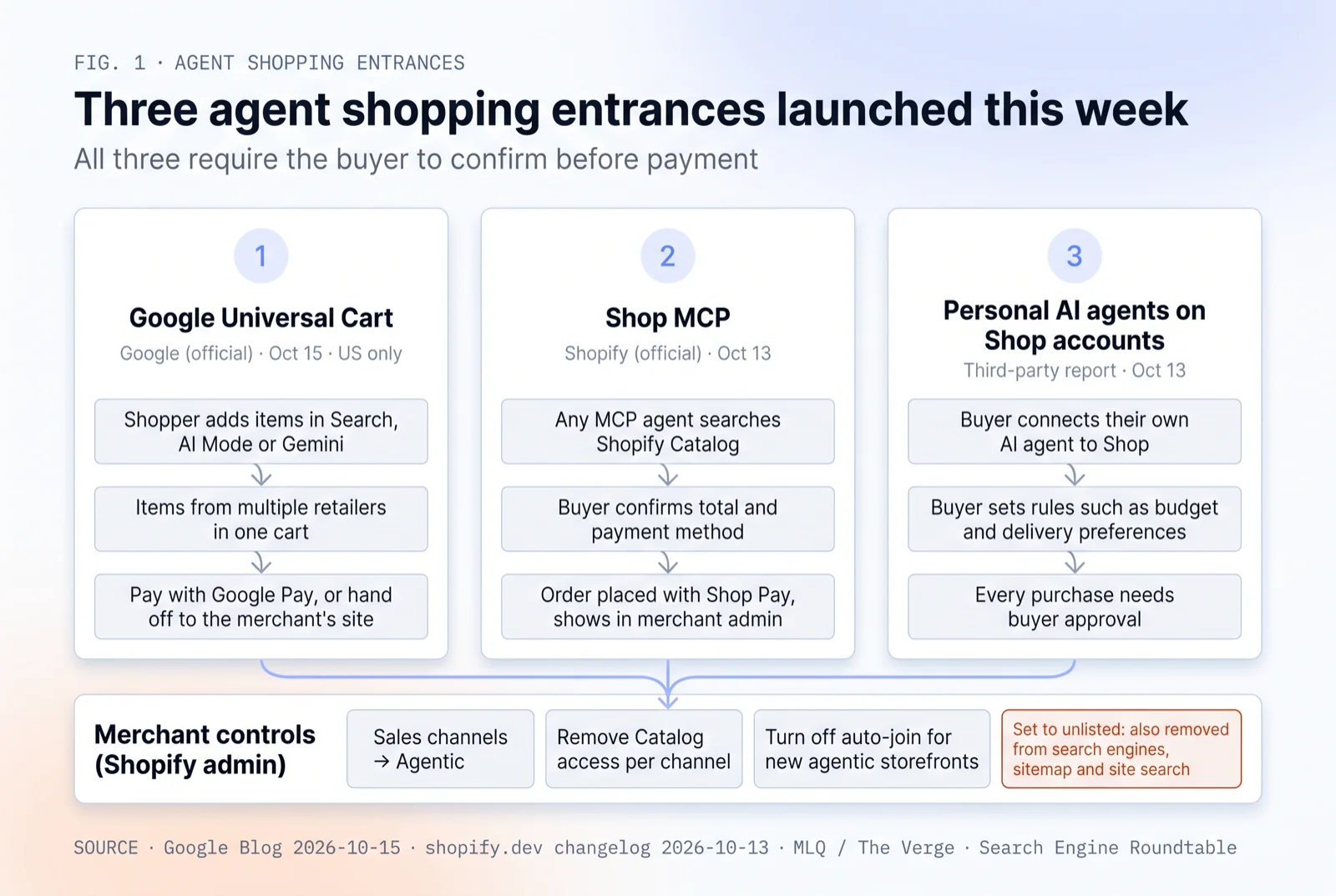
On October 15, Google announced Universal Cart in the US on its official blog. Shoppers can put products from several retailers into one cart, and the cart syncs between Search (including AI Mode) and the Gemini app. Google sends price-drop and restock alerts based on the more than 60 billion product listings in the Shopping Graph. There are two ways to check out: pay directly in the cart with Google Pay, or hand off the cart to the merchant’s own site. In both cases, the merchant is the seller of record.
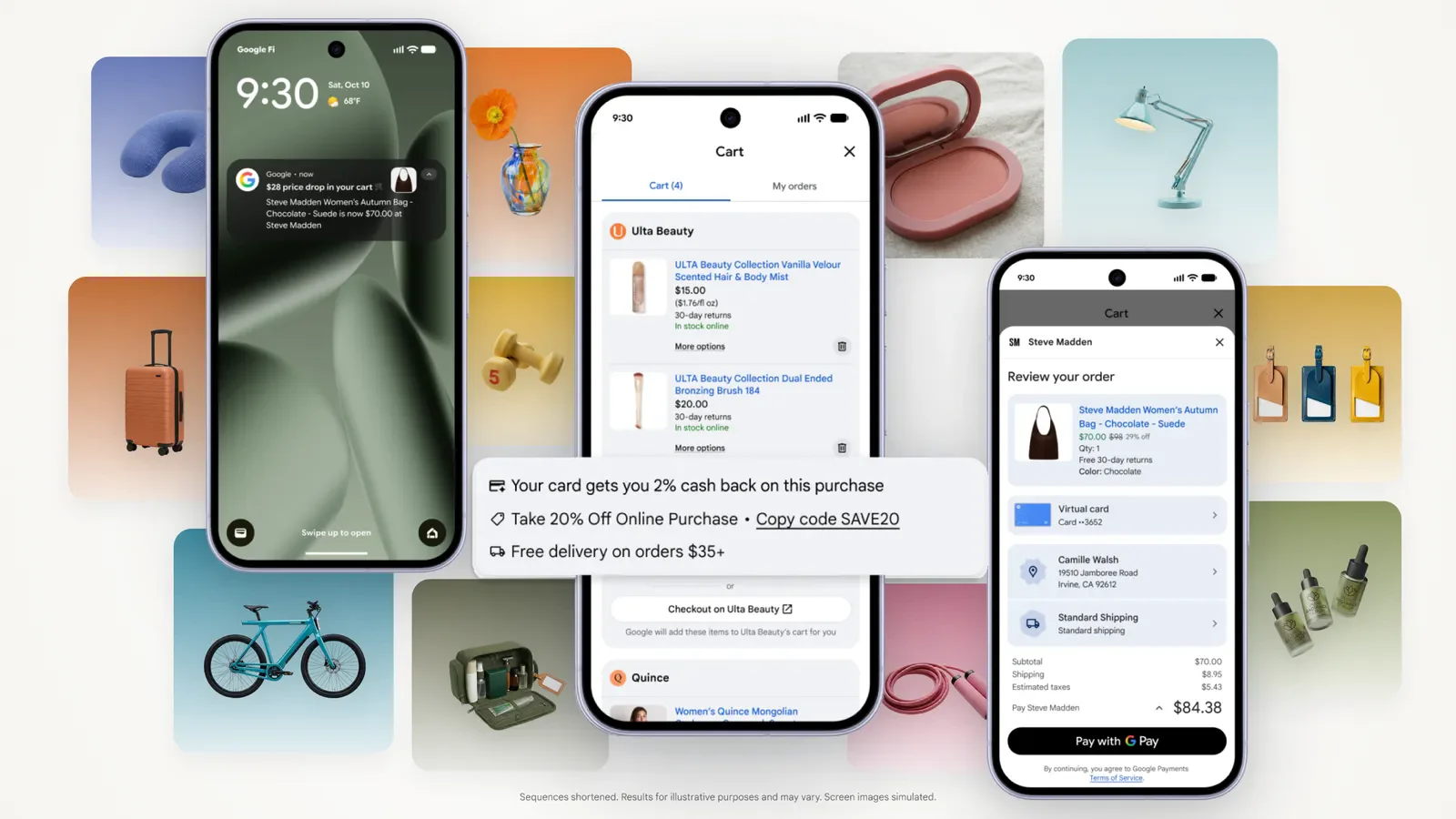
Google named large retailers such as Nike, Sephora, Target, and Walmart, as well as “many Shopify merchants,” as participants. The feature is only available in the US for now, and Google has not announced any fees.
Details on the merchant side come from third-party reports. According to Search Engine Journal, merchants choose native checkout or cart handoff in the UCP integration hub in Merchant Center, and cart handoff is one-way. Shopify’s Direct Checkout is on by default for eligible US stores, and these orders do not fire Google Analytics or Custom Pixels. Separately, ppc.land reported that Shopify merchants have been matched to Merchant Center accounts since September 18 and opted in by default to native checkout in AI Mode and Gemini. Merchants in Canada and Australia will have to wait until 2027.
On October 13, Shopify released Shop MCP in its developer changelog. It is an MCP endpoint hosted by Shopify (mcp.shop.com). Any MCP-compatible agent can use it to search more than 1 billion products in Shopify Catalog, and to create carts, check out, and look up orders. Search does not require an API key. After the buyer signs in to a Shop account, the agent must wait for the buyer to confirm the total and payment method before completing the purchase with Shop Pay. Orders appear in the merchant admin like any other order. The changelog does not explain how merchants can opt out.
On the same day, The Verge reported that Shopify lets buyers connect their own AI agents to a Shop account. We did not find a formal Shopify announcement for this issue. According to MLQ’s summary, buyers can set rules such as budget and delivery preferences, and every purchase needs the buyer’s approval. MLQ cites a Shopify help page that lists the merchant controls: removing Catalog access per channel, turning off “automatically join new agentic storefronts,” and managing direct checkout. Merchants can also hide a product completely by setting it to unlisted, but that removes the product from search engines, the sitemap, and on-site search as well.
On October 14, Shopify released Hydrogen 2026-10. Hydrogen is now a library that can be added to any JavaScript framework. In browsers that support WebMCP, shopping agents can search the product catalog and modify the cart, and Shopify Checkout submits the order after the buyer confirms. The release notes do not mention SEO.
For independent online stores, some of these entrances are on by default. According to a September 22 report from Search Engine Roundtable, the setting in Shopify admin is under Sales channels → Agentic, and merchants should check its current state there. For products you do not want in agent channels, remove Catalog access per channel. Do not set them to unlisted, because unlisted also removes the products from organic search.
Google adds more links to AI Mode and AI Overviews
On October 15, Google announced changes to links in AI Mode and AI Overviews on its official blog. Inline links will appear earlier and more often. Google is testing a block at the top of the answer that shows one or two official websites. The Preferred Sources news carousel is expanding to “more regions and languages,” but Google did not name specific markets.
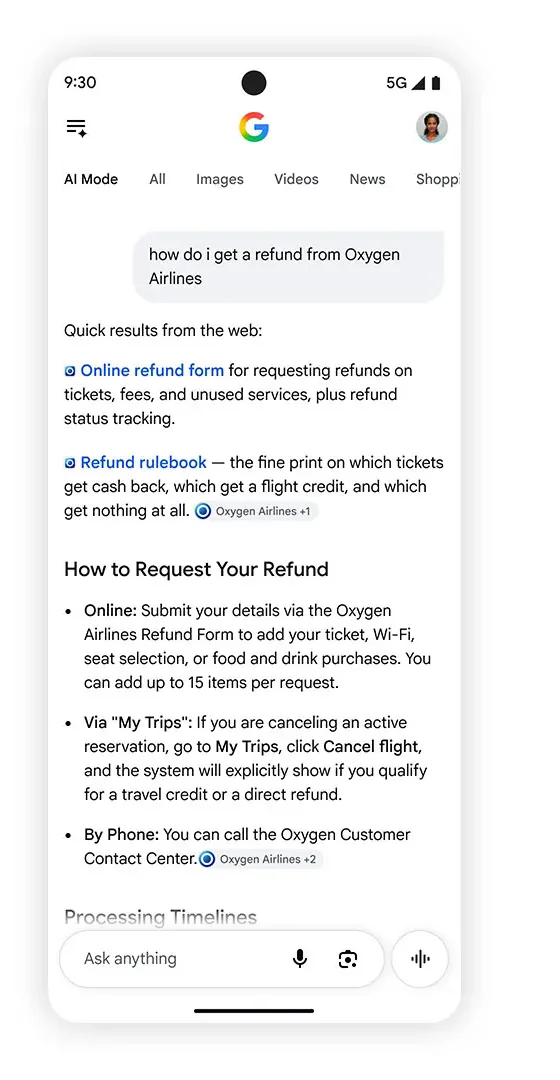
In the same post, Google said Preferred Sources usage has grown more than 7x since the start of the year. Google also told Search Engine Roundtable that the AI performance report still has no click data and that it will “gradually bring in more metrics.”
For independent online stores, the official website block in branded searches is worth watching. Your brand name, main product categories, and contact details should be clear and consistent on your site, which makes it easier for Google to identify it as the official website. However, Google’s reports do not yet show clicks from AI answers directly.
Google returns fake results to third-party rank trackers
Starting October 12, several rank trackers reported anomalies in Google data. Research from Nozzle, a rank tracking vendor, says that since September Google has returned results pages to rank trackers that look normal but contain replaced results. The research is based on results pages that Nozzle scraped itself, and about 8.0% of the pages it checked were “poisoned.” On these pages, tracked sites sometimes dropped out of the top 10, and social and forum sites filled the gaps. Nozzle believes Google is doing three things at once: blocking IPs from residential proxy networks at scale, adding more CAPTCHAs, and injecting fake data.
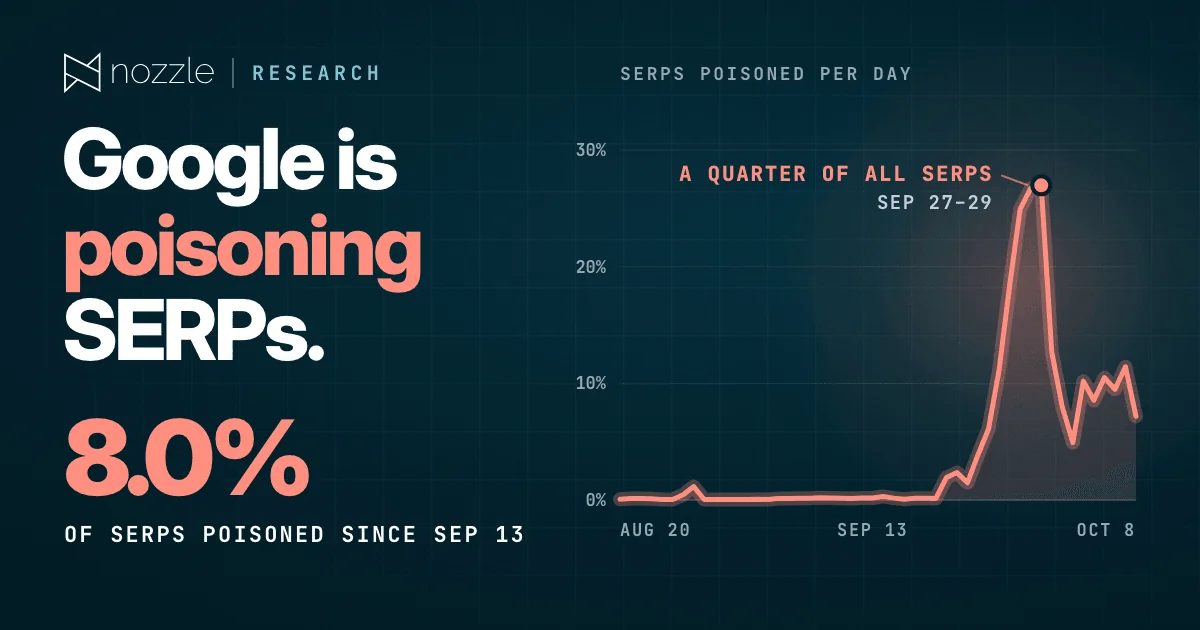
According to Search Engine Journal’s analysis, the affected tools include SE Ranking, Sistrix, DataForSEO, Advanced Web Ranking, and Morningscore. Google has not commented. All of this is third-party observation, and Google has not confirmed that fake results exist.
On October 15–16, Search Engine Roundtable reported that tool volatility charts and forum discussion were both rising, and site owners on WebmasterWorld said traffic and conversions had dropped. Google did not confirm any update, and the status page has no record of one.
Search Console also had a bug this week. According to Search Engine Roundtable, on October 13 the performance report showed the error “Date can’t be after 1969-12-31” when a custom date range was selected. The issue was fixed the same day, came back on October 14, and was fixed again that day.
For independent online stores, check any single-day ranking drop shown by rank trackers since September against Search Console first. If impressions and average position in Search Console did not change at the same time, the problem is more likely in the tool’s data.
ChatGPT links lose UTM parameters, and AI traffic is recorded as direct
According to Search Engine Roundtable, after GPT-6 launched, outbound links in ChatGPT opened with noopener and noreferrer and no longer carried utm_source=chatgpt.com. As a result, analytics tools recorded these visits as direct traffic. The issue lasted from about October 8 to 16, and OpenAI did not explain it publicly.
Several third parties measured the same drop. Ethan Smith of Graphite said GA4 sessions from ChatGPT fell about 45% below baseline from October 9. LLM Pulse counted a drop of about 46% in sessions from October 9 to 11, but did not disclose how many sites it monitors. Cedric Huesler of Adobe checked about 500 pages where ChatGPT accounts for 5% or more of visits. He found that ChatGPT visits fell by about 31,000 a day while direct visits rose by about 26,000 a day. The two numbers are close, which suggests most of this traffic was simply attributed to a different source.
Huesler said OpenAI told him this was a known bug and that a fix began rolling out early on October 15. Profound measured, in 30-minute UTC windows, the share of answers that contained at least one link with UTM parameters, without disclosing its sample size. By this measure, about 99% of answers carried UTM tags before October 8. The share fell to about 75% on October 9, dropped sharply to 5%–12% from 19:00 UTC on October 14 for about 27 hours, and returned to about 99% at 06:30 UTC on October 16. Because ChatGPT opens outbound links with noreferrer, analytics tools do not receive the referring page, so the UTM parameter is the main way to identify ChatGPT traffic.
The format of ChatGPT answers is also changing. Profound measured that answers with Intelligent UI (charts, calculators, and similar elements) rose from 2% on October 8 to about 35% on October 14, and briefly exceeded 90% on October 14–15. Tomek Rudzki of Peec AI compared about 1 million prompts before and after the change and found that answers containing a direct web page URL rose from about 8%–10% to 42%, and 54% of those URLs pointed to a site’s homepage. These numbers count links shown, not clicks, and Search Engine Journal reported them from a LinkedIn post.
For independent online stores, most of the drop in ChatGPT traffic and the rise in direct traffic in GA4 from October 9 to 16 is a tracking problem. In monthly reports and period-over-period comparisons, look at these two sources together.
Bing Webmaster Tools launches Topics Portfolio
On October 13, Bing released Topics Portfolio (beta) on its official blog. The feature sits in the AI Performance report and groups by topic the grounding queries (the queries an AI system uses to retrieve sources while generating an answer) for which your site was cited in AI answers. Each topic shows three figures: Topic Size, the approximate number of citations across all sites for that topic; Sites Cited, the number of competing sites that were cited; and the number of queries.
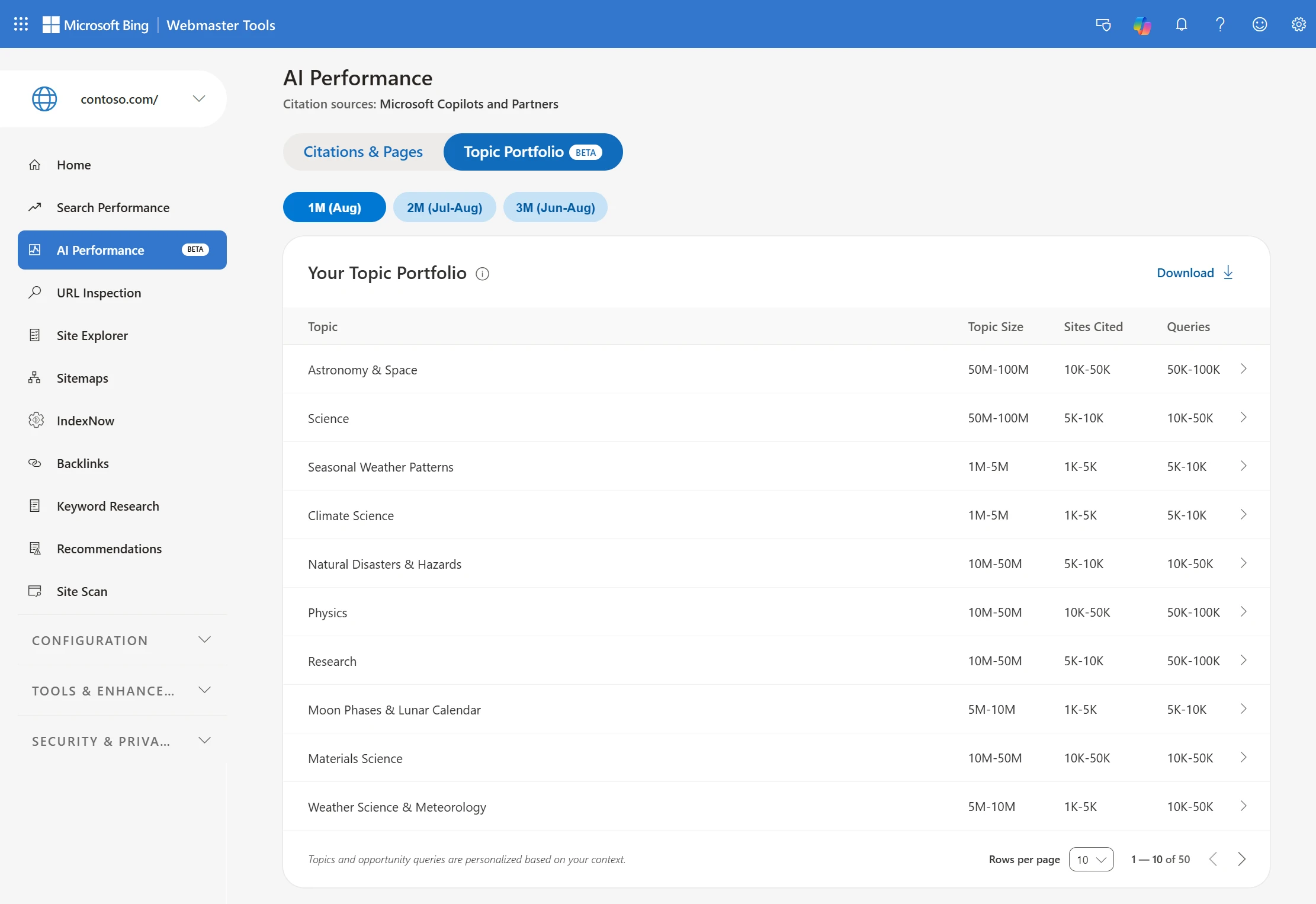
The report also has a separate list of Opportunity Queries, which are queries where competitors were cited and your site was not, with citation volume shown as a range. You can choose a time range of 1, 2, or 3 months. Topics only appear when the site has enough data. The report has no click data.
For independent online stores, Opportunity Queries can be used directly to find content gaps. Sites that already use Bing Webmaster Tools can start by looking for uncited queries in the topics for their core product categories.
Cloudflare and OpenAI share results of a crawl discovery pilot
On October 15, Cloudflare shared the results of its crawl discovery pilot with OpenAI on its official blog. The pilot began in July and covered about 1% of traffic on the Cloudflare network. Cloudflare’s network signals helped OpenAI’s search crawler discover “hundreds of millions” of new pages.
Cloudflare filters out wasted requests before OpenAI crawls them, including files that do not exist, sites that redirect every URL to the homepage, and duplicate URLs. It also provides page change signals, so pages that have not changed are not crawled again. Cloudflare said the pilot uses only metadata, page content is not used to train models, and discovery signals do not override the access settings site owners choose in AI Crawl Control.
For independent online stores, redirecting all broken URLs to the homepage causes those URLs to be filtered out at the discovery stage. URLs for discontinued products should return 404 or 410, or redirect to the most relevant collection page.
Other Google updates
Indexing API documentation: On October 16, Google recorded a change to the Indexing API quota page in the Search Central changelog. The quota page still lists 200 publish requests per day, but it removed the mention of a default testing quota, the instructions for requesting more quota, and the link to the request form. The API is still only for JobPosting pages and VideoObject pages with BroadcastEvent.
How PDFs are indexed: On the Search Off the Record podcast, Martin Splitt and John Mueller explained how Google handles PDFs, and Search Engine Journal covered it on October 14. After Google renders a PDF, it converts it to HTML before indexing, and links in the PDF are followed as usual. PDFs can appear in AI Overviews and AI Mode if they contain selectable text. Images inside PDFs are probably not indexed. Mueller recommended using HTML where you can.
Keywords in URLs: On October 14, Gary Illyes and Cherry Prommawin launched episode 1 of a new video series, The Non-Canonical Cabinet. They said keywords in URLs are a “very small signal.” Words joined with underscores are treated as one word, so you should use hyphens.
Merchant Center image quality: Google changed a Merchant Center help page. The “low image quality” issue now says products will continue to show in ads and free listings. The old text said products might be blocked from showing until the images improved. From January 31, 2027, the minimum size for all product images is 500×500 pixels, and Google has been sending warnings since July 2026.
Other Merchant Center attributes: The Merchant Center warranty attribute help page shows that this attribute now covers general merchandise. The format is a duration plus a unit, such as 6:year. It is optional unless local regulations require it. We did not verify the release date of this change for this issue.
Google Ads channel prioritization: On October 14, Google Ads launched channel prioritization and budget allocation, as reported by Search Engine Roundtable. Advertisers can mark Search, Shopping, and PMax channels as high or low priority, and high-priority channels receive budget first. Low-priority channels can have a daily cap set as a percentage of budget, and setting it to 0% stops delivery.
CrUX soft navigation metrics: On October 13, the Chrome team announced on web.dev that CrUX now includes experimental LCP, INP, and CLS data that covers soft navigations. A soft navigation is a page change in a single-page app that does not reload the full page. Existing stable scores do not change. Chrome plans to make this an official metric in May 2027, after which “Search Console will switch to the new data.”
For independent online stores, Core Web Vitals scores for stores built as single-page apps with Hydrogen or another headless architecture may change in 2027, and you can already check the experimental data in the CrUX API. For product manuals and spec sheets, it is best to publish an HTML version as well.
Rank Math SEO PRO is compromised with malicious code
According to the security outlet SecurityOnline, Rank Math disclosed that PRO version 3.0.123 contained malicious code. Affected sites are those that downloaded or updated the plugin between 20:02 UTC on October 15 and 07:12 UTC on October 16. We did not open the vendor’s original advisory for this issue. The malicious behavior listed in the report includes planting a backdoor that restores itself after deletion, adding admin accounts, writing malicious wp_options keys, staying persistent through cron jobs, connecting to rank1cdn.com, and leaking database and API credentials.
Version 3.0.124 is clean. The vulnerability is tracked as CVE-2026-111862, and most vulnerability databases give it a CVSS score of 9.8. Sites that activated the affected version should be treated as compromised: restore a clean backup and rotate all credentials.
SEO plugins have high privileges and can change the output of every page on a site. Once a plugin is hijacked, attackers can inject spam links and tamper with canonical and robots settings, and both directly affect search performance. For independent stores on WordPress or WooCommerce, first check whether your Rank Math PRO version and update time fall within the affected window.
Other industry news
Meta removes a disputed clause: According to TechCrunch, Meta’s new business terms, due to take effect on October 30, included a clause that allowed Meta to crawl domains linked to Facebook, Instagram, and WhatsApp business accounts and use the content for training, with no opt-out. After the report drew criticism, Meta removed the clause on October 17. Meta said its crawling practices have not changed.
Google News AI pilot: On October 15, Google said on its official blog that more than 400 publications have joined its news AI pilot. New participants include Axios, CNN, the FT, and Forbes.
Gemini 4 Argon: On October 13, Google announced Gemini 4 Argon on its official blog. Google AI Pro and Ultra subscribers can use it in the Gemini app and AI Mode. The Gemini app also added a “tasks” mode that connects to more than 40 apps, including Shopify and Instacart.
ChatGPT Chrome extension: On October 15, OpenAI announced a new Chrome extension on X, and 9to5Google and other outlets reported on it. Chat mode can read multiple tabs, and Work mode can send messages, fill in forms, and download files.
ChatGPT ads: An investigation by 404 Media says ChatGPT advertisers can target by conversation context, or by uploading email addresses, phone numbers, or advertising IDs, with a minimum match of 25,000 users. Search Engine Roundtable showed an email in which OpenAI assigns dedicated account managers to advertisers.
For independent online stores, Meta’s change shows that platform terms on crawling and training can change at any time. Brands that run ads through Meta business accounts should read the new terms before October 30.
Linus’s notes
Universal Cart, Shop MCP, personal agent access to Shop accounts, and WebMCP in Hydrogen all launched in the same week. These entrances read product data directly and only take payment after the buyer confirms, so product titles, prices, stock, specifications, and return policies need to be fields that machines can read accurately. Putting them only in images or marketing copy is not enough. Based on what was published this week, Shopify merchants face two likely problems. First, Direct Checkout and native checkout in AI Mode and Gemini are on by default for eligible US stores, and Direct Checkout orders do not fire GA or Custom Pixels. A store may therefore already have a new sales channel with no matching sessions in its analytics tools, so use orders in Shopify admin as the source of truth when checking AI channel sales. Second, if you want to keep some products out of agent channels, setting them to unlisted is the easiest option, but that setting also removes them from search engines, the sitemap, and on-site search. The safer approach is to adjust channels in Sales channels → Agentic first, and use unlisted only for products you do not want any channel to see.
This week, three data sources were distorted at the same time: ChatGPT links lost UTM tags, rank trackers received fake results, and the Search Console date picker threw errors. In each case, what looked like a ranking or traffic change was actually a measurement problem. So when you investigate a traffic change, first confirm that measurement is working, and only then consider whether an algorithm is involved. To identify the ChatGPT UTM problem, compare direct traffic and the chatgpt.com source day by day in GA4 for October 9 to 16. If the days ChatGPT dropped match the days direct traffic rose, and the new direct traffic is concentrated on landing pages that ChatGPT often cites, you can be fairly confident it is an attribution problem and not fewer ChatGPT recommendations. Treat rank tracker data the same way. Nozzle found about 8.0% of the results pages it checked had been replaced, so if a single keyword falls out of the top 10 on one day, check impressions and average position in Search Console first.
From an information security point of view, the Rank Math incident is a supply chain attack. The attackers delivered malicious code through the plugin’s official update channel and did not exploit any vulnerability in the sites themselves. “Update your plugins promptly” is the most basic security advice, yet this time the sites that updated on schedule were the ones affected. SEO plugins are among the most privileged components in WordPress because they can rewrite the title, canonical, robots, and sitemap of every page. When one is hijacked, it is both a security incident and a direct SEO problem. Sites that have used Rank Math PRO can check in this order. First, confirm whether the plugin was downloaded or updated between 20:02 UTC on October 15 and 07:12 UTC on October 16. Then check the admin account list for unfamiliar accounts, wp_options for keys you do not recognize, cron for unusual jobs, and server logs for connections to rank1cdn.com. If you confirm the site was affected, restore a clean backup and then change the database password, all API keys, and all admin passwords. After that, check the Security issues and Manual actions reports in Search Console to confirm there are no new warnings.
What this means for you
- Shopify merchants should open Sales channels → Agentic in admin and confirm which agent channels are already on by default. For products you do not want in agent channels, remove Catalog access per channel instead of setting them to unlisted.
- When checking AI channel sales, use order data in Shopify admin as the source of truth. Direct Checkout orders do not fire GA or Custom Pixels, so looking only at GA4 will miss these orders.
- Add an annotation in GA4 for October 9 to 16. In period-over-period comparisons, look at the chatgpt.com source and direct traffic together, and do not conclude from this period that ChatGPT traffic fell.
- For any single-day ranking drop in rank trackers since September, check impressions and average position in Search Console first, and only decide whether to change pages after confirming.
- WordPress sites should check the version and update time of Rank Math SEO PRO. If 3.0.123 was installed between 20:02 UTC on October 15 and 07:12 UTC on October 16, restore a clean backup, upgrade to 3.0.124, and rotate all credentials.
- Sites with Bing Webmaster Tools should open Topics Portfolio in the AI Performance report, list the Opportunity Queries related to their core product categories, and plan content updates by topic.
Google SEO & AI Weekly Roundup and Linus's Notes 261018
https://www.linusseo.com/en/google-seo-and-ai-newsletter-linus-thoughts-261018/