
What I Shared at the Yiguo SEO × GEO Conference: Making Content Rank on Google and Get Cited by AI


On August 12, 2026, we hosted the 2026 Google SEO × Overseas GEO Technical Conference in Shenzhen. I gave a 45-minute talk titled One Piece of Content, Two Wins: Ranking on Google and Getting Cited by AI. More than 300 cross-border e-commerce owners and content leads were in the room, and many of them asked the same question afterward: now that AI can draft a 2,000-word blog post in a few minutes, where should a content team actually spend its time so the same body of work both ranks on Google and gets cited in ChatGPT, Perplexity, and Google AI Overviews?
This post walks through all 30 slides from my talk. Instead of handing out a template for “what AI likes to read,” I will go through our team’s actual delivery workflow: how we map user questions, fill evidence gaps, keep dozens of pages aligned to one source of truth, run five pre-publish checks, and ship a reusable Topic Pack across ten roles.
Linus Li is an SEO practitioner based in Shenzhen. He heads Technical Solutions at Yiguo Tech (Jindouyun SEO), covering technical SEO, GEO and Shopify SEO.
GEO stands for Generative Engine Optimization. In this post, I use it to describe content and visibility work built around AI-generated search answers. If you are mapping out this area for the first time, you can pair this post with my Chinese guides on Jindouyun SEO, the Complete GEO Guide (2026 Edition) and the Complete SEO Content Strategy Guide. If you want to see what the guests from Google, Semrush, and Amazon—along with my four colleagues—shared on the same day, see the full conference recap on our company blog.
Key points
- Page ranking and fact citation are two different tests: In SEO, the unit of competition is the URL, which determines whether a page enters the candidate set. In GEO, the unit of selection is a specific claim, fact, or piece of evidence, which determines which sentence from your page makes it into the final answer.
- Decision-stage questions are the first to be answered by AI: Queries closer to comparison, product selection, and fit are much more likely to trigger generative answers. Being cited by AI will not hand back all your old click volume, but not being cited cuts your remaining clicks by more than half again.
- Use the “deletion test” to check for Information Gain: Strip out your brand name and self-praise. If only generic definitions and common industry advice remain, models and competitors can replace the page in seconds. If test numbers, failure cases, engineering trade-offs, and operating boundaries remain, the page has standalone value.
- In a topic cluster, the most expensive part is not writing—it is keeping dozens of pages saying the same thing over time: Use an eight-field claim table to govern claims across your site. Different channels can use different tones, but conclusions and conditions must not drift.
- Upgrade the deliverable from “one article” to “one Topic Pack”: For each core topic, deliver a claim table, a demand-and-page map, a master answer brief, reusable evidence blocks, and channel cards so SEO, writers, video, social, sales, and support all pull from the same verified numbers.
Why a page can rank without getting cited by AI
In the two months while I was preparing the deck, I reviewed Search Console data and AI sampling reports for dozens of cross-border brands. The most common frustration looked like this: a brand ranked in the top three on Google for a core query, yet when someone asked ChatGPT, Perplexity, or checked Google’s own AI Overviews, the brand was either missing altogether or the answer cited third-party reviews and forum threads instead.
I put the reason right at the start of the talk: a single piece of content now has to pass two separate tests—page competition and fact selection.
In traditional SEO, our unit of competition is the page (Page / URL). A search engine asks three things: does this page fit the current query, where should it rank relative to similar pages, and is it worth clicking for the next step? As long as the page covers the topic thoroughly, has enough authority, and has clean internal links and load performance, it can win a strong position.
In AI search, the unit of selection for generating an answer shifts to specific claims, facts, and evidence (Claim / Fact / Evidence). Once the system breaks a user prompt into sub-questions, it asks four further questions:
- Which specific fact on the page directly answers the current sub-question?
- Does that claim carry clear evidence and operating conditions?
- Which independent sources across the web corroborate that claim?
- Does the generated answer actually adopt your facts and numbers?
So SEO mainly determines whether your page enters the candidate set and wins a slot, while GEO focuses on which facts inside the page make it into the synthesized answer. They are not two separate content silos, but they are not the same exam either.
On stage, I shared two sets of industry research to show why this distinction matters in practice:
The first dataset comes from Seer Interactive’s 2026 update to its AIO Impact on Google CTR study (covering 53 brands and 5.47 million queries). Broken down by query intent, generative answers appear at very uneven rates: 88% on informational queries, 76% on commercial investigation queries, 66% on comparison queries, 38% on local queries, and only 12% on purely transactional queries. In other words, when users type “buy X” ready to check out, they still click straight into product pages. However, the closer a question gets to comparison, model selection, and “which one fits my situation”—the most important pre-purchase decisions—the more likely AI is to answer it first.
The second dataset combines citation and CTR measurements from Ahrefs and Seer Interactive. In July 2025, Ahrefs found that 76% of pages cited in AI Overviews also ranked in the organic top 10 for that query; in its 2026 measurement (reading all cited URLs), that share dropped to 38%, meaning roughly 62%–63% of cited URLs do not sit in the organic top 10 for the head query. Meanwhile, Seer’s data shows that organic CTR averages about 3.82% when no AI Overview is present; when an AI Overview appears and your page is not cited, CTR drops to 0.94%–1.3%; if your page is cited inside the AI Overview, CTR holds around 2.36%–2.4%—roughly 120% higher than when uncited.
Rankings still matter, but they no longer explain on their own who gets cited. Where an AI answer appears, getting cited will not restore all your old traffic, but it cuts your click loss by more than half compared with being left out. Your content has to state the key facts and operating conditions clearly at the exact moment it is cited, rather than padding out 2,000 words hoping to lure the user into clicking first.
Before changing how you write, you still have to meet Google’s technical baseline. On slide 5, I laid out the five-step pipeline:
- Technical eligibility: Crawlable, indexable, with a clear canonical URL.
- Demand match: Search intent, page type, and topic boundaries align.
- Candidate set and ranking: Passes core ranking and quality systems to enter the candidate pool.
- Fact selection: Definitions, numbers, comparisons, and steps can be extracted cleanly on their own.
- Answer and action: Earns citations, gets facts absorbed into the answer, and drives clicks and conversions.
Steps 1 through 3 are the SEO foundation; steps 4 and 5 are the extra work GEO requires. Google Search Central’s AI features documentation (updated July 2026) states plainly that a page must be indexed and eligible to show a snippet in Search to be eligible as a supporting link in AI Overviews or AI Mode. If you are not sure whether major AI crawlers can access and read your pages, run them through our free AI Crawler robots.txt Checker and What AI Crawlers See tool first.
Expanding from keywords to the user’s question network
Why do roughly 63% of cited pages sit outside the organic top 10 for the main query? Because generative search systems use query fan-out: the system decomposes the user’s prompt into a cluster of related sub-questions, retrieves passages across subtopics and sources, and synthesizes the pieces into one response.
That means we have to shift our planning unit from a single “head keyword” to a “question cluster + sub-questions + decision process.”
Instead of using an abstract SaaS keyword on stage, I used a concrete e-commerce scenario every DTC seller immediately recognizes: “For a home theater used every day in a hot, humid southern climate by a family with pets, which seating material should I choose?”
On the surface, the buyer asked one sentence. Underneath, they are trying to resolve a chain of purchase anxieties. If a writer simply targets a keyword and turns out a generic post titled Pros and Cons of Genuine Leather vs. Performance Fabric, the page will miss what the buyer actually needs to decide. Once you break the query into a question network, the content and product teams need to answer six specific sub-questions:
| What the buyer cares about | Specific question in the buyer’s mind | Facts the content and product teams must prepare |
|---|---|---|
| Scratch resistance | Will cat or dog claws tear the surface right away? | Surface scratch-test results, coating thickness, and real-world limits |
| Cleaning | How hard is it to clean spilled drinks or pet hair? | Step-by-step stain removal and which chemical cleaners damage the finish |
| Thermal comfort | Does it feel sticky in summer when the AC is off? | Breathability and contact feel by material, plus how room temperature and humidity change the choice |
| Durability | Sitting two to three hours a day, what wears out first? | Seam strength, foam rebound, and abrasion test numbers with test conditions |
| Risk and poor fit | Which households should not buy this material? | Explicit disqualifiers instead of claiming “suitable for every home” |
| Warranty | Does the warranty cover pet scratches or peeling? | Warranty scope, exclusions, and after-sales claim steps |
How do you map out this complete question network? In our team, we combine three demand sources before deciding what a page should do:
- Search demand: Keyword volume, SERP page types, People Also Ask, and real queries in Search Console. A keyword is not a blog title generator; it is proof that demand exists.
- AI prompt demand: How users phrase scenario-rich questions in conversational search, how sub-questions branch out, and what follow-up questions come next.
- Real business demand: Sales objection logs, customer support tickets, negative reviews, and return reasons—the exact hesitation where buyers stall right before paying.
Once those three sources are merged, the next step is assigning page responsibility. Uncovering six sub-questions does not mean spinning up six thin blog posts. Before creating a URL, we ask four questions: Should this demand live on a product page, collection page, blog guide, comparison page, or interactive tool? Does the page have one primary job? Is another page on our site already competing for the same intent? Which commercial page should the reader visit next? If existing pages can answer the sub-question well, we thicken those pages instead of minting new URLs.
Content matrices, topic clusters, and evidence networks
Many teams treat content scaling as “publish more posts.” On slide 8, I broke content organization into three stages: Content Matrix → Hub & Spoke → Evidence Network. Each stage builds on the previous one rather than replacing it.
| Stage | How it works | What it solves | Where teams get stuck |
|---|---|---|---|
| 01 Content Matrix | Map “keyword × page type” in a spreadsheet and produce pages by template, one keyword per URL | Solves baseline coverage and captures long-tail queries quickly | Flat structure; easily degrades into near-duplicate thin pages with swapped keywords |
| 02 Hub & Spoke | Use a core pillar page (Hub) connected via internal links to deeper sub-topic pages (Spokes) | Solves information architecture and helps search engines and users see topic hierarchy (see Topical Authority Guide) | Draws a neat folder tree, but the spoke pages are still filled with generic industry filler and lack verifiable facts |
| 03 Evidence Network | Connect core claims, factual evidence, and authoritative sources across on-site and off-site pages | Solves credibility and consistency so AI retrieval systems can verify, attribute, and cite your claims | Numbers conflict across pages on your own site, or third-party coverage contradicts your official specs |
Why can’t you stop at an on-site topic cluster? Because in many industries, your brand’s facts are not carried primarily by your own domain—third-party sources actively define you in AI answers.
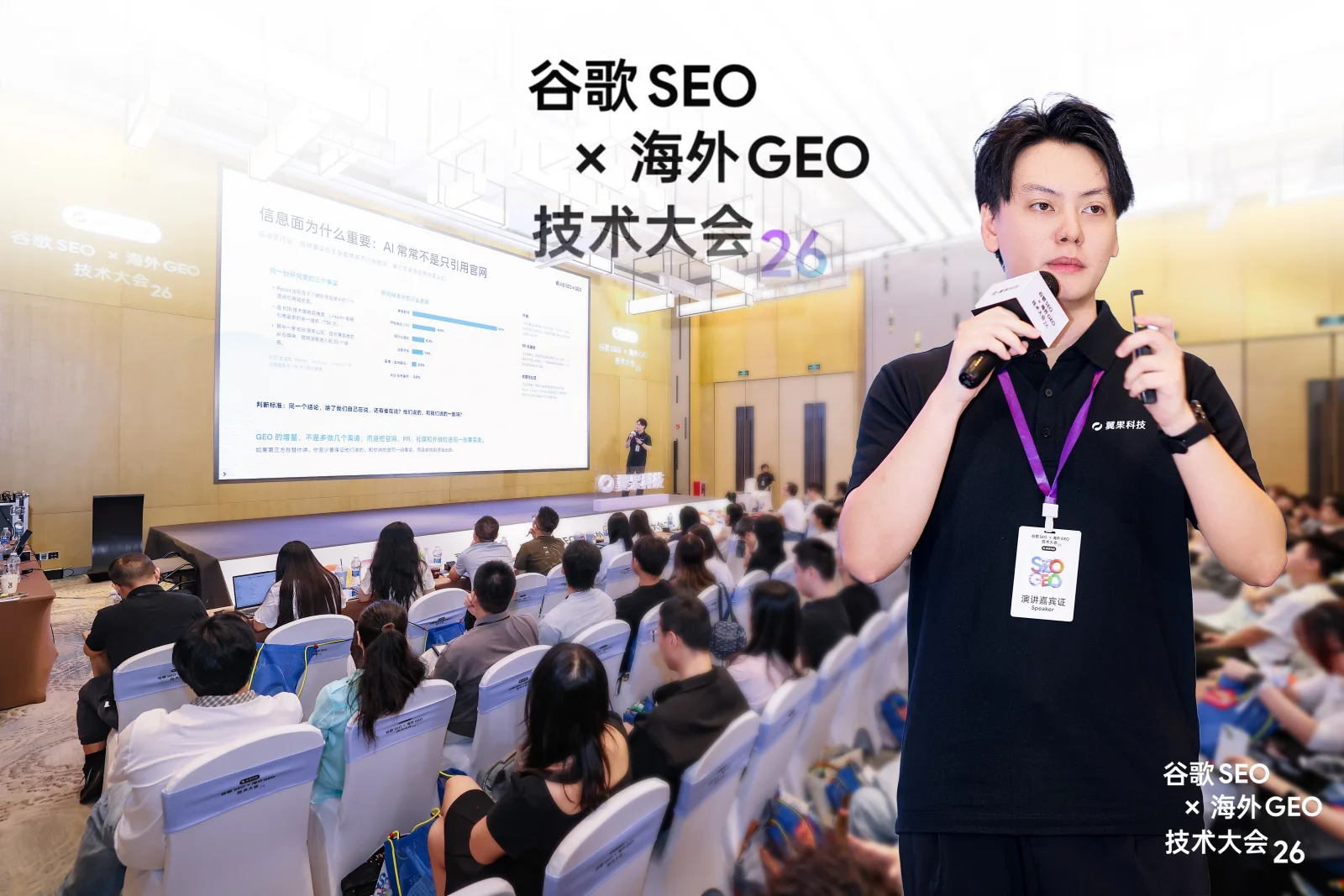
Slide 9 of my talk: “Why the information surface matters: AI often cites more than your official site.”
On stage, I shared findings from a multi-industry AI citation study (visible on the projection screen above):
- Across 8 studied brands, Reddit appeared among the top cited domains for 7 of them (for how Reddit’s anti-spam defenses work in the GEO era, see my post Reddit Blocks 23M Spam Views a Day).
- For B2B technical service brands, LinkedIn was the single most-cited domain (736 citations); for one B2B service company, its own official website did not even make the top 30 cited domains in its category.
- UGC domains (Reddit, YouTube, LinkedIn) averaged 1.16 citations per search.
- Official-site share of citations varied dramatically by sector: higher education reached 74.7%, specialty food CPG 18.9%, healthcare nonprofits 8.3%, consumer automotive 7.4%, local med-spa services 3.0%, and B2B technical services in the sample sat at 0.0%.
Those numbers force us to rethink what off-site channels actually do:
- Backlinks: Used to be mostly about passing link equity; now they also serve as a verifiable citation path that machines follow to check whether independent sources back up your claim.
- PR and media: Used to be about impressions; now they put your brand’s test data and methodology into an independent third-party source. One reproducible test number cited by an industry publication enters AI answers far more easily than ten self-congratulatory posts on your own blog.
- Social and communities: Used to be about traffic; now they act as an evidence repository of real user questions and long-term usage feedback. Reddit, YouTube, and LinkedIn show up in citations constantly because they supply real-world trade-offs that official product pages leave out.
That is why I emphasized on stage: the incremental work of GEO is not opening more social accounts or buying more guest posts—it is pulling your website, PR, social content, reviews, and backlinks into the same claim table. Your official site serves as the canonical source of truth; when third parties talk about you, you want to make sure they are citing the latest verified numbers and linking back to your original source.
To anchor each major cluster, we also design one or two “center of gravity” pieces. The test is simple: does this page give other people a reason to cite us, instead of us citing them? A strong center-of-gravity page includes at least one of the following five assets:
- Original test or survey numbers nobody else has;
- A reproducible test methodology with stated conditions;
- A quotable definition or industry benchmark;
- A comparison chart peers or journalists can screenshot or reference directly;
- A clear takeaway that the PR team can pitch as a data story.
Once that page exists, external links point to it naturally, social posts slice scenarios from it, PR pitches its data, spoke pages link back to it, and sales and support send it directly to buyers.
Information Gain: Use the “deletion test” to strip out filler
If original evidence is that important, how can an editor tell in five minutes whether a draft actually adds anything new? On slide 12, I shared the simplest check we use internally: the deletion test.
Take a draft and delete your brand name, product model numbers, and self-praising adjectives. Then look at what is left:
- If all that remains is generic definitions, standard how-to steps, and common knowledge any competitor could recite, the page can only do basic keyword coverage. An LLM can generate the same text in 30 seconds, and competitors can copy it effortlessly. Never treat that draft as a differentiating asset.
- If what remains includes real test results under stated conditions, actual customer usage stories, failure cases you learned from, engineering trade-offs, recurring buyer misconceptions from sales calls, and clear explanations of when the conclusion changes—that is where Information Gain and irreplaceability begin.
This aligns directly with what Google Search Liaison Danny Sullivan highlighted in April and July 2026 as “non-commodity content”: content that offers something unique, specific, and grounded in real experience.
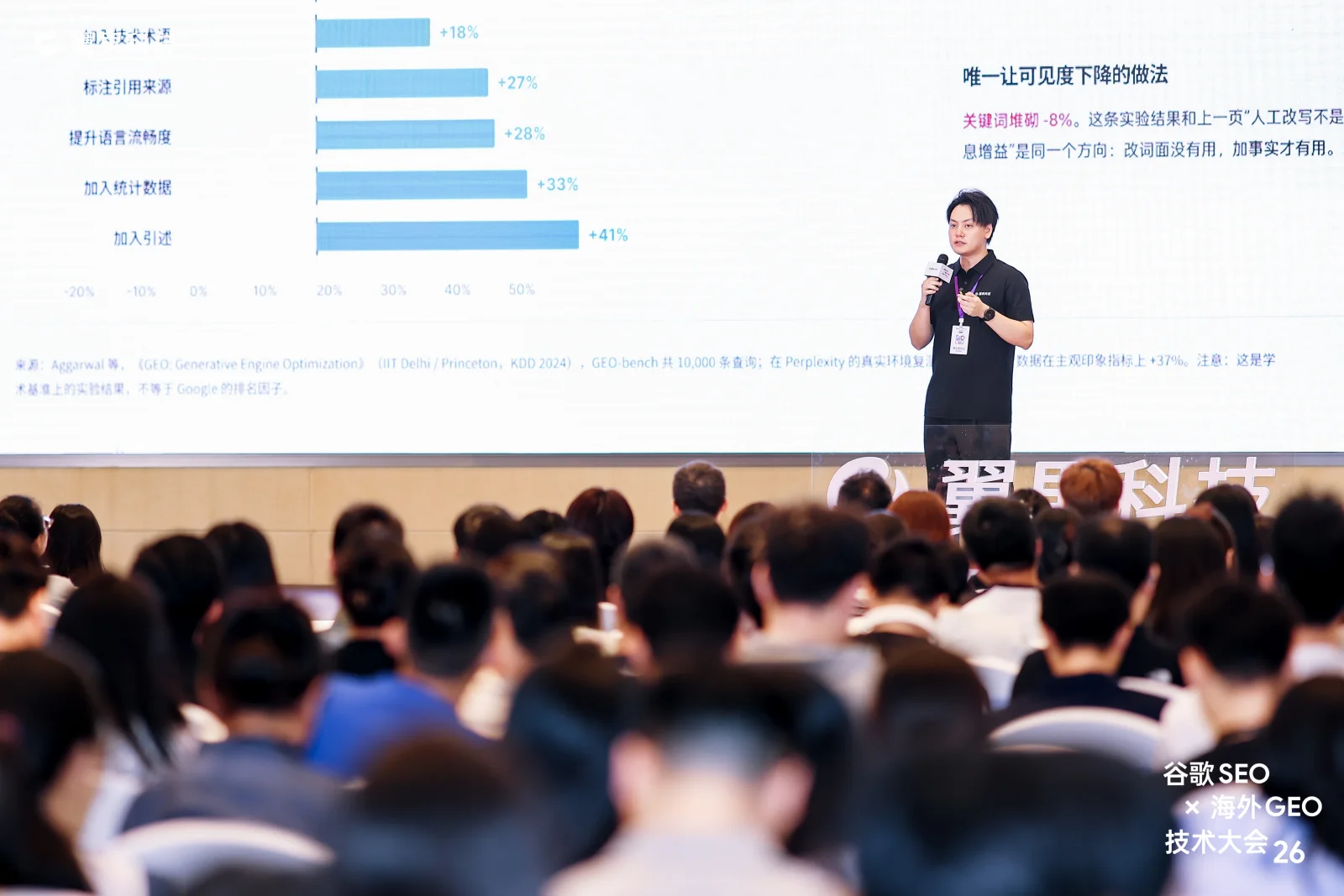
Explaining the KDD 2024 GEO benchmark results on stage: synonym swapping and keyword stuffing fail; statistics, quotations, and cited sources move the needle.
On slide 13, I showed the controlled experiment results from the KDD 2024 paper GEO: Generative Engine Optimization by researchers at IIT Delhi and Princeton University (pictured above). Across the 10,000-query GEO-bench benchmark and live re-tests on Perplexity:
- Quotation Addition improved visibility by +41%;
- Statistics Addition improved visibility by +33%;
- Fluency Optimization improved visibility by +28%;
- Cite Sources improved visibility by +27%;
- Technical Terms improved visibility by +18%;
- Keyword Stuffing—the old SEO habit—was the only method that hurt visibility, dropping it by -8%.
As I noted at the bottom of that slide, a controlled academic benchmark is not a list of Google’s production ranking factors. Still, it points in the exact same direction as our editorial deletion test: rewriting surface wording does nothing; adding verifiable facts, numbers, and sources is what helps. You can also run your URLs through our free AI Citability Checker to see whether your pages contain extractable answer blocks, numbers, and comparison tables.
At the same time, I reminded the audience that non-commodity content is not an automatic ranking switch. A page will not rank #1 just because it is original, nor will it get cited by AI if nobody is asking the question it answers. We use a 2×2 Demand × Evidence matrix as our topic gate:
| Demand × Evidence | What state the page is in | What to do |
|---|---|---|
| Real demand + Original evidence | Core asset: right page type, relevant to search, and contains facts others do not have | Invest heavily; this is the only quadrant that wins rankings, AI citations, and buyer trust together |
| Real demand + No original evidence | Average answer: accurate and complete, but AI and competitors can write the exact same page | Hold production as a priority piece until you add product test data, engineering judgment, or customer cases |
| No real demand + Original evidence | Internal monologue: unique testing, but no one searches or asks for it this way | Reframe the angle and attach the evidence to a real buying decision users actually make |
| No real demand + No original evidence | Dead weight: neither user demand nor new information value | Cut it before writing; if thin pages like this already exist on your site, merge or retire them via a content audit |
Govern dozens of pages with one eight-field claim table
Once a topic cluster grows, the same product specification or test conclusion ends up across product pages, collection pages, buying guides, comparison posts, YouTube scripts, press releases, and sales decks.

Slide 14 of my talk: “In a topic cluster, the most expensive part is not writing—it is keeping dozens of pages saying the same thing over time.”
As the caption at the bottom of slide 14 says: in a cluster, the most expensive part is not writing words—it is making sure dozens of pages keep saying the same thing over time.
How do cross-border e-commerce sites shoot themselves in the foot in AI search? A product gets a hardware revision or a promotional price change, and the merchandising team updates the product detail page—but forgets the five comparison blog posts written six months ago and the hand-written FAQ at the bottom of the collection page (I also covered how hardcoded prices and stock statuses in static HTML trigger Merchant Center disapprovals in my 261011 weekly notes). When Googlebot and AI crawlers visit, your product page says 12 hours of battery life, your blog says 10 hours, and an old press release says 15 hours. When sources conflict, the model either drops your brand or quotes an outdated number to the buyer.
To prevent this, we maintain an eight-field claim table governed by four operating rules:
| Field | What it records |
|---|---|
| 1. Claim ID | A unique identifier across the site (e.g., CLM-014) to track the same fact everywhere |
| 2. Exact claim text | A complete statement with its operating conditions that remains accurate if quoted out of context |
| 3. Canonical owner page | The single URL responsible for hosting the primary truth for this fact |
| 4. Referencing pages | Every internal blog post, comparison page, collection page, or external channel that cites this claim |
| 5. Evidence and conditions | Lab report, sample size, measurement tool, and operating boundaries backing the claim |
| 6. Effective date | When the fact took effect and its scheduled review cycle |
| 7. Owner | Which product manager, engineer, or legal reviewer verified the fact and owns future updates |
| 8. Status | Whether the claim is currently Active, Needs Review, Expired, or Conflicting |
Once the table is in place, daily maintenance follows four strict rules:
- Every fact has exactly one canonical owner page; every other page merely references it.
- When a number or conclusion changes, update the owner page first, then update every URL listed in “Referencing pages.”
- If the same Claim ID shows different numbers on different pages, flag a conflict immediately to check whether an update was missed or whether two different test conditions were left unstated.
- Different tones are fine; different conclusions are not. Blog posts can be explanatory, short videos can lead with a sharp scenario hook, and sales decks can be direct—but product specs, pricing and stock, target fit, warranty terms, core claim boundaries, and links back to the official source of truth must never drift. To check whether your brand entity details conflict across platforms, run our free Entity Consistency Checker.
Outdated numbers hurt a brand more than missing numbers because the sentence quoted to the buyer is wrong. Beyond an effective date and an owner, every claim has five review triggers: model or spec changes, price/stock/warranty changes, test expiration dates, regulatory or industry standard updates, and competitor launches that shift the comparison baseline. Whenever we re-verify a claim, we check both our own pages and whether AI answers or cited sources for that question have shifted.
Trace AI citations back to their sources to find your missing evidence
Managing your own facts is half the job. How do you find out which piece of evidence you are still missing in the eyes of AI engines? On slides 17–19, I walked through Citation Traceability.
Many teams read GEO reports only for “brand mention rate” and celebrate as soon as their name appears. However, being mentioned is not the same as being trusted, and trust depends on whether a reader or retrieval system can follow a citation link to solid proof.
When we run citation traceability, we feed core buying questions into major AI engines, break the response into individual claims, and ask seven questions in sequence:
- What specific claims did the AI make to answer this question?
- Which exact URL did it cite behind each claim?
- Does that URL belong to a brand’s official site, industry media, an independent review site, an expert body, a community forum, or a marketplace?
- When you open that URL, does the page text actually prove the claim? (For example, an AI answer might cite a review to claim a sofa is “great for pet owners,” yet opening the review reveals it only discussed styling and never tested scratch resistance or stain removal.)
- Is the cited source independent, is it outdated (such as using a discontinued model from three years ago to judge this year’s lineup), and does it contradict other sources?
- Which key claims currently rely 100% on our brand’s self-description with zero third-party verification?
- What specific material do we need to publish or commission next so this claim has stronger backing?
Different types of claims require different kinds of proof. Your official site is the right source for baseline specs, but once the buyer asks “is it actually good, is it worth the price, and how does it compare with X,” brand self-claims are rarely enough on their own:
| Type of claim | Best primary source | Supporting proof to build |
|---|---|---|
| Model numbers, dimensions, materials, features | Official product page, manual, help center | Clean HTML spec tables, Product structured data, consistent model naming across the web |
| Noise, battery life, durability, performance metrics | Official technical sheets, independent labs, review sites | Stated test conditions, raw measurements, uncut test videos, third-party replication reports |
| Comfort and long-term ownership experience | Verified buyer reviews, Reddit threads, review channels | Specific usage scenarios, honest pros and cons, feedback after 6+ months of use |
| Fit for a specific user group | Vertical publications, domain experts, trade bodies | Explicit boundaries (who should buy and who should skip), expert commentary, real customer cases |
| Value compared with competitors | Independent review sites, category roundups, user comparisons | Side-by-side tables under identical test conditions, price/spec diffs, clear selection criteria |
| Price, stock, promotions, returns | Official product page, retail listings, Merchant Center feed | Synced pricing, live stock status, and explicit promotion windows |
| Brand identity, company background, awards | Official About page, industry databases, award organizers | Cross-verifiable entity markup and direct links to the organizer’s official winner list |
We turn this audit into an 11-column Citation Traceability Sheet (tracking keyword, core prompt, key claim, current AI answer, cited URL, source type, evidence status, proof to build, content format, owner/status, and re-test result).
The real value of this sheet is connecting SEO, GEO, PR, social, and paid media around the same gap list. Paid search managers share high-converting value propositions, social managers surface recurring comment-section debates, and sales and support log the objections stalling deals. The SEO team maps these against the URLs AI engines currently cite. Instead of asking “what blog title should we write next week,” the team answers “which verifiable piece of evidence is still missing across the web, and should content, PR, or product engineering build it?”
Five pre-publish checks before any page goes live
Pulling all of these requirements into day-to-day publishing gives us the Five Pre-Publish Checks on slide 20.
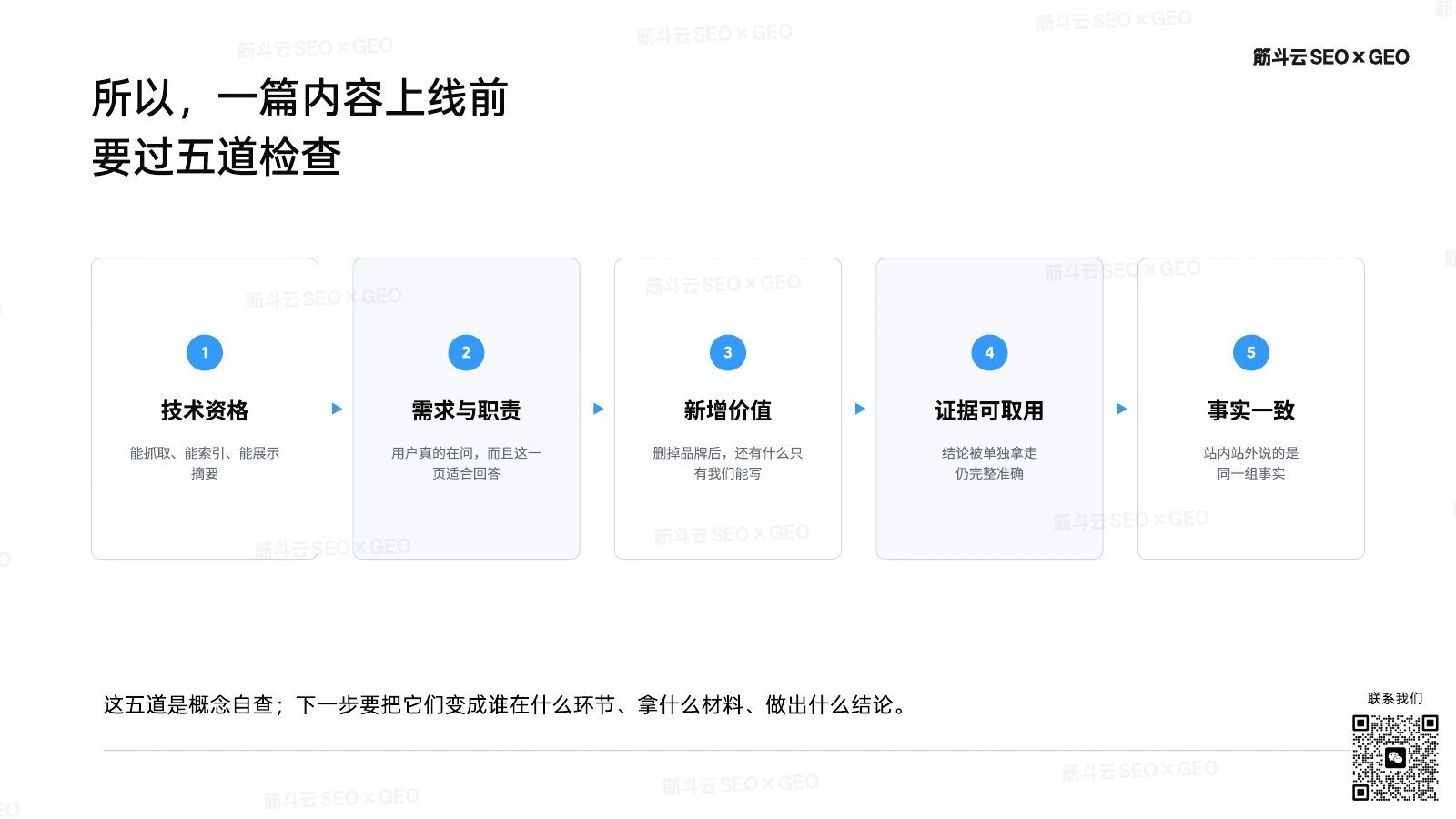
Slide 20 of the public deck: the five checks every page must pass before publishing (Chinese slide from the conference).
Whether a draft is written by a human or assisted by AI, the writer and reviewer check five gates before it goes live:
- Technical eligibility: Can the page be crawled and indexed, and is it eligible to display a search snippet?
- Demand and page role: Are real users asking this question, is this page type the right place to answer it, and does it avoid cannibalizing an existing URL on our site?
- Added value: After running the deletion test and removing our brand name, what information on this page could only have been written by us?
- Extractable evidence: If an AI engine or another site quotes a key conclusion or table on its own, does it remain complete, accurate, and attached to its operating conditions? (See my guide on content chunking and extractability.)
- Fact consistency: Do the numbers, specs, and boundaries on this page match our canonical claim table, product feeds, and off-site channels?
Why enforce such a strict gate now? Because once AI drove the cost of generating paragraphs down to near zero, spinning up more URLs stopped being an advantage. What is scarce now is a page that deserves to exist on its own.
During the talk, I shared a real example of content imbalance from a cross-border DTC brand. Their site had over 1,000 blog posts—every single one neatly formatted and over 1,500 words long. Yet when we checked the three questions customers asked support every single day (Can I bring this device on a plane? Can it power my CPAP machine overnight? How much battery capacity does it lose at -10°C?), not a single post among those 1,000 articles answered them with real test data and airline rules. The team spent a full year optimizing article headcount while completely missing the decisions buyers needed to make before paying. Mass-producing templated, near-duplicate pages like that is also exactly what Google’s September 2026 spam update targeted.
Before creating any new URL, ask three questions: What specific problem does it solve? What new facts does it add compared with pages we already have? Why does the user need a separate page for this? If you cannot answer all three, strengthen an existing core page instead.
From “delivering an article” to “delivering a Topic Pack”
If content production still ends with an editor handing over a single Word document, neither evidence networks nor cross-channel consistency will survive in practice. That is why the second half of my talk focused on team workflow: upgrading the content team’s deliverable from “one article” to a five-part Topic Pack.
For any core business topic, a complete Topic Pack contains five deliverables:
- Claim and Fact Table: The factual foundation. It lists core conclusions, product specs, test data, source documents, operating conditions, non-extrapolation boundaries, owners, reviewers, expiration dates, and prohibited exaggerations.
- Demand and Page Map: Defines where this knowledge belongs. It maps target keywords, Search Console queries, buyer decision stages, page types, target URLs, old pages to merge, internal link flows, and the commercial destination page.
- Master Answer Brief: Instead of “write a 2,000-word post,” it specifies the buyer problem being solved, the brand’s core thesis, mandatory facts to include, counterexamples and limits that must be acknowledged, required comparison dimensions, and the exact decision the reader should be able to complete after reading.
- Reusable Evidence Blocks: Pre-verified building blocks—standard comparison tables, lab numbers, engineer explanations, before/after photos, customer scenario cases, risk callouts, formulas, or step-by-step SOPs.
- Channel Cards: Breaks the four items above into ready-to-use packets for each downstream team.
Take our earlier “home theater seating material durability” example. Once product and engineering confirm the material specs, abrasion tests, cleaning methods, and warranty boundaries in the claim table, ten different roles pull from that same package:
| Team / Role | What they pull from the Topic Pack | What they produce |
|---|---|---|
| Product / Engineering | Claim table, open question list, update triggers | Confirm spec accuracy, supply lab test conditions and sample photos |
| SEO Team | Demand and page map, page roles, URL and internal link plan | Plan the material selection hub page, product spec tables, and two comparison pages |
| Content Writers | Master answer brief, reusable evidence blocks, boundary rules | Write the complete buying guide with stated conditions and disqualifiers |
| Video Team | Core test numbers, visual proof requirements, cleaning steps | Film an uncut stain-cleaning test and surface abrasion test |
| Social Team | Scenario hooks and pain-point conclusions | Create posts and short videos around “why pet owners shouldn’t look only at the ‘genuine leather’ label” |
| Sales Team | Objection cards, competitor comparison talking points, fit table | Answer buyer hesitations on pets, humid summers, and daily heavy use with verified facts |
| Customer Support | Operating conditions, troubleshooting, and care steps | Turn cleaning warnings and warranty boundaries into standard help docs to cut avoidable returns |
| PR / Media | Data story, test methodology, link to official source of truth | Pitch industry benchmark findings on material wear and breathability to trade media |
| Brand / Legal | Approved claims, operating conditions, prohibited claims list | Review superlative wording and warranty promises to prevent compliance and support disputes |
| Dev / Data | Feed attributes, structured data, Asset IDs and Claim IDs | Keep page copy, Schema, and Merchant Center feeds aligned; pipe channel performance back to the table |
The most important loop in this workflow is reverse feedback. When sales hears a new competitor comparison on calls, support notices buyers misreading a spec, social comments surface a new usage scenario, or product switches material suppliers, those frontline signals flow straight back into the question map and claim table. The next time the team updates content, they build on accumulated company knowledge instead of starting from scratch with a fresh keyword search.
Pages must work for AI agents as well as human readers
On slide 25, I dedicated a section to preparing pages for the agentic era: we used to care only whether machines could read a page; now AI agents are starting to act on pages on the user’s behalf.
Whether through Google’s agentic experiences in AI Mode and the Universal Commerce Protocol (UCP), browser-native WebMCP drafts, OpenAI’s Computer-Using Agent, or Shopify’s Agentic Storefronts, software agents are increasingly handling five tasks for buyers: comparing products, filling out forms, adding items to cart, submitting checkout, and booking appointments.
That adds a practical engineering question beyond readable prose: can an AI agent execute the next step on your page without failing? During technical and UX audits, we check four areas:
- Explicit button and action labels: Does a button say a vague “Submit,” or does it clearly state “Request a Custom Quote” or “Book a 15-Minute Demo”? Avoid styling semantic-free
<div>elements with fragile hover states as fake buttons, which frequently break agents that rely on the DOM and Accessibility Tree. - Clear form labels and post-submission expectations: Can a machine read every form field label unambiguously? Is it clear who will contact the user after submission, via email or phone, within what timeframe, and whether the request can be modified or canceled?
- Immediate, machine-readable state feedback: Can an agent tell which size or configuration option is currently selected, whether the item is in stock or on backorder, whether a click succeeded, and what specific error occurred if validation failed?
- Strict cross-channel data alignment: Do your visible page copy, Product Schema, product feed, and Merchant Center data show the exact same stock status, current price, compare-at price, order status, and return/warranty policies?
As I noted on stage, “agent readiness” is not a Google search ranking factor. Making your buttons and forms clearer will not automatically push a page to position #1. What it determines is whether a high-intent transaction succeeds when an AI agent brings a buyer to your store—or gets abandoned midway because your DOM state or pricing data conflicted.
Measure across four layers—and enforce eight sampling rules
Once your pages and Topic Packs are live, how do you measure results? On slides 26–28, I laid out our core rule: never compress everything into a single black-box “AI visibility score.” Separate observation into four distinct layers: demand, search visibility, AI answer visibility, and business outcomes.
Why shouldn’t you rely on a single composite score? Because the AI search landscape and its answers shift constantly. Similarweb web traffic data from June 2025 to May 2026 shows that while monthly web visits across AI platforms grew 70% year-over-year to 9.5 billion, platform share reshuffled within twelve months (ChatGPT shifted from ~76% to 53%, Gemini rose from 8.6% to 27.5%, with Claude and Perplexity also moving), while the share of US ChatGPT prompts producing citations rose from 1.6% to 6.8%. Ask the same question across two engines, two countries, two months, or even three times in one afternoon, and both the wording and cited URLs can change.
Look at what official analytics tools currently give us—and what they still hide:
- What we already have: Google Search Console launched its generative AI performance reporting in June 2026, showing impressions from AI Overviews and AI Mode by page, country, device, and date; GA4 includes a default
AI Assistantschannel that captures referred visits from ChatGPT, Gemini, DeepSeek, Copilot, Perplexity, Grok, and others (you can pair our GA4 AI Traffic Tracker and AI Crawler Log Analyzer to reconcile bot crawl volume with actual referral sessions). - What we still do not get: No first-party platform hands over a complete list of user prompts; Google’s AI Overviews and AI Mode clicks are still rolled into standard
Organic Searchin GSC; and many buyers read an AI recommendation and then search your brand name or type your URL directly, creating zero-click assisted conversions that default GA4 attribution misses.
Because of those gaps, we review performance across four separate layers and enforce strict AI sampling rules:
| Layer | Core question | Metrics and checks |
|---|---|---|
| 1. Demand | Are users actually asking this question? | Keyword trends, new queries in Search Console, sales objection logs, and support ticket volume |
| 2. Search visibility | Did the page enter the candidate pool and win positions? | Index status, organic impressions and clicks, ranking distribution, which URL ranks, and internal cannibalization checks |
| 3. AI answer visibility | Did our brand and facts make it into the answer? | Separate three things: Brand mention (is our name present?), Source citation (is our site or a third party linked?), and Fact adoption (did the answer use our numbers accurately?) |
| 4. Business outcomes | Did this work help the business? | Visits to product/service pages, branded search lift, assisted conversions, sales/support adoption of the Topic Pack, and fewer wrong-fit returns or repeat tickets |
Whenever our team runs manual or scripted sampling for Layer 3 (AI answer visibility), every internal report must record eight sampling conditions: engine and model version, test location (use our UULE Generator when checking localized Google results), language, test date, whether conversation history was cleared, whether web search was enabled, the fixed prompt list, and the number of repeat runs per prompt.
Being mentioned is not being cited, being cited is not having your facts adopted, and having your facts adopted does not automatically equal revenue. A single screenshot of a favorable AI answer only documents one moment in time; it neither proves stable visibility nor proves which edit caused the change. Locking down those eight sampling conditions and tracking the same prompt cluster monthly is what reveals where the pipeline is actually stuck.
What this means for your team
If you lead content or SEO for an e-commerce store or cross-border brand, you do not need to throw out your entire roadmap next Monday, and you certainly do not need a goal like “generate 200 AI blog posts a month.” Pick your highest-AOV product line—the one where buyers ask the most questions before paying—and run one topic through these five steps first:
- Map one real question network: Sit down with sales and customer support for 30 minutes. List the 10 specific questions buyers ask right before purchasing (covering scenarios, comparisons, and warranty worries), check Search Console to see which existing pages answer them, and merge thin, overlapping posts.
- Run the deletion test on your top 3 guides: Take your three highest-traffic buying guides or comparison pages, hide your brand name, cut the generic industry filler anyone could write, and sit with a product manager or engineer to add test conditions, real measurements, disqualifiers, and warranty boundaries.
- Stand up your first claim table: Even in a simple spreadsheet, assign Claim IDs to the 20 most important specs and conclusions for that product line. Record the canonical owner URL, referencing pages, effective date, and verifier, then fix outdated prices and conflicting specs across old blog posts and FAQs.
- Trace citations for those 10 core questions: Run the 10 questions through Google AI Mode, ChatGPT, and Perplexity. Open every cited URL to see which claims rely solely on your own site and which third-party reviews still reference a discontinued model from three years ago. Turn those gaps into next month’s evidence-building list for PR, reviews, and content.
- Enforce the five pre-publish checks and monthly sampling rules: Run every new draft through technical eligibility, demand and role, added value, extractable evidence, and fact consistency before publishing; track mentions, citations, and fact adoption monthly under fixed sampling conditions, and feed frontline objections back into your claim table.
AI has driven the cost of stringing together fluent sentences down to nearly zero, but it has not lowered the cost of uncovering real buyer questions, running honest product tests, and standing behind your claims. When you stop treating content as disposable articles paid by the word and start managing it as a verifiable, reusable Topic Pack shared across teams, both Google rankings and AI citations follow naturally.

Speaking at the conference in Shenzhen on August 12, 2026.
For experienced practitioners: 30-slide deck structure and cited research
This article expands on the 30-slide public deck from my August 12, 2026 talk at the Yiguo SEO × GEO Technical Conference, One Piece of Content, Two Wins: Ranking on Google and Getting Cited by AI. The table below maps each section of this post to the corresponding slides and primary sources:
| Article section | Slide numbers | Core content and cited sources |
|---|---|---|
| Why a page can rank without getting cited by AI | Slides 1–5 | Page competition (Page/URL) vs. fact selection (Claim/Fact/Evidence); Seer Interactive AIO Impact on Google CTR 2026 update (53 brands, 5.47M queries); Ahrefs July 2025 vs. 2026 AIO citation overlap with organic top 10; Google Search Central AI features and your website (updated 2026-07-10) five-step pipeline |
| Expanding from keywords to the user’s question network | Slides 6–7 | Query fan-out decision breakdown (six-part sub-question network for home theater seating materials); combining search demand, AI prompt demand, and business demand; four page-responsibility questions |
| Content matrices, topic clusters, and evidence networks | Slides 8–11 | Three-stage progression from Content Matrix to Hub & Spoke to Evidence Network; multi-industry AI citation domain study (Reddit, LinkedIn, YouTube citation share and official-site share ranging from 74.7% in higher education to 0.0% in B2B tech services); five criteria for a cluster “center of gravity” page |
| Information Gain: Use the “deletion test” to strip out filler | Slides 12–13 | Editorial deletion test; Danny Sullivan’s April and July 2026 guidance on non-commodity content (unique, specific, real experience); Aggarwal et al., GEO: Generative Engine Optimization (IIT Delhi / Princeton, KDD 2024, GEO-bench 10,000 queries and Perplexity live tests); 2×2 Demand × Evidence matrix |
| Govern dozens of pages with one eight-field claim table | Slides 14–16 | Eight-field claim table (Claim ID, exact claim text, canonical owner page, referencing pages, evidence and conditions, effective date, owner, status) and four operating rules; five review triggers; six cross-channel consistency requirements |
| Trace AI citations back to their sources | Slides 17–19 | Seven citation-traceability questions; primary sources and supporting proof across seven claim types; 11-column Citation Traceability Sheet and cross-team workflow |
| Five pre-publish checks before any page goes live | Slides 20–21 | Five pre-publish checks (technical eligibility, demand and role, added value, extractable evidence, fact consistency); three questions before creating a new URL and the case study of a 1,000-post DTC blog missing three core buying questions |
| From “delivering an article” to “delivering a Topic Pack” | Slides 22–24 | Five Topic Pack deliverables (Claim and Fact Table, Demand and Page Map, Master Answer Brief, Reusable Evidence Blocks, Channel Cards); role breakdown across ten teams and reverse feedback loop |
| Pages must work for AI agents as well as human readers | Slide 25 | Agentic UX and technical readiness checklist; informed by Google’s 2026 guidance on agentic experiences, web.dev, OpenAI Computer-Using Agent, WCAG state semantics, and Shopify Agentic Storefronts |
| Measure across four layers—and enforce eight sampling rules | Slides 26–29 | Four-layer measurement framework; Similarweb June 2025–May 2026 AI platform web traffic data (excluding mobile apps); Search Console generative AI performance report (launched June 2026) and GA4 AI Assistants channel limits; eight mandatory AI sampling conditions |
Note: Third-party industry studies and academic benchmark experiments cited in the deck are bound by their respective sample scopes, time windows (2025–2026), and methodologies. They are presented here with their original conditions intact and should not be treated as universal guarantees of Google’s internal ranking algorithms.
Follow on WeChat and keep the conversation going
If you work on technical SEO, GEO, Shopify, or cross-border content engineering, you can scan the QR code below to follow my WeChat Official Account “Linus SEO 海外流量玩家” (Chinese) for field notes and breakdowns.

You can also explore my About page, Selected Works, and Free SEO / GEO Tools to see what my team and I are building.
What I Shared at the Yiguo SEO × GEO Conference: Making Content Rank on Google and Get Cited by AI
https://www.linusseo.com/en/seo-geo-conference-content-talk/