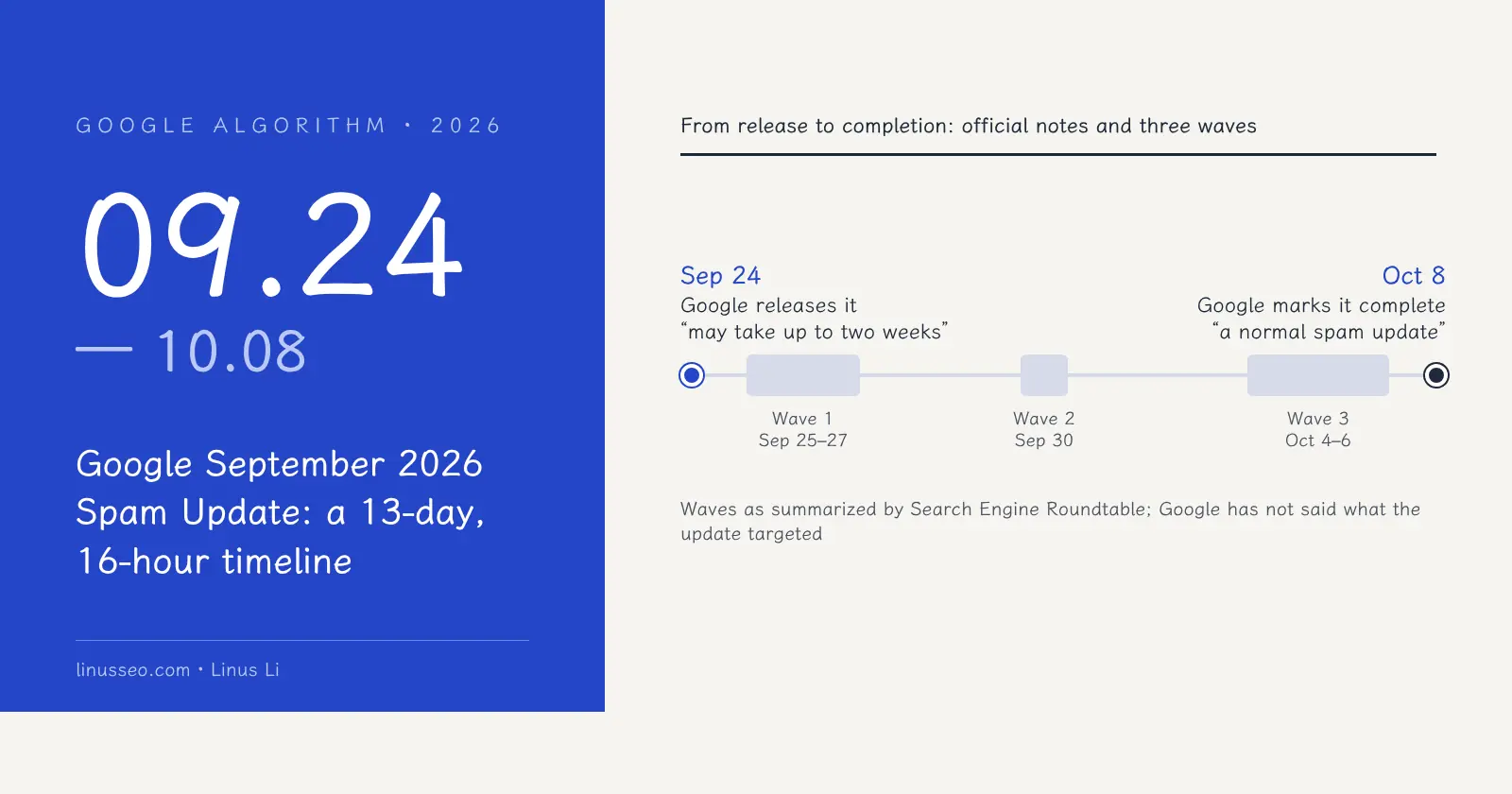
Google September 2026 Spam Update: A 13-Day, 16-Hour Timeline


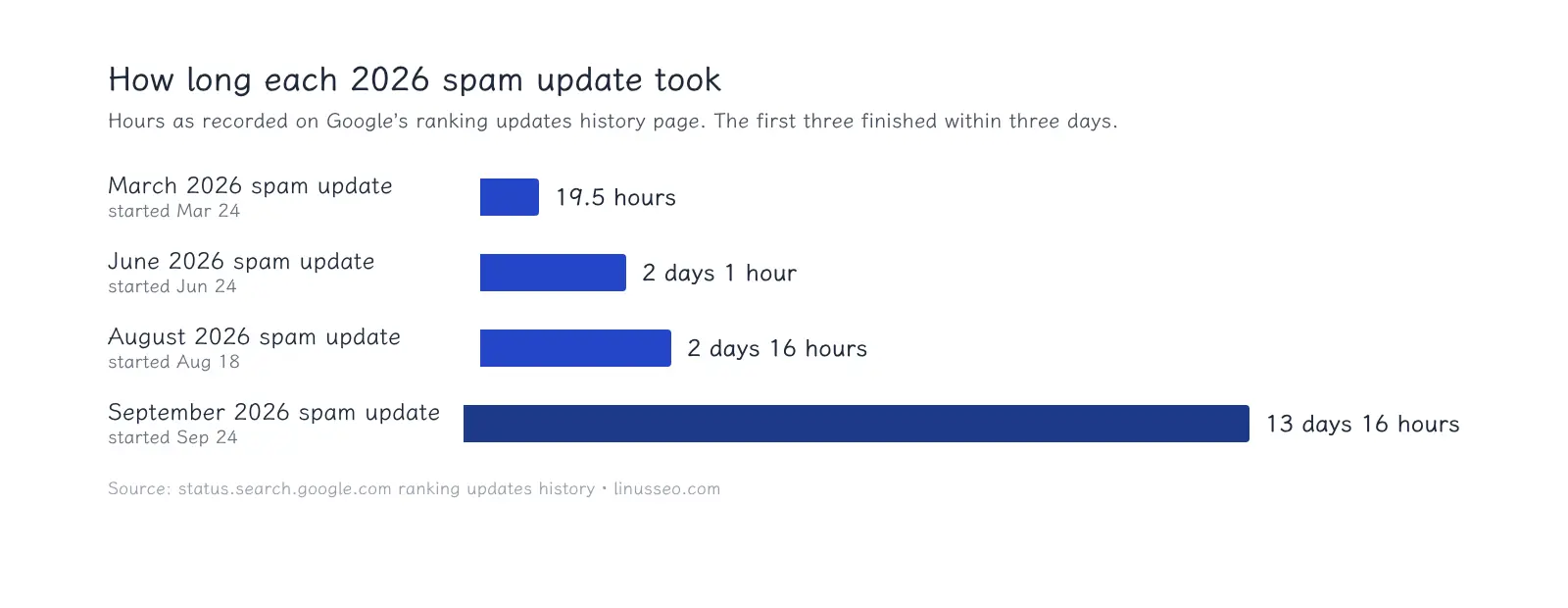
Google released the September 2026 spam update on September 24, 2026 and marked it complete on October 8. The rollout took 13 days 16 hours. It was the fourth spam update of 2026 and the first one this year to run longer than three days. The earlier three took 19.5 hours, 2 days 1 hour and 2 days 16 hours.
Where the first three spam updates of the year each wrapped up within three days, this one ran for nearly two weeks in three distinct waves. Mid-rollout, Google also revised its generative AI content guide and added a “main content” definition and a fake-author clause to the helpful content page. If your site lost traffic between late September and early October, the two easiest mistakes to make are treating the September 26 rank-tracker scraping glitch as a real demotion, and overhauling your whole site for a core update when an algorithmic filter only hit one templated directory.
Key points
- Google confirmed only a few things. The update was released on September 24, applies globally and to all languages, and could take up to two weeks. Google called it “a normal spam update” and marked it complete on October 8. It did not name a tactic, a scope or a fix.
- The industry saw three waves of volatility: September 25–27, September 30, and October 4–6. This is Search Engine Roundtable’s summary of tracker data and webmaster reports, not Google’s statement.
- The page type named most often is scaled templated content: pages generated per phone number, area code or city, plus unreviewed AI content and thin affiliate sites. These come from Lily Ray’s and Glenn Gabe’s case observations. Google has not confirmed them.
- Google changed two documents in the same period. The generative AI content guide, stamped October 1, now says manual fact-checking of AI content is “critical”. The helpful content page, stamped October 5 as of October 9, adds a definition of “main content” and a paragraph calling fabricated author profiles deception. Google has not linked either change to the update.
- Tracker data was unreliable during the rollout. From September 26, Google returned incomplete results to scrapers. Sistrix and SEOmonitor both published notices. Diagnose with Search Console, not tracker charts.
Who dropped and who gained
Aside from Google’s confirmation that link spam was not the target, everything below on affected page types, wave dates, documentation links and core update predictions comes from third-party trackers, webmaster reports and practitioner observations rather than official statements. As of mid-October 2026, no tool vendor had published a winners and losers domain list either.
| Page type | Who said so | Nature of evidence |
|---|---|---|
| Templated pages generated per phone number, area code or city | Lily Ray (Sep 28, Oct 4), Glenn Gabe (Sep 28) | Case observations, the most widely cited |
| Unreviewed AI content, thin affiliate sites | Glenn Gabe (Sep 28) | Case observations |
| Sites already hit by the August spam update falling further | Glenn Gabe (Sep 25, a visibility set of about 1,500 sites) | Aggregate observation, no figures published |
| Discover and Google News publishers | Several WebmasterWorld members (Sep 24 to Oct 8) | Self-reported single sites; Discover is volatile on its own |
| Link spam | Barry Schwartz relaying Google: not a target | Confirmed negative |
Two kinds of recoveries were recorded. First, Reddit’s AI-translated pages recovered in Italy, Germany, Brazil and France (Glenn Gabe, October 1; for context on how Reddit content and anti-spam work in search and GEO, see our analysis of Reddit spam defenses and GEO). Second, some sites hit in August later rose again; Gabe shared such cases, though public material does not include specific click figures. One WebmasterWorld member also reported traffic up more than 35% on October 8.
As of October 2026, public material is not enough to tie the site reputation or expired domain policies to this update. Semrush’s article notes it was the first spam update since the August 28 revision of the site reputation policy, with no official link between the two.
Which spam policy each observed page type maps to
The table maps the observed page types to the wording of Google’s spam policies so you can check your own pages against each clause.
| Observed page type | Closest policy | What the policy says |
|---|---|---|
| Pages generated per phone number, area code or city that differ only by a few variables | Scaled content abuse; doorway abuse when pages exist only to rank for near-identical queries | “Many pages are generated for the primary purpose of manipulating search rankings”, whether by AI, scripts or people; doorways are “pages created to rank for specific, similar search queries” |
| Unreviewed AI content | Scaled content abuse | The policy is about volume without value for users, not about whether AI was used |
| Thin affiliate sites | Thin affiliation | Affiliate pages that copy merchant descriptions and add nothing |
| Site reputation abuse, expired domain abuse | The clauses exist, but no expert or dataset links them to this update | Not listed as targets in this article |
| Link spam | Link spam | Google told Search Engine Roundtable this update does not target link spam |
Timeline
- Sep 4 – Sep 23CommunityUnconfirmed volatility before the announcement
Search Engine Roundtable reported ranking volatility on September 4–13, September 15 and September 22–24. On September 12, Marie Haynes wrote on X that there had been an "unannounced, but significant change in Google's algorithms in early September", and that one site she analyzed "clearly had programmatic scaled content". Google later told Search Engine Roundtable that the pre-announcement volatility was not this update.
- Sep 24, 09:15 PDTOfficialGoogle releases the September 2026 spam update
The Search Status Dashboard entry reads: "Released the September 2026 spam update, which applies globally and to all languages. The rollout may take up to two weeks to complete." Google's LinkedIn post added: "This is a normal spam update." Status page
- Sep 24GooglerJohn Mueller confirms "two weeks" is not a typo
On Bluesky, Barry Schwartz asked John Mueller whether two weeks was a typo, since the previous three spam updates took about two days. Mueller replied: "Yes, it's likely to take longer than some of the previous ones." Bluesky thread
- Sep 24MediaSearch Engine Roundtable and Search Engine Journal report the launch
Barry Schwartz obtained a few extra details from Google: the update does not target link spam, Google would not say what share of queries was affected, and recovery "can take many months". SEJ listed the durations of the year's first three spam updates: 19 hours 30 minutes in March, 2 days 1 hour in June, 2 days 16 hours in August. SER · SEJ
- Sep 24 – Sep 25CommunityWebmasterWorld members complain about Discover
On the day of the announcement, posts in the WebmasterWorld September thread were mostly about Discover: "Discover down 70%", "Today after 11 hours traffic -80%", "I'm currently down 48% (my ad revenue for September has literally been cut in half so far)". One member wrote after the announcement: "Another phenomenally broken 'spam update' that does the opposite of combating spam." WebmasterWorld
- Sep 25 – Sep 27Wave 1Heavy weekend volatility, trackers spike together
Semrush Sensor jumped from 22 to 94 on September 25, stayed at 94 on the 26th and read 76 on the 27th. AccuRanker was at full scale on the 26th and 27th; Wincher and Zutrix were close to it. Barry Schwartz summarized on September 28: "The first stage of the Google September 2026 Spam update seems to have been felt in a big way starting Friday, September 25th, with even more movement on Saturday, September 26th and then ending on Sunday, September 27th." SER
- Sep 26ToolGoogle starts returning distorted results to scrapers
Sistrix's status page noted on September 26: "Google is currently returning incomplete or distorted search results in some cases." SEOmonitor explained that from September 26 "Google began sending back incomplete and incorrect results, which showed up as sudden drops or spikes", that real searchers did not see these changes, and that affected keywords kept their September 25 ranks. Part of the tracker volatility in this period is therefore a scraping problem rather than a ranking change. Sistrix · SEOmonitor
- Sep 28CommunityGlenn Gabe and Lily Ray publish the first case observations
Glenn Gabe wrote on X: "This weekend it really showed itself. I'm seeing big drops across a number of sites. And that's across verticals and countries." He called the shape of the drops "Mt. AI" and "Mt. Programmatic", referring to traffic curves that climbed steeply on bulk-generated pages and then plunged vertically back to baseline during the update, and said he was mostly seeing scaled content abuse, programmatic expansion and thin affiliate sites, as in August. Lily Ray wrote the same day: "Early signs that the current Google Spam update is hitting sites with highly templated, programmatic, (probably) AI-generated pages, like one page for every phone number/area code." Gabe · Ray
- Sep 29ToolDiib publishes early data from 32,569 sites
Diib compared September 24–26 with the same days a week earlier. The median share of visits from unpaid Google search fell from 34% to 31%, and the share of sites that lost half or more of their search share rose from 5% to 10%. Diib noted this was an early reading and could not show which sites Google's spam systems specifically targeted. Diib
- Sep 30Wave 2Several site owners drop on the same day
Semrush Sensor went from 54 on the 29th back to 91 on the 30th and 93 on October 1. Glenn Gabe wrote on October 1: "I received emails from several site owners explaining they saw a huge drop right on 9/30." WebmasterWorld had several posts that day saying "Discover and News traffic has again vanished." Barry Schwartz recorded September 30 as phase two. SER
- Sep 30 – Oct 2Event recapSearch Central Live Barcelona: "scaled content is now more of a problem than link spam"
According to We Are Roast's notes, Gary Illyes said "scaled content is now becoming more of a problem than link spam" and that core updates "target content at page level, not at domain level". Duy Nguyen said "there have been more spam updates recently because there is so much more new content" and that the team "is now using AI to help catch more of it". Eric Murillo of the Discover trust and safety team said "AI slop is increasing, which means more poor quality content in the feed." Roast recap
- Oct 1CommunityGlenn Gabe: Reddit's AI translations are back
Gabe observed that Reddit's AI-translated pages, which fell hard in the May core update and the June spam update, were rising again in Italy, Germany, Brazil, France and other countries. He asked: "So did Reddit complain enough to Google or is this just Google's systems rewarding those translations?" It is one of the few recorded recoveries of this update. X
- Oct 1OfficialGoogle revises its generative AI content guide: fact-checking is "critical"
The revised page says that "generative models don't retrieve facts, but predict a likely sequence of words", so "it is critical to manually factcheck and review all AI-generated content for accuracy and trustworthiness before publishing". Google's stated reason was to bring the documentation in line with its developer event presentations. Barry Schwartz noted that Google rarely uses the word "critical" in its documentation and wondered whether the spam update was going after this kind of content. Document · SER
- Oct 1 – Oct 2OfficialThe helpful content page adds a "main content" definition and a fake-author clause
The page now defines main content as "any part of the web page that directly helps the page achieve its purpose" and lists four attributes quality raters look at: effort, originality, talent or skill, and accuracy. On effort it says that "automatically generating pages from feeds or using generative AI to produce large amounts of text without manual oversight or curation represents little to no effort". A new paragraph says that "fabricating creator profiles (such as by using AI-generated headshots, made-up names, or false credentials to make content appear as if it was written by human experts) is a form of deception" and "is a signal of a low-quality page". As of October 9, the page was stamped October 5; the fake-author paragraph was not in SER's October 2 report and was covered separately on October 6. Document · SER Oct 2 · SER Oct 6
- Oct 2 – Oct 4CommunitySeveral experts predict a core update
Marie Haynes wrote on October 2: "I predict we will soon have a significant core update!" Glenn Gabe wrote: "I feel like we are going to see a very big update from Google." Lily Ray published a Substack post on October 4 titled "Prediction: the next massive Google update is around the corner", arguing that the two-week window is the one Google uses for core updates and that the gaps between this year's spam updates shrank from 92 to 55 to 37 days. Ray · Haynes
- Oct 4 – Oct 6Wave 3The final wave; Advanced Web Ranking hits its ceiling
Semrush Sensor fell to 32 on October 3, then read 72, 76 and 94 on October 4, 5 and 6. Advanced Web Ranking rose from 39.4 on the 3rd to 94.7 on the 4th and 100 on the 7th. Barry Schwartz judged on October 6: "I suspect this is it - we are pretty much done with this spam update." On WebmasterWorld, one news publisher said earnings were "currently down 80%"; another said "Discover traffic is picking up again." SER
- Oct 7CommunityMarie Haynes: a clear rise in manual action requests
Haynes wrote on X: "Have had a big increase in requests for help with manual actions lately", going "from essentially no requests to several per week", for thin content, pure spam and scaled content, and "most of these sites are legitimate long standing businesses". She added that it is "not nearly as high as the pre-Penguin manual action era". Daniel Foley Carter wrote the same day that manual actions are "often bringing entire sites down with some losing 90%+ of their traffic overnight". Haynes · SER
- Oct 8, 01:00 / 01:37 PDTOfficialGoogle posts the completion note
The status page records the incident ending at 01:00 PDT and the completion note at 01:37 PDT: "The rollout was complete as of October 8, 2026." The ranking updates history page lists the duration as 13 days 16 hours. In Beijing time the note was posted at 16:37 on October 8. Updates history
- Oct 8MediaTrade press wrap-ups
Barry Schwartz wrote: "I am not sure why this is 'normal' when it took two weeks to roll out instead of two days but what do I know." He summarized three impact windows: September 25–27, September 30 and October 4–6. SEJ pointed out that, as of publication, neither the documentation nor the dashboard explained what the update targeted or why it ran longer than the earlier 2026 updates. SER · SEJ
 Search Engine Roundtable
 Google
 John Mueller
 Search Engine Journal
 WebmasterWorld
 Sistrix
 SEOmonitor
 Glenn Gabe
 Lily Ray
 Diib
 We Are Roast
 Marie Haynes
Note: Each entry is tagged by source type. "Official" is a Google announcement or document. "Media" is trade press reporting. "Community" is an SEO expert, a webmaster forum or a social post. "Tool" is rank tracker data. "Googler" is a Google employee's public reply on a personal account, grouped under community. "Event recap" is a third party's notes from a Google event, grouped under media. The "Wave" labels are this article's summary of media, tool and community information, not a separate source type. Times are US Pacific. Add 15 hours for Beijing time: 09:15 PDT on September 24 is 00:15 on September 25 in Beijing.
Three waves as seen by rank trackers
The chart below shows Semrush Sensor’s daily reading from September 15 to October 8, taken from the Wireboard aggregate charts embedded in Search Engine Roundtable’s reports. The three shaded bands are the waves Barry Schwartz summarized.
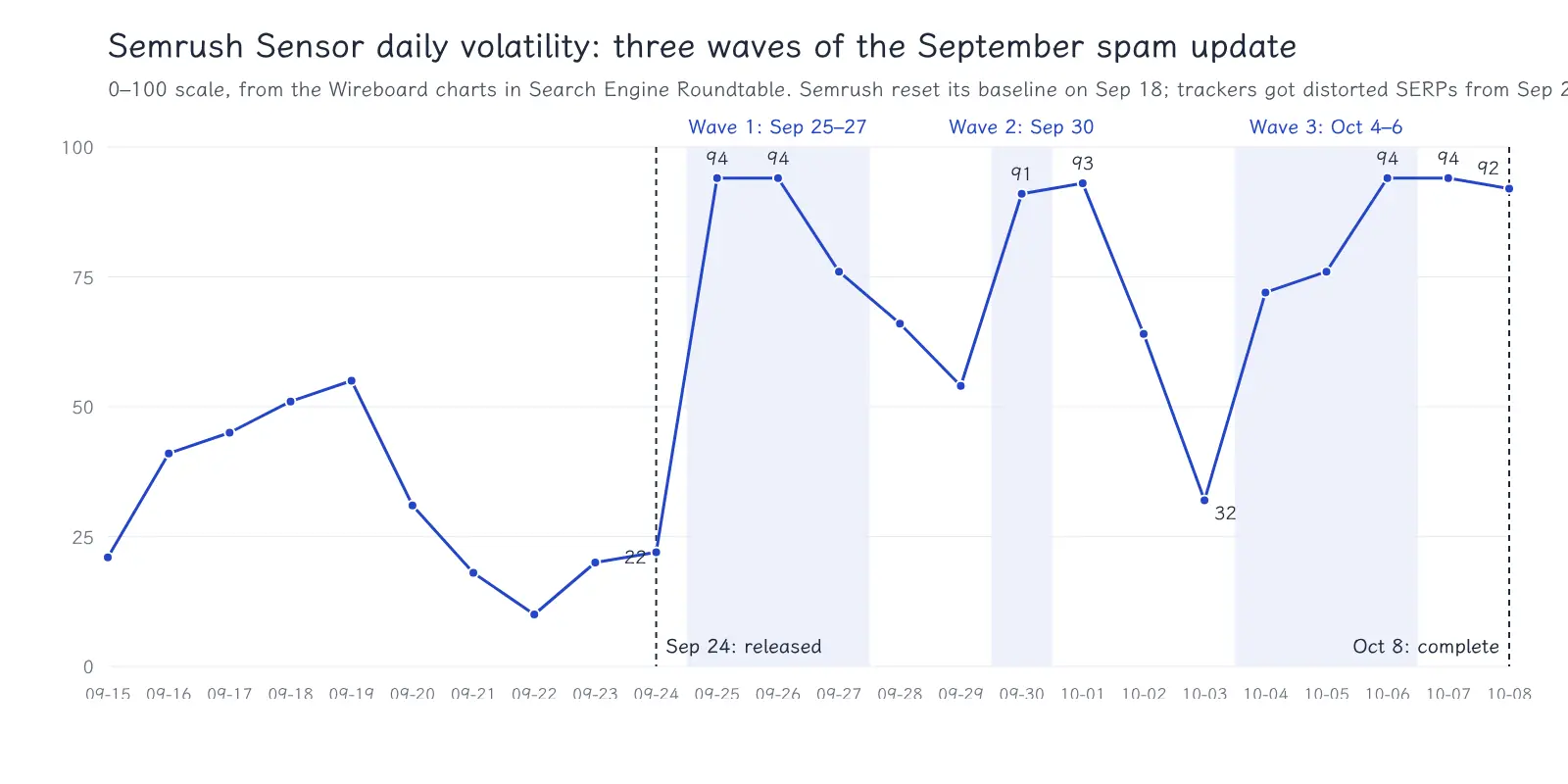
Two caveats apply. First, Semrush recalculated its market baselines on September 18, so readings before and after that date are not directly comparable.
Second, Google returned distorted results to scrapers from September 26, as the Sistrix status page logged that day. According to seo-kreativ’s compilation, Sistrix’s German mobile index hit an anomalous 136.34 on September 27 against a prior 90-day maximum of 35.68. Some of the spikes in tracker charts are scraping artifacts, not ranking changes.
The next chart puts eight major trackers side by side, one per panel, each on its own scale. They do not move in step. Semrush Sensor and the Wireboard aggregate show three peaks; Advanced Web Ranking did not rise until October 4; Wincher has been pinned at full scale since September 29 and no longer discriminates; Sistrix and Similarweb read low and only show direction. The same update looks very different from tracker to tracker, which is why reading one tool alone is easy to misjudge.
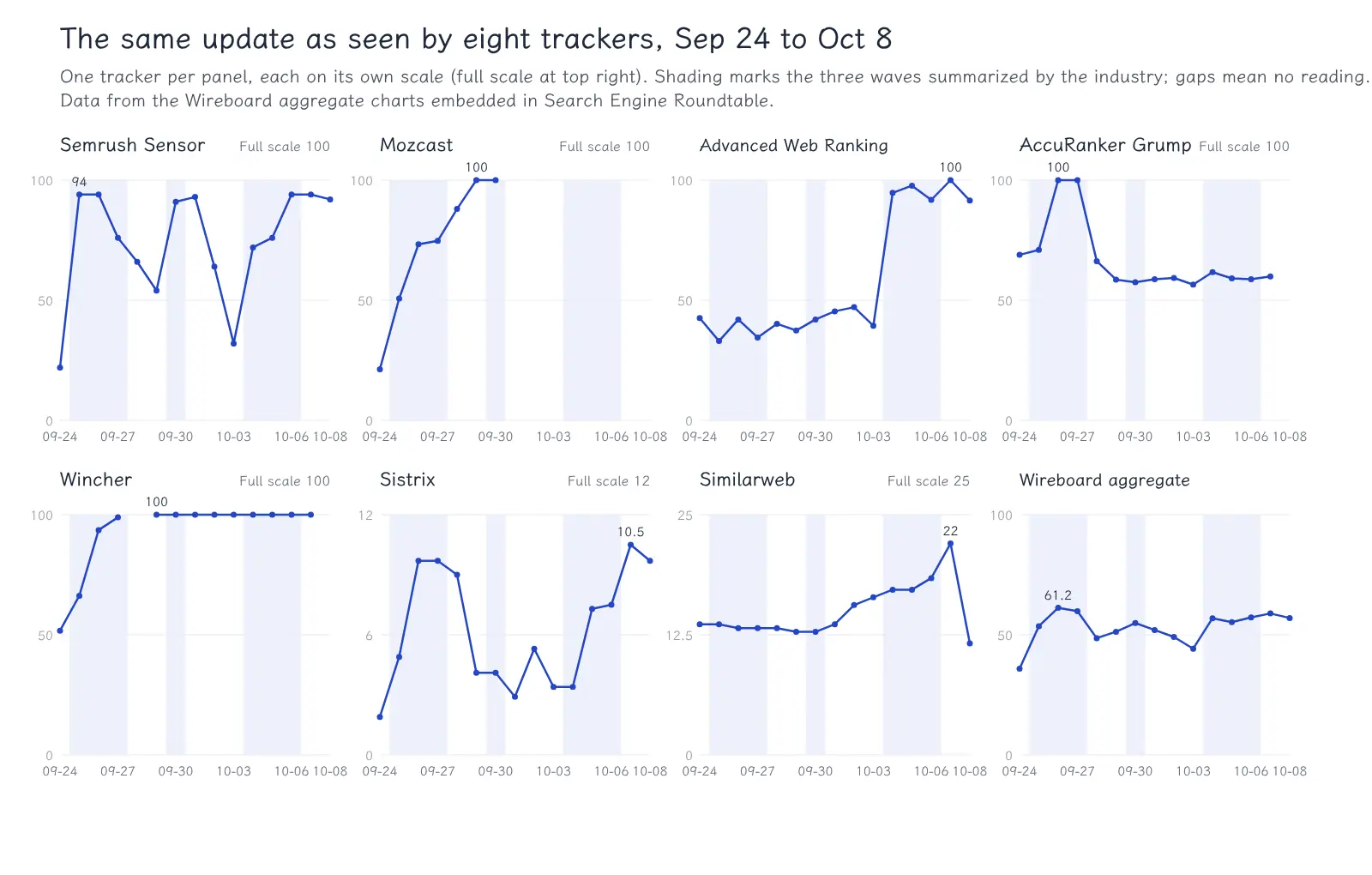
So “rank trackers are unreliable” needs to be split in two. What is unreliable is any single day’s reading and any comparison across tools: the scraping distortion from September 26, the Semrush baseline reset on September 18 and the aggregate values that were backfilled afterwards all mean that one tool’s number on one day is not evidence on its own. The overall trend is reliable. The three wave dates show up independently in Semrush, AccuRanker, AWR and the aggregate index, and they line up with site owners’ emails, the experts’ case studies and the WebmasterWorld posts. Several independent sources pointing the same way is not one tool’s artifact. The distortion also affected only tools that scrape result pages; Search Console, Diib’s GA-connected sample and traffic estimates such as Similarweb were not touched by it. And it had a clear start and end: SEOmonitor reprocessed its data by September 28. The tools were not broken for the duration.
For practitioners: daily readings from the main trackers
The values below are those plotted on the Wireboard aggregate charts embedded in Search Engine Roundtable’s articles, in each tool’s own display scale; “-“ means no reading that day. Some tools use 0 to 100, while Sistrix and others can exceed 100. The tools differ in metric, baseline, sampling timezone and update time, so daily points are a trend reference and not strictly comparable across columns. Mangools, Algoroo, CognitiveSEO, DataForSEO, Serpstat and Zutrix are omitted.
| Date | Semrush | Mozcast | AWR | AccuRanker | Wincher | Sistrix | Similarweb | Aggregate |
|---|---|---|---|---|---|---|---|---|
| 09-24 | 22 | 21.3 | 42.6 | 68.9 | 51.7 | 1.9 | 13.6 | 35.9 |
| 09-25 | 94 | 50.7 | 33.0 | 71.0 | 66.3 | 4.9 | 13.6 | 53.6 |
| 09-26 | 94 | 73.3 | 42.0 | 100 | 93.6 | 9.7 | 13.2 | 61.2 |
| 09-27 | 76 | 74.7 | 34.5 | 100 | 98.9 | 9.7 | 13.2 | 59.8 |
| 09-28 | 66 | 88 | 40.2 | 66.3 | - | 9.0 | 13.2 | 48.6 |
| 09-29 | 54 | 100 | 37.4 | 58.6 | 100 | 4.1 | 12.8 | 51.3 |
| 09-30 | 91 | 100 | 42.0 | 57.5 | 100 | 4.1 | 12.8 | 54.9 |
| 10-01 | 93 | - | 45.4 | 58.8 | 100 | 2.9 | 13.6 | 52.0 |
| 10-02 | 64 | - | 47.1 | 59.3 | 100 | 5.3 | 15.6 | 49.1 |
| 10-03 | 32 | - | 39.4 | 56.5 | 100 | 3.4 | 16.4 | 44.2 |
| 10-04 | 72 | - | 94.7 | 61.7 | 100 | 3.4 | 17.2 | 56.9 |
| 10-05 | 76 | - | 97.7 | 59.1 | 100 | 7.3 | 17.2 | 55.3 |
| 10-06 | 94 | - | 91.8 | 58.8 | 100 | 7.5 | 18.4 | 57.2 |
| 10-07 | 94 | - | 100 | 59.9 | 100 | 10.5 | 22.0 | 58.9 |
| 10-08 | 92 | - | 91.5 | - | - | 9.7 | 11.6 | 57.0 |
Mozcast and Mangools did not update after September 30; the September 30 readings are kept in the table. In SER articles published after September 28, the aggregate values for September 25–27 were backfilled to 54.2, 62.3 and 60.1. Semrush Sensor desktop readings by market, compiled by seo-kreativ: US 2.2 on September 24, 9.4 on the 25th, 9.4 on the 26th, 7.6 on the 27th, 9.1 on the 30th; Germany 8.5 on October 4, 9.0 on the 5th, 8.7 on the 6th, 6.4 on the 7th, 5.5 on the 8th. iSocialWeb’s sample of 24 projects and 698 keywords on Google Spain lost 4.2% of its top-10 keywords on the first full day against a daily median of 1.9%; the author notes that most of these were the usual short-lived drops that reverse within 48 hours and could not yet be attributed to the update.
How this differs from the three earlier 2026 updates
The first three spam updates of 2026 each finished within three days in a single burst of volatility, whereas this one took 13 days 16 hours and rolled out in three waves. A slide at Google’s Barcelona event still read “Spam updates roll out in 1-2 days” and “Core updates take 2-4 weeks to roll out” (per We Are Roast’s recap); as Barry Schwartz wrote on September 30, once Google announced a two-week window, “we are expecting to see multiple cycles”, and the later pattern matched.
By PPC Land’s count, this is the sixth-longest of 15 spam updates since June 2021. The longer ones, as recorded on Google’s ranking updates history page, are the December 2022 link spam update at 29 days, the August 2025 spam update at 26 days 15 hours, and the October 2023 and March 2024 updates at about 15 days each. PPC Land lists December 2022 as 19 days, which does not match Google’s record. The July 2021 link spam update ran about 29 days, but Google’s history page starts in November 2021, so that figure comes from industry records.
Because the duration entered core update territory, Barry Schwartz, Lily Ray, Marie Haynes, Glenn Gabe and WebmasterWorld members all debated whether this was a core update in disguise or whether one was about to land, while Google’s only public line remained “this is a normal spam update” (see Search Engine Watch’s wrap-up).
In my view, debating whether to label it “spam” or “core” misses the practical point: spam enforcement and content quality evaluation are converging. Putting three things from these two weeks side by side makes the direction clear: the rollout duration and multi-wave rhythm resembled a core update; the October 1 revision to the AI content guide stressed manual fact-checking before publication; and the helpful content documentation—originally written for the core ranking system—explicitly classified bulk generation from feeds or generative AI without human oversight as “little to no effort” and labeled fabricated author profiles as deception. Practitioners used to treat spam policy violations and low content quality as two separate buckets, but now that AI has made bulk page generation trivial, thin templated pages and scaled spam share the exact same production pipeline. For background on how Google’s AI spam-prevention system evolved alongside the 2024 abuse policies, see my SpamBrain overview on Jindouyun SEO (in Chinese).
How to tell whether your site was hit
Google will not tell you whether a given site was affected by a given update, so the only method is elimination. When all five conditions hold, this update is the main suspect. If any one fails, look for another cause first.
- The timing matches. In Search Console, impressions and clicks started falling on September 25–27, September 30 or October 4–6, and stayed down for several days rather than spiking for one. In Beijing time the update only started at 00:15 on September 25.
- The data comes from Search Console, not only from third-party tools. Scrapers received distorted results from September 26, so a drop that appears only in a tracker does not count yet.
- The affected pages share one template. Filtering the Performance report in Search Console by directory prefix or page regex shows the drop concentrated in a set of pages that differ only by variables, rather than spreading evenly across the site; you can also check Settings > Crawl stats to see whether Googlebot requests to that directory dropped in tandem.
- There is no manual action. The Manual actions report in Search Console is empty. If there is a notice, that is a different process; follow the notice.
- Other changes are ruled out. No redesign, migration, robots change or mass deletion in those two weeks, and no anomaly in server logs or crawl stats.
For practitioners: how a spam update drop differs from a core update drop
The two sets of documentation read differently. The core updates page says core updates “don’t target specific sites or individual web pages”, that pages which move down “aren’t necessarily bad”, that site owners should “avoid doing quick fix changes”, and that some changes take effect in days while others take months or wait for the next core update. The spam updates page says that “sites that violate our policies may rank lower in results or not appear in results at all”, that affected sites should review the spam policies, and that automated systems may take months to confirm compliance.
In practice, a core update drop usually looks like a broad downward shift in positions across a site or a topic, with the pages still indexed. A spam update drop more often looks like one class of pages disappearing from results at scale, concentrated in one template. Gary Illyes said in Barcelona that core updates “target content at page level, not at domain level”; that statement is a third-party record, grade B. These distinctions are rules of thumb, not Google’s criteria.
What it means for you
If the five-step check above points to pages generated in bulk by city, phone number, model or specification, you should audit that directory against the early-October revisions to the helpful content page, even though timing overlap alone cannot prove causation.
Test the template against the documentation’s four criteria (effort, originality, talent or skill, and accuracy): beyond swapping variables in the title and opening paragraph, does each page provide data, specification differences or test results that do not exist on sibling pages? When pages are generated in bulk from a feed, spreadsheet or AI prompt without human selection and fact-checking (including titles, meta descriptions, structured data and image alt text), they trip both the “little to no effort” quality standard and the scaled content abuse policy. Consolidating empty combination pages, adding real product or local data, or setting noindex on thin variants is much more effective than tweaking site-wide templates.
Use this window to audit your author pages and bylines as well. Personas built from AI-generated headshots, invented names or padded credentials (“John Smith, 10 years of industry experience”) are now explicitly called “deception” and “a signal of a low-quality page” in Google’s documentation. That playbook has been common on cross-border ecommerce sites; replacing fabricated experts with real team members, founders or product leads—even with modest titles—is far safer. After updating your author pages, run our Entity Consistency Checker to make sure the Person structured data matches across your site.
Finally, plan for a recovery window measured in months. Both Google’s documentation and its replies to the press state that automated systems need months of observation to confirm a site complies with the spam policies. If Search Console shows a manual action notice, file a reconsideration request once the cleanup is done; if the report is empty, the demotion is algorithmic and has no appeal form, so you can only clean up the affected directory, monitor crawl stats and index coverage, and wait for the system to re-evaluate.
FAQ
What did the September 2026 spam update target? Google has not said. It called the release “a normal spam update” and told Search Engine Roundtable it does not target link spam. Lily Ray, Glenn Gabe and others observed the largest drops on templated pages generated per phone number, area code or city, and on unreviewed AI content.
Do landing pages generated by city, model or specification have to be deleted? Not necessarily. The spam policies target bulk pages that add no standalone value. If each city or model page carries real local service details, distinct specifications, test data or inventory status, it is not scaled content abuse. Only pages that swap a few variables while keeping the same body text need to be consolidated, rewritten or marked noindex.
Does a sharp drop that appears only in rank trackers like Semrush or Sistrix mean my site was hit? Do not treat it as an update hit yet. From September 26, Google returned incomplete or distorted results to scrapers, and both Sistrix and SEOmonitor confirmed that some spikes during this window were scraping artifacts unseen by real users. Always verify impressions and clicks in Search Console first.
How do I tell a manual action apart from an algorithmic spam demotion? Check Security & Manual Actions > Manual actions in Search Console. If a notice appears there, a human reviewer flagged the site and you must submit a reconsideration request after fixing the issue. If the report is empty but a templated directory dropped between September 25 and October 8, it is an algorithmic action by automated systems such as SpamBrain; there is no appeal form, so you fix the pages and wait for recrawling and re-evaluation.
Appendix: evidence list
Claims in this article are graded by the site-wide standard into A (confirmed by Google), B (documented or participant record) and D (industry observation or speculation); this event involves no patents, so there are no grade C claims.
| Claim | Grade | Source |
|---|---|---|
| Released September 24 at 09:15 PDT, global, all languages, up to two weeks | A | Search Status Dashboard incident, first update |
| Incident ended October 8 at 01:00 PDT, completion note at 01:37 PDT, duration 13 days 16 hours | A | Search Status Dashboard incident, end time and completion note; ranking updates history |
| “This is a normal spam update” | A | Google Search Central on LinkedIn, as quoted by SER on September 24 |
| “Two weeks” is not a typo; longer than some previous ones | B | John Mueller, personal Bluesky reply, September 24 |
| Not targeting link spam; no query share; recovery takes many months | B | SER, September 24, “Quick facts”, Google’s replies relayed by the press |
| Durations of the first three 2026 updates: 19 h 30 min, 2 d 1 h, 2 d 16 h | A | SEJ, October 8, citing the ranking updates history |
| Affected sites should review the spam policies; improvement takes months | A | Google spam updates documentation |
| Manual fact-checking of AI content is “critical” | A | Using generative AI content, October 1 revision |
| Main content definition, four quality attributes, fake-author clause | A | Creating helpful content, page stamped 2026-10-05 as of 2026-10-09 |
| Illyes: scaled content more of a problem than link spam; Nguyen: AI used to catch spam | B | We Are Roast, Barcelona day 3 recap, no official transcript |
| Distorted results returned to trackers from September 26 | B | Sistrix status page; SEOmonitor explainer |
| Three waves: September 25–27, September 30, October 4–6 | D | SER, September 28, October 1, October 6, October 8; Schwartz notes the grouping assumes Google ran no other update during the rollout, which he could not verify |
| Scaled templated pages, unreviewed AI content and thin affiliate sites hit | D | Lily Ray, September 28; Glenn Gabe, September 28; Lily Ray on Substack, October 4 |
| Reddit’s AI-translated pages recovering | D | Glenn Gabe, October 1 |
| Diib: median share 34% to 31%, sites losing half 5% to 10% | D | Diib, September 29, 32,569 sites |
| Rise in manual action requests | D | Marie Haynes, October 7; SER, October 8 |
| Webmasters’ self-reported Discover drops | D | WebmasterWorld September thread, October thread |
| Sixth-longest of 15 spam updates (individual durations per Google’s history page) | D | PPC Land, October 8 |
| A core update is coming | D | Haynes, Gabe, Ray and Schwartz, see the timeline |
Note: some quotes from X and WebmasterWorld are taken from Search Engine Roundtable’s and PPC Land’s reporting. The relaying sources were checked before publication; the original posts could not all be accessed directly.
Google September 2026 Spam Update: A 13-Day, 16-Hour Timeline
https://www.linusseo.com/en/google-september-2026-spam-update-timeline/