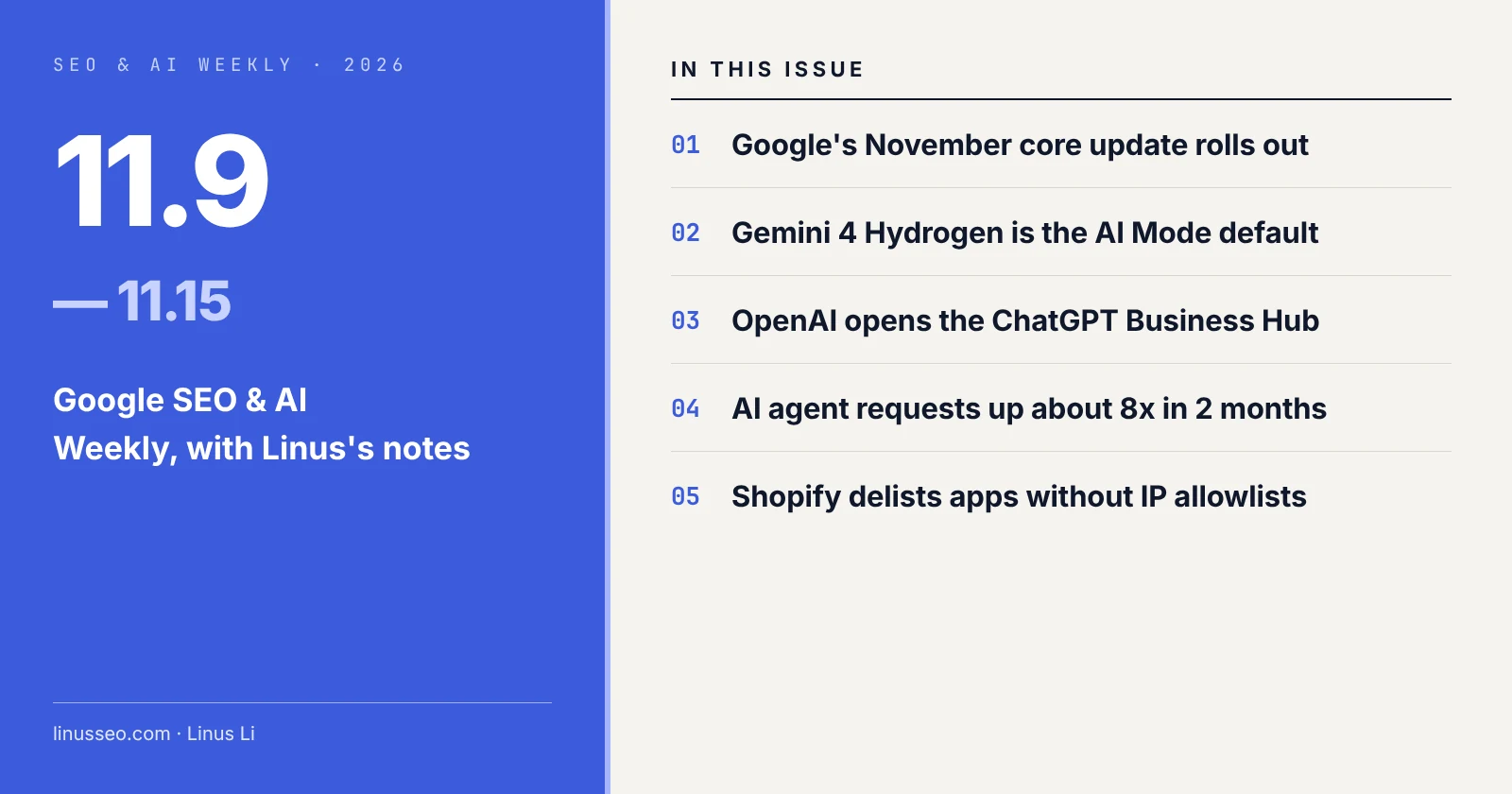
SEO & AI Weekly, Nov 9–15: Core Update & ChatGPT Biz Hub


During the week of November 9–15, 2026, Google began rolling out its third core update of the year on November 10. The Search Status Dashboard says the rollout may take up to two weeks, and it was still running as of November 16. Two days later, on November 12, Google made its new Gemini 4 Hydrogen model the default in AI Mode and began routing the hardest AI Overviews questions to it. Meanwhile, a logging bug caused Search Console’s Generative AI performance report to undercount impressions from November 9 to 11. Because all three events overlapped in the same week, separate them before reading too much into ranking or traffic shifts over the next two weeks.
OpenAI opened its “Businesses in ChatGPT” hub in beta on November 10, giving verified businesses first-party counts of how often ChatGPT links to their website and how many clicks those links get. Shopify confirmed that its November 20 IP allowlist deadline stands and rebuilt the store activity log in the admin.
AI agent traffic kept climbing: HUMAN Security measured October agent requests at about 8x August levels, with Meta’s Muse accounting for 59%. On November 11, United Airlines changed its website terms and contract of carriage to ban AI agents that access its site or book tickets without written permission.
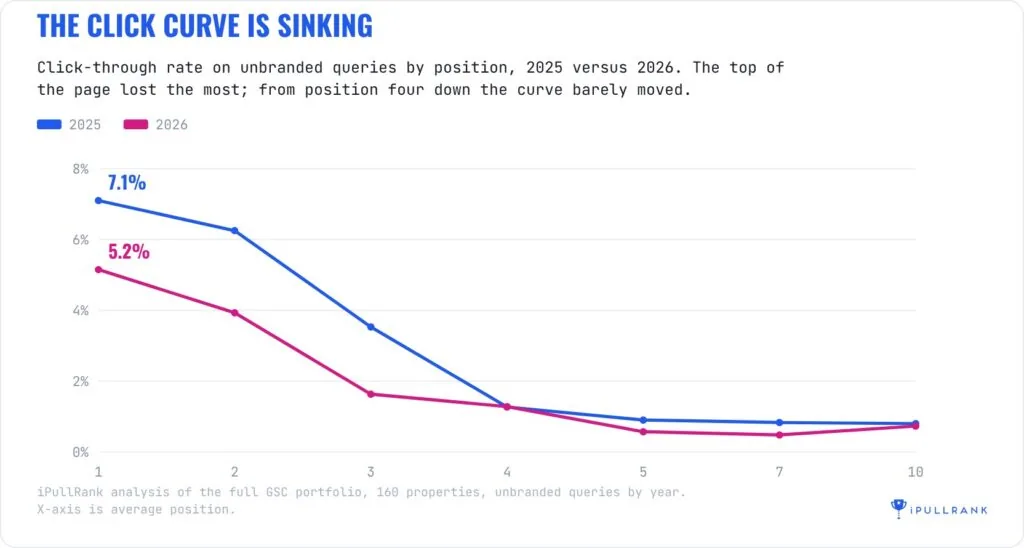
On the research side, SparkToro found that browser visits to the world’s top 1 million websites are 12.2% below their 2022 peak, and visits per internet user are down 29.2%. iPullRank’s Search Console data shows the unbranded click-through rate for position 1 falling from 7.1% to 5.2%. In China, Tencent launched a standalone web portal for Yuanbao Search at so.qq.com on November 11, while DeepSeek brought its consumer app’s web search and page-reading tools to the developer API on November 13.
Key points
Each point is labeled by urgency: Act now means affected sites should take action this week, Watch means there is a deadline or the situation is still changing, and For reference covers research and documentation updates.
- Act now: Google’s November core update started on November 10 and may take up to two weeks. Annotate November 10 and November 12 (the AI Mode model switch) in your reports, use November 3 to 8 as the pre-update baseline, and avoid major page changes until the rollout ends.
- Act now: Shopify confirmed that after 11:59 PM ET on November 20, public apps without an IP allowlist will be delisted from the App Store and blocked from new installs, though existing installs keep working. Check flagged apps under “Settings > Apps” and use the new store activity log to see which settings each app changed.
- Watch: OpenAI opened the ChatGPT Business Hub (
chatgpt.com/business-hub) in beta. Online stores can verify with a DNS TXT record or a Shopify login, followed by a Persona business and identity check (conversational Business Agents are US-only). The hub only counts “mentions” that link to your website, and a recorded click does not confirm a site visit. - Watch: Gemini 4 Hydrogen is now the AI Mode default. Google says its query fan-out connects searchers to a broader range of sites and adds more comparison tables and images. Low impressions in Search Console’s Generative AI report for November 9 to 11 stem from a logging bug and do not reflect actual search visibility.
- Watch: HUMAN Security measured October AI agent requests at about 8x August, with Meta Muse at 59%. Muse moved its signing key directory from meta.com to muse.ai between November 7 and 9, and about half of its requests arrived unsigned; United Airlines now bans unauthorized agents in its terms.
- Watch: Tencent launched a standalone web portal for Yuanbao Search at so.qq.com, indexing WeChat Official Accounts, WeChat Channels, and Tencent News. DeepSeek brought its consumer app’s web search and deep-thinking search tools to the developer API, allowing the model to run up to roughly 20 tool calls and search for text inside opened pages.
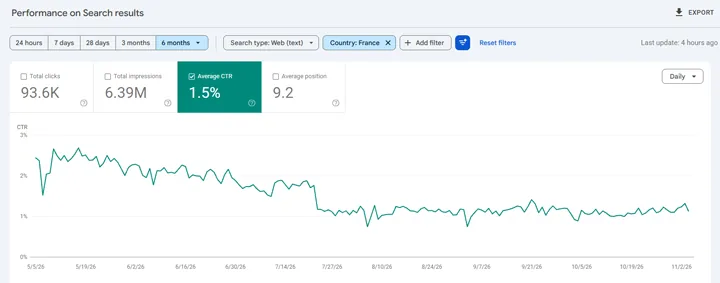
- For reference: SparkToro measured a 12.2% five-year drop in open-web visits and a 29.2% drop per user; iPullRank found unbranded position-1 CTR falling from 7.1% to 5.2% while positions 4 and below barely moved; Glenn Gabe’s French data showed one site’s CTR falling from 2.0% to 1.1% the day AI Overviews launched.
- For reference: Ahrefs counted brands across 5.5 million ChatGPT answers and found Walmart mentioned most often. DEJAN found that sub-brands such as Windows and Android score highly in Gemini 4 Hydrogen’s memory through links to their parent companies.
Google starts the November core update and makes Gemini 4 Hydrogen the AI Mode default
At 10:06 AM PT on November 10, Google posted the November 2026 core update on the Search Status Dashboard. The entry says the update “applies globally and to all languages” and that the rollout “may take up to two weeks to complete.”
In a LinkedIn post, Google called it a regular update “designed to better surface relevant, satisfying content for searchers from all types of sites.” Google singled out no specific industries and published no new blog post or documentation (Search Engine Roundtable).
This is the third core update of 2026, following March 27 to April 8 and May 21 to June 2. It started 173 days after the May update, and Google released several spam updates in between. Search Engine Journal estimates that the rollout will finish around November 24. Third-party tools had already recorded unconfirmed ranking volatility on November 8 and 9.
On November 12, Google Search VP Robby Stein announced on the Google blog that Gemini 4 Hydrogen is “now available globally in Google Search for all users.” On X, he added that Hydrogen is “the new default model in AI Mode” and is “being used for your hardest questions in AI Overviews” (Search Engine Roundtable).
Google’s side-by-side screenshots compare Hydrogen with Gemini 3.5 Flash, which Search Engine Journal notes had been the AI Mode default since I/O in May. Google SVP Nick Fox called it “the biggest model improvement to Search yet.”
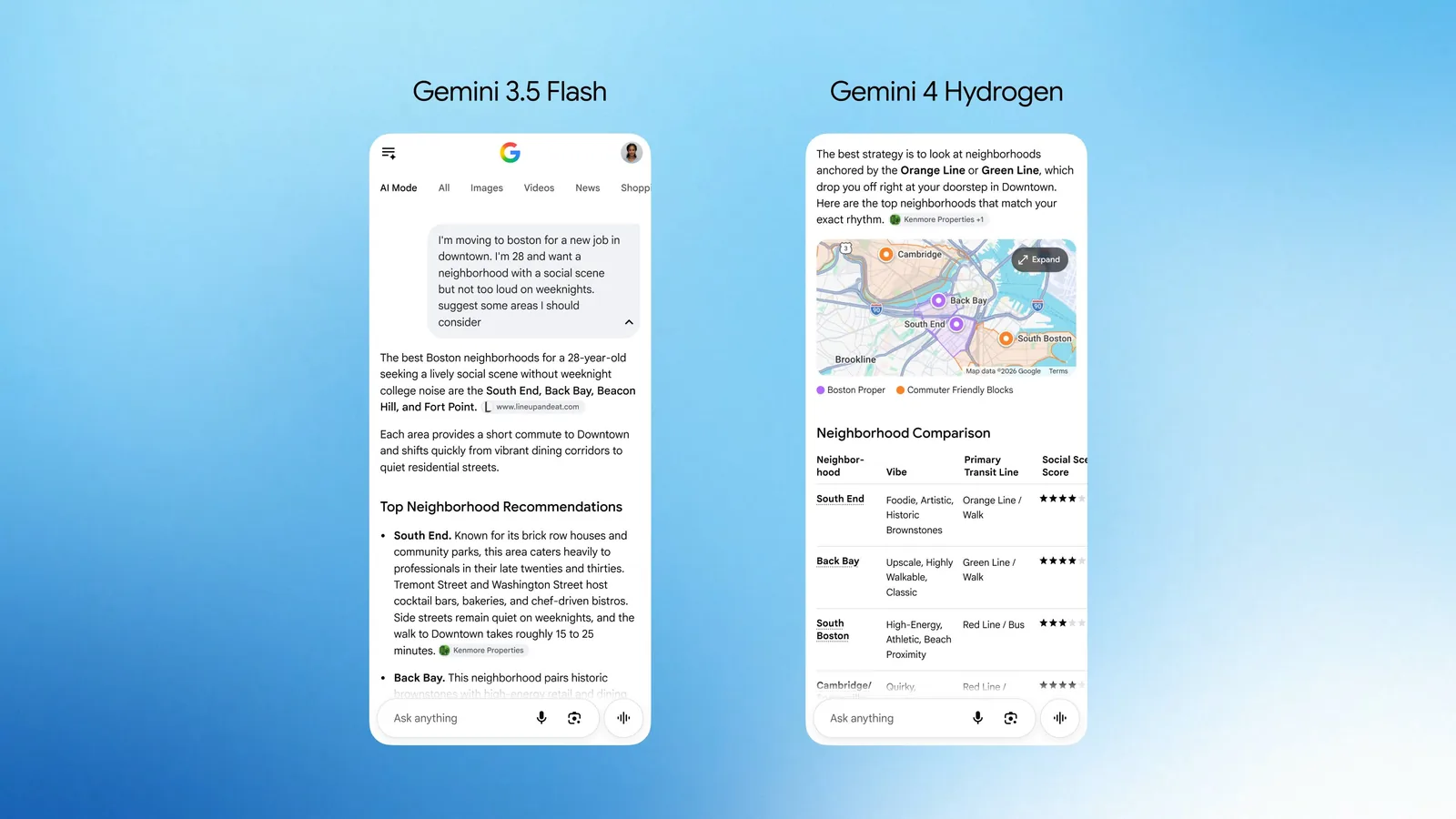
Google says Hydrogen brings an upgraded query fan-out (splitting one question into several sub-queries and searching each), “connecting you to a broader range of helpful links than before,” along with more images, structured responses, comparison tables, and custom tools. Two days earlier, on November 10, Google had also brought the larger Gemini 4 Carbon to AI Mode for Google AI Ultra subscribers.
The performance figures come from Google DeepMind’s model announcement and are aimed at developers migrating from Gemini 3.8 Flash: tasks finish 2.5 times faster at the default high thinking setting, and fabricated claims drop by more than 5x. On the Artificial Analysis intelligence index, Hydrogen scores 51, slightly ahead of the larger Gemini 4 Argon at 50. These are API benchmarks, not measures of search result quality.
On November 12, Google added an entry to Search Console’s data anomalies page: “A logging error caused a decrease in impressions on the Generative AI performance report in Search for data from November 9 - November 11, 2026. This issue affects data logging only.” The note covers impressions in that report only and says nothing about the standard Performance report or a backfill.
A separate, unconfirmed issue surfaced the same week: Search Engine Roundtable reported on November 9 that the standard Performance report looked off for many sites, and Joy Hawkins called Search Console “unusable” on November 11.
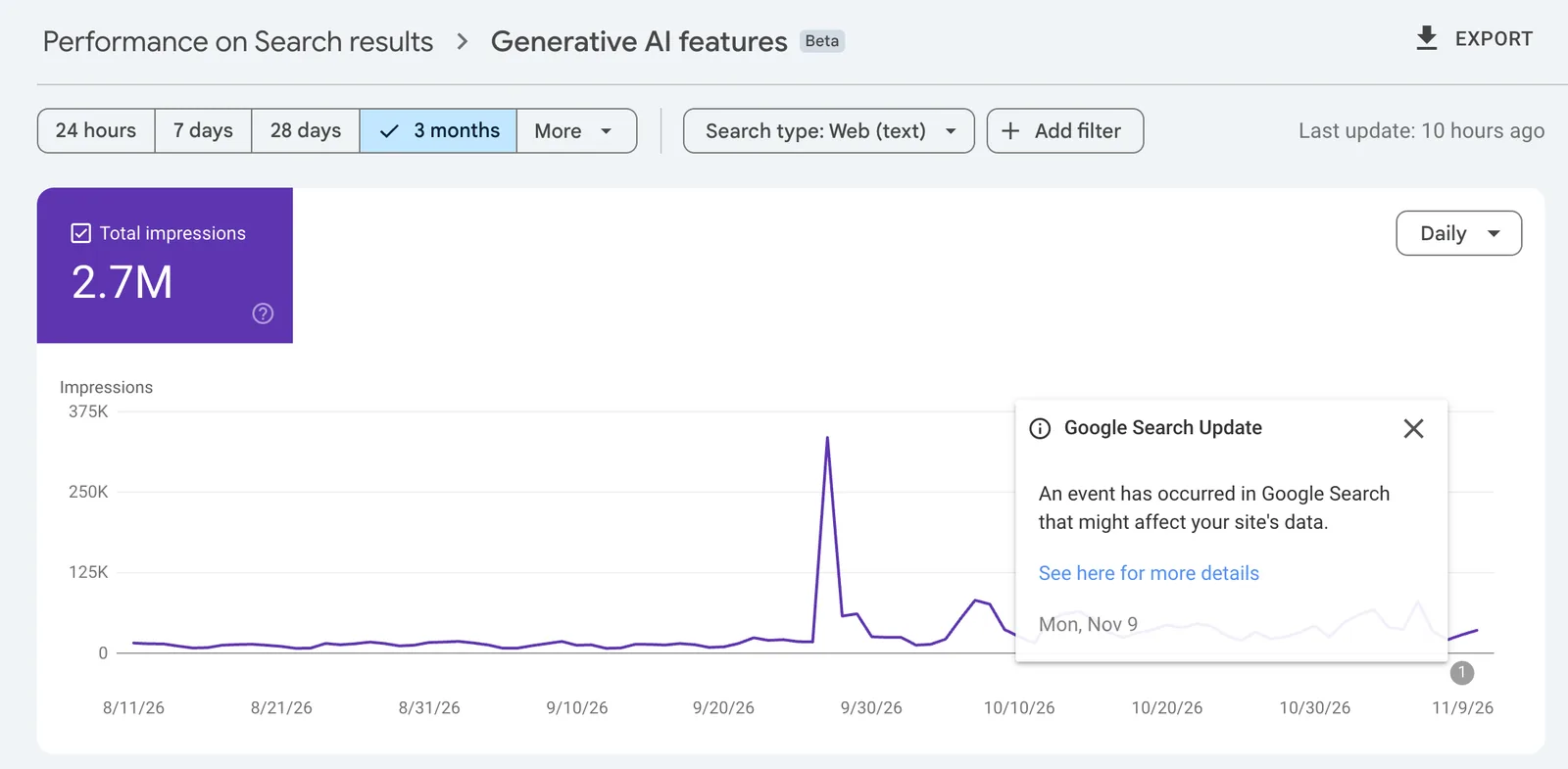
With a core update, a default model switch, and a reporting bug landing in the same week, hold off on changing pages based on single-day swings over the next two weeks. Google’s core updates documentation recommends “waiting at least a full week after a core update completes before analyzing your site in Search Console.” For before-and-after comparisons, use November 3 to 8 as the baseline (excluding the October 31 to November 2 desktop click spikes covered last week), annotate November 10 and November 12, and exclude November 9 to 11 from the generative AI report.
OpenAI opens the ChatGPT Business Hub, and “mentions” only count answers that link to your site
On November 10, OpenAI launched “Businesses in ChatGPT” in beta, letting businesses claim their profile at chatgpt.com/business-hub (Search Engine Roundtable). Last week’s issue covered the test spotted on November 6; this is the public beta. OpenAI’s announcement refers to “the 1.2 billion people who use ChatGPT each week.”
Claiming takes three steps: choose a physical location or an online store; verify ownership by business phone (SMS or automated call), business email, a DNS TXT record on your website’s domain, or a Shopify login; and pass a business registration and representative identity check with Persona to receive a blue verification badge. OpenAI’s help center notes that availability depends on location, industry, and verification checks, and local listings are US-only for now.
Once verified, Shopify stores can use their catalog as the product feed, while other stores can upload a CSV or provide a hosted feed URL. Eligible US e-commerce and online service businesses can also turn on conversational Business Agents. Profound’s walkthrough found the “service business” type still marked as coming soon, which leaves most SaaS companies unable to sign up for now.
The hub has two tabs, “Brand insights” and “Agent insights,” with 7-day and 28-day views of mentions, profile views, website clicks, and top discovery topics.
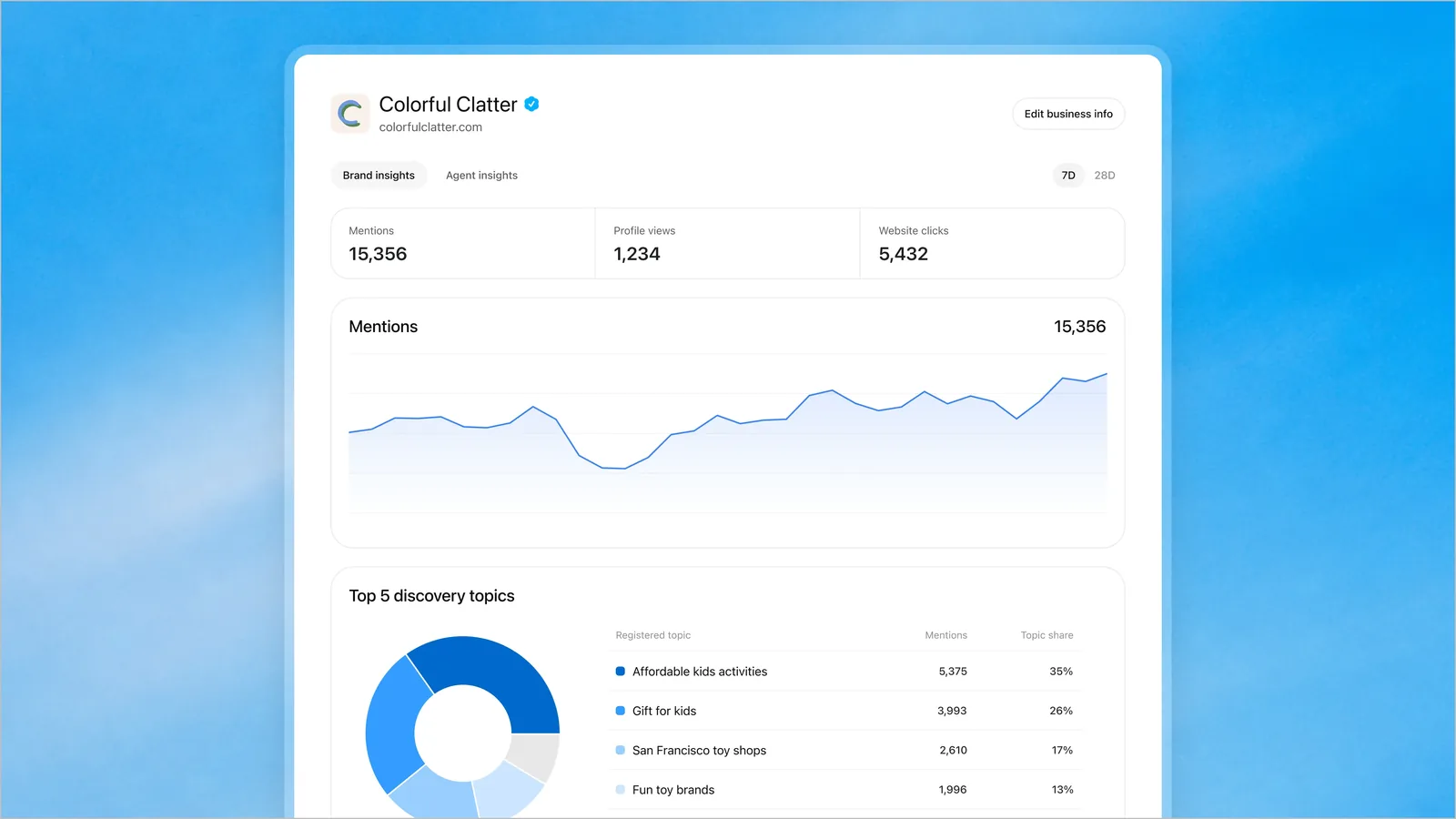
Read the metric definitions before you read the numbers. According to Profound’s breakdown of the hub’s documentation:
- Mentions: For an online store, a mention counts only when ChatGPT links to your website: “only URL mentions,” and “A brand name with no reference to your site is not counted.” For a local business, a mention counts when ChatGPT shows a result for your location.
- Website clicks: Recorded clicks on links to your website in ChatGPT. The tooltip says “Clicks don’t confirm website visits or conversions,” so this number will not match GA4 sessions.
- Discovery topics: Common themes across conversations where your website is cited.
- Data below an unpublished threshold is hidden, so a blank is not a zero. The hub does not show user prompts or competitor benchmarks, and offers no CSV export or API.
These definitions miss part of a brand’s exposure. According to a Profound study cited by 5WPR, of 37,842 brand mentions, 54.9% linked to the brand’s website, 40.2% named the brand without a link, and 4.8% linked to a third-party site. If ChatGPT recommends your product but links to a retailer, the recommendation counts as neither a mention nor a click in your hub.
On the ads side, new ChatGPT ad campaigns switched to Target CPA and Target CPC on November 9, as covered last week. OpenAI’s November 12 advertiser email announced three more changes (Search Engine Roundtable): “Maximize Results (Autobid)” is now called intelligent bidding, product feed campaigns can target “specific regions or markets within a country,” and product sets can “combine multiple conditions on the same product field.”
Separately, on November 10 ChatGPT started showing ads while it generates an image, labeled “Here’s an ad while we create your image” (Search Engine Roundtable).
Search Engine Land cited estimates from ad intelligence firm AdClarity for US ChatGPT ads from April 13 to August 31. Monthly active advertisers grew about 21x, from 839 in April to 17,934 in August, with an estimated $419 million in cumulative spend. Because monthly spend held roughly flat at $90 million to $100 million after May, average spend per advertiser fell about 85%, and about a third of advertisers who tried ChatGPT ads were no longer running them in August.
Spend also remained concentrated: the top 100 advertisers, fewer than 0.5% of the total, accounted for 43% of spend, and 57 of them were software and workplace services companies. Retail and consumer brands made up 7.6% of total spend.
AI agent requests grow 8x in two months as United Airlines bans unauthorized agents
On November 14, Search Engine Journal covered HUMAN Security’s October agentic traffic report. Across HUMAN’s customer network, October AI agent requests reached roughly 8x August volume and 2.6x September volume.
By source, Meta’s Muse accounted for 59% of agent requests, up 19 percentage points from September, with 3.7 times as many requests as ChatGPT Agent; Meta and OpenAI together made up nearly 90%. Standalone agent browsers lost share, with Perplexity Comet falling from 41% in August to 3.6% in October.
By industry, e-commerce received about 60% of requests, followed by travel and media. Product and site-search pages drew 85% of requests, while visits to checkout and payment pages slipped from 2.4% to 1.9%.
The main problem Muse creates for site owners is identification. HUMAN notes that most analytics tools “can’t tell AI agents from human visitors.” Muse signs its requests with Web Bot Auth (the agent signs each HTTP request with a private key, and the site verifies it against a published key directory).
According to a DataDome report cited by Search Engine Journal, Muse moved its key directory from meta.com to muse.ai between November 7 and 9, and as of November 10 about half of Muse requests on DataDome’s network carried no signature. If your WAF or CDN rules verify Muse against the meta.com key directory, add muse.ai/.well-known/http-message-signatures-directory. As of November 16, that directory was reachable and the old meta.com directory was still live.
United Airlines changed both its website terms of use and its contract of carriage on November 11 (Search Engine Journal). The new terms allow search engines to index public pages, allow assistive technology, and allow AI trip research that does not touch united.com or the app. However, “No Automated Agent shall be permitted to access United’s site or app without prior written permission,” and United’s fare and availability data may not be used to “train, fine-tune, ground, evaluate, or otherwise develop” AI models.
Rule 6.J.6 of the contract of carriage bans using AI agents to “make, modify or service a Ticket,” and Rule 5.H lets United cancel such bookings without notice; bookings made before November 11 are not affected. When Search Engine Journal checked on November 14, United’s robots.txt named no AI crawlers, so for now United restricts agents only through its terms.
When you tighten agent rules, make sure you do not block Googlebot. On November 11, Google’s Cherry Prommawin and Gary Illyes published a guide to moving to a CDN on the Search Central blog. It makes four points:
- Google’s crawl capacity (hostload) follows server health. Faster responses after a CDN switch can lead Googlebot to crawl more.
- A new CDN starts with an empty (cold) cache, so crawl requests hit the origin. Pre-warm important and frequently crawled URLs before launch.
- If the origin is overloaded, return 429 or 503 “for a short window (a few hours, or 1-2 days at most).”
- Do not let blanket WAF or CAPTCHA rules block Google’s crawlers with 403 responses or challenge pages. Allow verified crawlers based on Google’s published IP ranges.
Those same four principles apply when tightening bot-protection rules ahead of Black Friday.
Shopify delists public apps without IP allowlists on November 20 and rebuilds the store activity log
On November 14, Shopify confirmed in its developer changelog that the deadlines covered last week have not changed. Since November 12, bulk queries and mutations from public apps without an IP allowlist have been blocked. Every public app that calls the Admin API must configure an IP allowlist by 11:59 PM ET on November 20, or it will be delisted from the App Store and blocked from new installs. Existing installs keep working, and apps are relisted automatically once they add an allowlist.
The same post adds two requirements. First, custom apps installed outside the developer’s own organization (such as apps an agency builds for client stores) need an IP allowlist for new installs from November 20 and for existing installs from January 1, 2027 (details). Second, multi-factor authentication becomes mandatory on all partner accounts next week.
On November 13, Shopify rebuilt the admin’s store activity log. Changes to products, orders, discounts, themes, apps, staff, payments, and settings now appear in one log. Each entry shows which person or app made the change and the old and new values, entries can be filtered, and history goes back 18 months. After October’s checkout hijacks through three compromised apps, merchants can use this log to check which settings a given app changed.
Other Shopify updates for online stores this week:
- Storefront MCP’s policies tool is deprecated (November 11): The
search_shop_policies_and_faqstool is being replaced by the UCP MCPask_businesstool athttps://{shop-domain}/api/ucp/mcp, with a migration deadline of January 15, 2027. The new tool returns a written answer rather than raw policy text. AI agents use it to answer questions about returns, shipping, and other store policies, so keep your policy pages and FAQs accurate. - Shop accepts stores without Shopify Payments (November 10): Eligible stores can receive organic discovery traffic from the Shop app and Shop.com, though they cannot run Shop Campaigns (details). Shopify updated Shop eligibility criteria for all merchants at the same time; stores that fall short are hidden from discovery, and merchants can check their status in the Shop channel. Because Shopify Payments is only available in select countries and verticals, this opens Shop discovery to international merchants using third-party gateways.
- Self-serve returns and cancellations per market (November 10): Each market can now have its own return and cancellation rules (details).
Click studies: open-web visits down 12% in five years, unbranded position-1 CTR down to 5.2%
On November 10, SparkToro’s Rand Fishkin and Similarweb measured browser visits to the world’s top 1 million websites from 2021 through Q3 2026. Monthly visits peaked at 2.243 trillion in Q1 2022, fell to 1.914 trillion in Q1 2026, and recovered to 1.970 trillion in Q3, still 12.2% below the peak.
Over the same period, internet users grew from 4.95 billion to 6.15 billion (about 24%), so visits per user fell 29.2%, while the top 100 sites’ share of traffic rose by only about 3 percentage points. Fishkin notes that the data covers browser visits only, not in-app visits, and cannot separate the underlying causes.
On November 12, Michael Tandoh at iPullRank analyzed Search Console data from 166 brands and 272 properties between March 2025 and mid-July 2026, covering 151 billion impressions and 1.68 billion clicks. Unbranded CTR fell most in the top three positions: position 1 went from 7.1% to 5.2%, position 2 from about 6% to about 4%, and position 3 from about 3.5% to under 2%, while position 4 and below barely moved.
The author calls AI summaries and other SERP features the “likely” cause, though the study did not test it directly. Across the same dataset, a URL in the top three is still there a year later 76% of the time.
On November 9, Glenn Gabe published a before-and-after comparison using French data (GSQi). Google launched AI Overviews and AI Mode in France on July 22, 2026, and that clear launch date makes the comparison unusually clean. In the first of his five cases, impressions held steady while daily clicks fell from about 750 to about 400 and CTR from about 2.0% to 1.1%. Two health (YMYL) sites saw a second drop in mid-August, which Gabe attributes to Google being cautious with sensitive queries at launch and expanding coverage later; the other two cases showed no meaningful impact.
Gabe also explained why average position started to wobble after launch. An AI Overview citation records an impression only when it is visible, so a collapsed AI Overview records one only after the user expands it. If the same URL also ranks in the regular results below, its average position moves back and forth between the two positions. As a result, swings in Search Console’s average position after an AI Overviews rollout do not necessarily mean traditional organic rankings moved.
AI Overviews coverage is also widening in the UK. SISTRIX’s Steve Paine reported on November 11 that more than 80% of the 1 million UK keywords SISTRIX tracks now show an AI Overview, up from about 55.6% in early August. E-commerce sites are being affected faster: for outdoor retailer Go Outdoors, the share of its keywords showing an AI Overview rose from 21.5% on August 31 to 87.4% on November 9. In Germany, the figure has just passed 50%.
Brand studies: ChatGPT mentions Walmart most, and Gemini remembers sub-brands through their parents
Graphite’s November 9 report uses Similarweb web and mobile app data (Search Engine Journal). In September 2026, ChatGPT, Gemini, Claude, Grok, Perplexity, and DeepSeek together logged 76 billion monthly sessions, up 37% year over year. ChatGPT still holds an 81.2% share; it captured 58.9% of net new sessions while Claude captured 26%. Year over year, Claude’s global sessions jumped 1,901%, whereas Perplexity’s fell 27%.
AI referral traffic grew 92% year over year through July but remains under 1% of total site traffic. Graphite no longer compares AI with search engine share, because it cannot tell how much of the Google Android app’s roughly 11.8 billion monthly US sessions are searches. In the same article, Search Engine Journal cited a separate Similarweb study from June: among US desktop users who visited a brand’s website after a ChatGPT recommendation, 55.9% arrived through a subsequent branded search. Referral reports alone undercount the effect of AI recommendations.
On November 11, Ahrefs used Brand Radar to count brands across 5,516,381 US ChatGPT answers (study). Walmart was mentioned most (95,605 times, 1.73%), followed by Target (0.94%), Apple (0.82%), Amazon (0.70%), and The Home Depot (0.63%).
Retailers made up 23 of the top 100 brands and 35% of mentions within that group; carmakers were 15 brands and 14%; tech companies were 10 brands and 13%. After reading a sample of answers for the top 10 brands, the author found that “where to buy” and money-saving questions tend to surface retailers, while “what to buy” and “how to use” questions bring up manufacturer brands.
Dan Petrovic at DEJAN ran two experiments this week. The first, on November 12, generated 15 Gemini answers for each of 15 topics: five with a well-known expert’s name in the system instruction (for example Andrej Karpathy or Lily Ray), five with a random name, and five with no name. A separate Claude session scored the answers blind; the three groups averaged 7.8, 6.8, and 5.8, and the expert group beat the random-name group in 12 of 15 topics.
Gemini recognized the expert in its thinking in 53 of 75 expert runs and used 59% more thinking tokens than in the no-name group. The sample is small, with five answers and one AI rater per topic.
The second experiment, on November 13, sent 52,923 requests to gemini-4-hydrogen with search turned off and applied personalized PageRank to the links among 239,000 brands to estimate brand authority in the model’s memory. Apple scored 100, Microsoft 94.3, Google 90.9, Samsung 88.6, and Amazon 86.7, with Nike tenth at 81.0.
Windows ranked 11th and Android 30th even though neither was named directly in 8,511 brand-listing requests; their scores came from links to their parent companies, and 94% of 17,009 reasoning summaries mentioned competitors while 76% mentioned parent companies or subsidiaries. The results reflect only what the model remembers from training, not citations in grounded search, and DEJAN sells a related tool.
On November 9, Kevin Indig published Wynter’s survey of 200 software buyers in Growth Memo (Indig is an investor in Wynter). Seventy-nine percent already had vendors in mind when they started using AI; among the 40 without candidates, 82.5% got a shortlist from AI, but only 40% went on to choose a vendor, compared with 69% of those who started with candidates.
After the AI conversation, 72.5% visited vendor websites, 48% searched Google, 29% searched Reddit, and 23% checked G2 or other review sites. Buyers who asked six or more follow-up questions requested a demo or signed up 41.8% of the time, versus 32.3% for one to five. The survey is self-reported and does not show causation.
China AI search: Tencent launches so.qq.com, and DeepSeek brings its app search tools to the API
Tencent’s Yuanbao AI assistant (mobile app and web chat) already supported AI search across WeChat’s closed content ecosystem, including Official Accounts and short-video Channels. On November 11, Tencent’s 28th anniversary, the company broke that search experience out into a standalone web portal at so.qq.com and added it as a search engine option in QQ Browser (36Kr). China.com notes that it is Tencent’s first standalone web search brand since launching Soso in 2006.
According to 36Kr, Yuanbao Search pulls from WeChat Official Accounts, WeChat Channels, and Tencent News, and badges official brand websites in its results. Paid ads are separated from organic results, clearly labeled, and collapsible, and Tencent says ad spend does not affect organic rankings. Tencent Cloud had previously opened a commercial search API on October 20 starting at 14 RMB (about $2) per 1,000 calls (ifeng Tech). As of November 16, so.qq.com’s robots.txt allowed crawling of the homepage only, and its static assets loaded from search.sogoucdn.com/aimode/, pointing to infrastructure from Sogou (the search engine Tencent acquired in 2021).
DeepSeek’s web chat and mobile app already offered web search and deep-thinking search. On November 13, DeepSeek announced a “full suite of application APIs” in its API changelog, exposing those built-in consumer tools to developers so deepseek-flash can call them across the Messages, Responses, and Chat Completions endpoints:
- Web search: With thinking turned off,
deepseek_web_searchqueries web pages and images and cites sources in the response. - Deep-thinking search: With thinking turned on, the model can run roughly 20 tool calls before answering, using
search,open_page, andfind_in_page(scanning an opened page for specific text) (docs). - Other tools:
deepseek_read_urlfor fetching URLs, PDF and Office document parsing, plus standalone OCR, speech-to-text, and text-to-speech endpoints.
DeepSeek opened its standalone Search and Fetch APIs earlier on October 17, as covered in our October 25 roundup, returning an authority score from 0 to 4 for each result. The find_in_page action documented this week confirms that the model opens candidate pages and scans for exact text to verify facts. Keep prices, specifications, and shipping rates in plain HTML text so retrieval tools can verify them on the page.
Two more updates from China:
- China AI-native app MAUs (September data): According to QuestMobile data cited by The Paper, the top three AI-native apps in China in September 2026 were ByteDance’s Doubao at 419 million (up 143.6% year over year), Alibaba’s Qwen at 158 million, and DeepSeek at 123 million (down 15.2%).
- Baidu World 2026 (November 12): Baidu released the ERNIE Lightning deep-thinking model (originally built for Baidu Search) and an ERNIE 5.5 Flash preview, with no updates for Baidu Search or its webmaster platform (China Daily).
Other Google updates
- New doc on identifying Google Search traffic (November 12): Google published a Search Central guide on identifying Google Search traffic in analytics tools and server logs. Because Google uses the
originreferrer policy, the Referer header carries only the scheme and hostname, with no path or query parameters: “The Referer header doesn’t include the search query.” When the Google Android app opens a result in a browser tab, it sendsandroid-app://com.google.android.googlequicksearchbox/https/www.google.com, while Google Discover sends the same referrer as the surface it appears on. The doc does not mention AI Mode or AI Overviews. - Mueller: many “Crawled - currently not indexed” pages usually point to quality (November 10): On Bluesky, John Mueller wrote, “Usually this is a sign that Google’s quality systems are unconvinced about your site,” and “Just making the site smaller doesn’t significantly raise the overall quality of the site” (Search Engine Roundtable). In a separate thread about a new site, he said it can take time for Google’s systems to understand a new site’s unique value (source).
- Google tests removing the AI Mode tab (November 13): Glenn Gabe saw results pages with no AI Mode tab and no “Ask anything” box at the bottom of AI Overviews. Barry Schwartz could not replicate it, and Google has not commented (Search Engine Roundtable).
- AI-generated images return in AI Overviews (November 13): The feature, announced in July and paused in August, reappeared for some users this week with no new statement from Google (Search Engine Roundtable).
- Other AI Overviews interface changes: On November 11, Glenn Gabe found that AI Overviews for definition queries now open fully expanded, and Brodie Clark spotted a test that moves AI Overviews source icons to the bottom. Joy Hawkins spotted a mobile local result where an AI Overview strips out call, directions, review, and photo buttons while replacing the classic local pack (Search Engine Roundtable).
- Google’s case against SerpApi dismissed again (November 9): Chief Judge Yvonne Gonzalez Rogers of the US District Court for the Northern District of California granted SerpApi’s motion and dismissed Google’s amended DMCA anti-circumvention complaint a second time. Google has 21 days (until about November 30) to cure the deficiencies, or the case will be dismissed with prejudice (Search Engine Roundtable). The court ruled on the complaint’s deficiencies and did not decide whether scraping search results is lawful.
Other industry news
- Yahoo Scout leaves beta and becomes ILC’s first paying licensee (November 10 and 12): Yahoo announced that its AI answer engine Yahoo Scout has delivered more than 3 billion answers since launching in Q1 2026. Scout is now out of beta and built into a rebuilt Yahoo Search, available on the web in the US, UK, Europe, and Switzerland, with the mobile app in the US only. On November 12, the RSL Collective renamed itself the Internet Licensing Collective (ILC), representing more than 3,000 media brands and publishing platforms, and named Yahoo Scout its first commercial licensee (announcement). In Digiday‘s interview with ILC head Doug Leeds, he described a separate royalty pool for each AI company, with payouts weighted by how content is used (grounding, retrieval, or display) and whether the source is credited.
- Reddit tests Reddit Reviews (November 10): Reddit uses generative AI to summarize community discussion for about 10,000 products across electronics, health and beauty, home and garden, and fashion and apparel. Prices, images, and purchase links come from brand and retailer catalogs, and “Businesses cannot pay for product inclusion.” It launches in English in the US first, with additional markets planned for 2027 (announcement). Brands and retailers can search Reddit for their products now to see what threads feed into those summaries.
- Ads at the top of Bing AI Mode (November 9): After renaming Copilot Search to AI Mode, Bing began showing standard search ads and shopping ads at the top of its results, including on follow-up queries (Search Engine Roundtable).
- Google Ads search terms reports hide long AI Mode queries (November 9): Rémi Kerhoas analyzed more than 400 agency accounts in Search Engine Land and found almost no trace of AI Mode or AI Overviews in search terms reports. Google’s help page says these queries “are included in aggregate in your search terms report,” and the reported term is the “best approximation” of the user’s intent.
- Semrush rounds up AI traffic quality studies (November 12): Semrush cites Shopify data showing that in Q1 2026 more than half of AI-referred sessions started on product pages, compared with about 20% for organic search. Meanwhile, Siege Media found that among sites with reliable revenue attribution, AI traffic beat organic search on revenue per session at fewer than half of them.
- Chiang Mai SEO Conference (November 9 to 13): According to DeCODE Digital’s recap, Joy Hawkins shared local business lead data in which AI tools produced 81 leads (2%), Google Business Profiles 2,498 (61%), and Google organic search 1,536 (37%).
Linus’s notes
Black Friday and Cyber Monday are less than two weeks away. Right in that window, Google kicked off its November core update and swapped the default model in AI Mode, while Shopify kept November 20 as the IP allowlist deadline for public apps. Over the next ten days, the safest rule for any e-commerce team is to leave core revenue pages alone and focus strictly on clearing operational risks.
If Search Console clicks dip over the coming days, hold off on rewriting titles or copy on your top collection and bestseller pages. A core update takes up to two weeks to settle, so mid-rollout daily swings tell you very little. As this week’s CTR studies also show, organic rankings often hold steady while wider AI Overviews pull clicks away from the top three positions. Overhauling pages right now risks unsettling rankings that are still intact ahead of peak shopping week.
Take the same measured approach to your Shopify app stack. Missing the November 20 deadline delists an app from the Shopify App Store and blocks new installs, but aside from bulk Admin API calls, existing store installs keep working that day. Uninstall unused apps this week, and resist ripping out active apps that handle your theme, site search, or checkout a week before Black Friday. Ask the developer for their allowlist status first, and check the rebuilt store activity log to confirm no app has altered critical settings recently.
WAF and CDN bot rules are another easy place to trip up before a major sale. AI agent traffic to online stores is climbing fast, yet more than 80% of requests hit product and site-search pages while under 2% reach checkout, meaning most agents are comparing prices and specs on a shopper’s behalf. Most DTC brands and online retailers do not have the direct-booking moat an airline like United has, so a blanket agent ban accomplishes little. When tightening bot rules for holiday traffic, make sure CAPTCHA challenges or 403 blocks never catch verified Googlebot IPs in the middle of a core update.
Keep an eye on unsigned agent traffic skewing your analytics, too. Since Meta moved Muse’s signing key directory to muse.ai, roughly half of Muse requests arrive unsigned, and standard web analytics tools cannot separate them from human shoppers. If product-page sessions spike while conversion rate drops right before Black Friday, check your server or CDN logs for unsigned agent hits before blaming the page itself. After updating bot rules, you can verify crawler access with our AI Crawlability Checker and inspect real bot hits in the AI Crawler Log Analyzer.
As for the new ChatGPT Business Hub, my take is to treat it as low priority before Black Friday: claim your profile if you operate a US entity and have ten spare minutes, and do not sweat it if you are outside the US. Across OpenAI’s earlier merchant integrations and GPT programs (as well as the new conversational Business Agents), account linking has mostly required a US legal entity, and Persona checks matching corporate registration and representative ID documents. How smoothly non-US merchants can pass verification, and how much functionality unlocks outside the US, remains to be seen.
Even once a store is verified, the hub’s “mentions” metric for online stores only counts answers that include a link to your domain. When shoppers ask ChatGPT where to buy something cheaply, retail giants like Walmart, Target, and Amazon dominate the citations; individual brands mostly earn mentions on “what to buy” and “how to choose” queries, and more than half of interested buyers still go to Google and search the brand name to visit the site.
Wrestling with hub verification right before Cyber Week is a poor use of time. Put clear prices, product specs, holiday shipping cutoffs, and return windows directly into plain HTML text on your product pages instead, then run key URLs through the Product Schema Checker and Entity Consistency Checker so both shoppers and comparison agents read consistent facts.
What this means for you
- Annotate November 10 (core update start) and November 12 (AI Mode model switch) in Search Console and GA4 reports, and use November 3 to 8 as your pre-update baseline. Exclude November 9 to 11 impressions in the Generative AI report. The core update should finish around November 24; wait a full week after completion before evaluating, and avoid overhauling pages over single-day swings in the meantime.
- Merchants with a US legal entity (or stores in eligible regions and categories) can try claiming their profile at
chatgpt.com/business-hubusing a DNS TXT record or Shopify login, followed by Persona verification. Once approved, log mentions and website clicks weekly alongside GA4 sessions from chatgpt.com, and remember that a blank metric in the hub means data is below the reporting threshold rather than zero. - Shopify merchants should open “Settings > Apps” before November 20, review any apps flagged without an IP allowlist, check progress with their developers, and uninstall unused apps. Use the rebuilt store activity log to audit recent setting changes by app. If an external agency built a custom app for your store, remind them to configure an IP allowlist before January 1, 2027.
- Review WAF and CDN bot rules: add the
muse.aikey directory when verifying Meta Muse signatures, and allow Googlebot by Google’s published IP ranges so CAPTCHA challenges or 403 blocks never catch it. If you switch CDNs before Black Friday, pre-warm important URLs, and if the origin is overloaded, return 429 or 503 only for a few hours, or two days at most. - Write prices, specifications, shipping rates, and return windows in plain HTML text on product and policy pages. DeepSeek’s
find_in_page, Google’s query fan-out, and Shopify’sask_businessall extract facts directly from page text. If your custom app or agent integration uses Storefront MCP’ssearch_shop_policies_and_faqs, migrate toask_businessbefore January 15, 2027. - Shopify stores that do not use Shopify Payments (including merchants in unsupported countries) should check their status in the Shop channel, as eligible stores can now receive organic discovery traffic from the Shop app and Shop.com.
- Track branded clicks and impressions in Search Console every week as a proxy for indirect demand from AI recommendations. When pitching product reviews or press coverage, ask publishers to link to your domain alongside your brand name, since tools like the ChatGPT Business Hub only count linked mentions.
SEO & AI Weekly, Nov 9–15: Core Update & ChatGPT Biz Hub
https://www.linusseo.com/en/google-seo-and-ai-newsletter-linus-thoughts-261115/