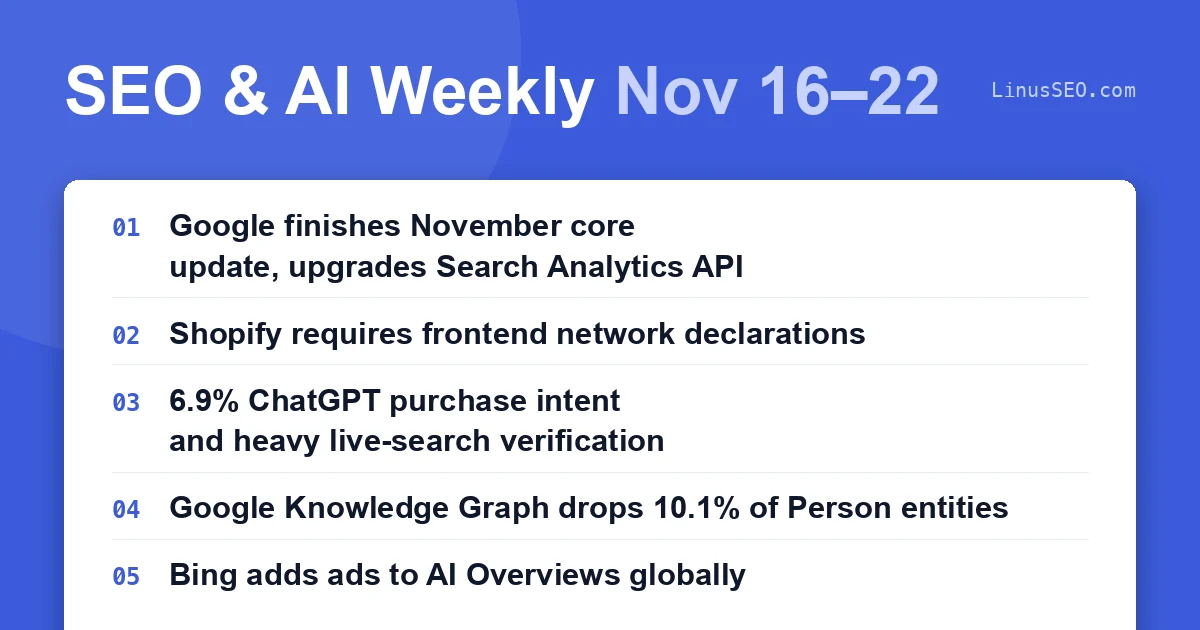
SEO & AI Weekly, Nov 16–22: AI Brand Studies & Shopify Rules


During the week of November 16–22, 2026, Google’s November core update entered its main volatility phase before finishing on November 24 while Google upgraded the Search Analytics API; Shopify mandated frontend app network declarations amid major script and WordPress alerts; and three empirical studies broke down how AI engines actually select brands.
Two shifts stood out across the week: AI search moved past slogans into measurable mechanics, and ecommerce security pressure shifted directly into the browser frontend. The sections below lay out the facts and primary data first; if you are short on time, use the table of contents to jump straight to Linus’s notes and the action list at the end.
Google finishes November core update, upgrades Search Analytics API
On November 24 at 06:03 PST, Google updated the Search Status Dashboard to confirm that the November 2026 core update had finished rolling out. Starting November 10, the global, all-language update ran for roughly 14 days (via Search Engine Roundtable).
Although Google announced the update on November 10, Glenn Gabe and site owners comparing Search Console graphs noted that the main ranking shifts landed on November 13–14, with volatility carrying through the following week and no clear mid-rollout reversal (via Search Engine Roundtable). Site owners in webmaster forums reported steep drops on scaled content and repetitive template folders, along with ecommerce category pages occasionally swapped out for editorial or filtered URLs.
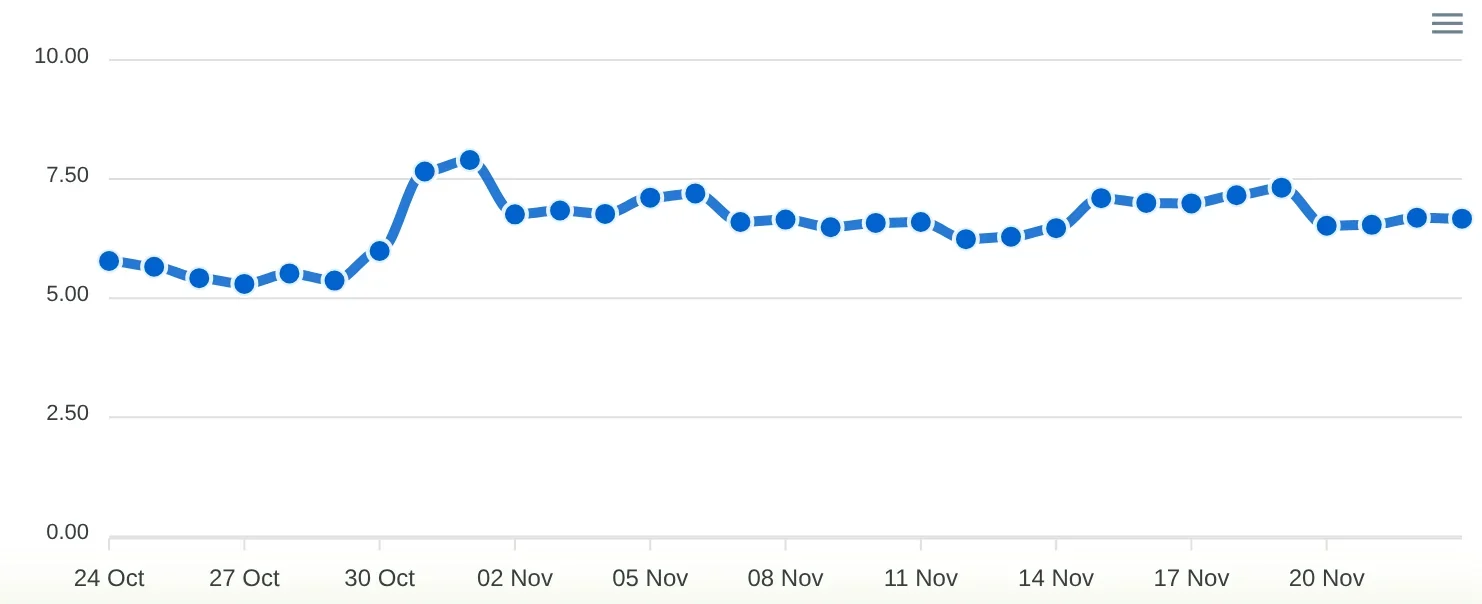
Reading this update through third-party rank trackers proved harder than usual because of “poisoned Google SERPs,” which Search Engine Land broke down on November 20. Since September 13, automated requests have frequently received HTTP 200 pages that look visually normal but silently swap organic listings with unrelated domains. Nozzle measured a 68.6% peak poisoning rate on November 2 (27.6% average), while DataForSEO observed 20%–30% ongoing noise.
On November 16, DataForSEO launched the resolve_poisoned_results parameter for its Google Organic SERP API. When enabled, the API cross-checks organic listings against Google’s Web mode (udm=14) within the same task, swaps corrupted results, and flags restored listings with from_web at double the standard SERP task cost. A day later, Brodie Clark spotted Google forcing a sign-in wall immediately after a user’s first incognito search; Google Search VP Rajan Patel replied that it was not meant to trigger on the first query and that the team was checking active tests (via Search Engine Roundtable).
With third-party SERP feeds noisy, Google’s November 16 Search Analytics API update brought three key Search Console UI controls into automated reporting:
- Branded query segmentation (
brandedClassification): Group or filter directly byBRANDEDandNON_BRANDEDwithout maintaining manual regex lists. Historical data starts February 21, 2026, applies only to eligible top-level properties, cannot be combined with a custom query filter, and returns empty rows for ineligible properties. - Web multimodal reporting (
webMultimodal): SettingtypetowebMultimodalpulls performance from Google Lens, Android Circle to Search, and image uploads (see our GSC web multimodal guide for background), with BigQuery bulk export support planned next. - Multi-country and multi-device filtering (
filterLists): Query combinations of multiple countries or devices in one API call instead of stitching separate requests together.
When rank-tracker noise overlaps with Black Friday traffic swings, your baseline for diagnosing the November core update should rely on Search Console’s branded/non-branded split, GA4 organic sessions, and actual store orders.
Shopify requires frontend network declarations amid script and WordPress alerts
Right as Shopify’s November 20 public-app IP allowlist deadline took effect, the platform tightened storefront security another notch on November 19 by introducing mandatory network access declarations.
Public apps—and custom apps installed outside a developer’s own organization—that run code on the online store via theme app extensions, script tags, app proxies, the write_themes scope, or web pixels using write_open_pixels must now declare allowed_sources in the [network_access] section of shopify.app.toml. Even apps that do not contact external servers must explicitly declare allowed_sources = [].
Shopify set two firm enforcement dates:
- December 1, 2026: Shopify rejects app deploys and App Store submissions for undeclared apps and displays warnings in the merchant admin. Existing app versions continue running.
- January 1, 2027: Public apps are delisted and blocked from new installs, and external custom apps are blocked from new installs outside the developer’s organization.
Apps that only write content (such as metafields or products), web pixels running in the default strict sandbox, and checkout-only UI extensions without those storefront capabilities are unaffected.
Shopify shipped three additional updates over the same stretch:
- Stricter Server Pixel mutation auth (November 20): The GraphQL Admin API’s
eventBridgeServerPixelUpdateandpubSubServerPixelUpdatemutations began rejecting online tokens from staff users without explicit app access. - Catalog API image swatches (November 19): The Catalog API added
swatch.image_urltoget_productresponses so AI shopping surfaces can display color and variant swatches. - ChatGPT agentic checkout controls (November 23): Just after the weekly cutoff, Shopify rolled out ChatGPT agentic checkout settings inside Agentic Storefronts, enabled by default for eligible stores with automatic channel management turned on.
The timing of Shopify’s frontend domain rules lined up directly with a major third-party script incident on November 16. According to Search Engine Journal, an attacker exploited a signup-flow flaw in Optimizely Web Experimentation to inject malicious JavaScript into projects belonging to 178 organizations, including Zoom, the BBC, CNN, Salesforce, and GitLab. Because the payload still loaded from trusted cdn.optimizely.com scripts, basic host allowlists missed it; the script skimmed credit card numbers, expiry dates, and CVVs typed directly into site forms (hosted payment iframes like Stripe and Adyen were unaffected) and swapped cryptocurrency wallet addresses.
WordPress site owners faced three separate security and technical alerts in the same week:
- Gootloader SEO poisoning takedown (November 16–17): The U.S. Department of Justice and FBI announced an international disruption removing Gootloader malware from over 100 servers, including hacked WordPress sites. Since 2018, Gootloader used SEO-poisoned business-document pages to infect at least 25,000 computers globally and drive roughly $28.8 million in ransomware losses across at least 44 U.S. victims (via DOJ press release and Search Engine Roundtable).
- Rank Math reaches 16 vulnerabilities in 2026 (November 18): Search Engine Journal documented 16 disclosed vulnerabilities in Rank Math SEO during 2026 (including remote code execution and file-upload flaws, versus four in free Yoast SEO), alongside an October supply-chain backdoor incident affecting Rank Math PRO 3.0.123.
- WordPress 7.2 defaults to
/random/redirects (November 21): Slated for December 8, WordPress 7.2 enables/random/by default with no dashboard toggle, issuing a 302 redirect (withX-Robots-Tag: noindex, followon the redirect only) to published posts and publicly queryable custom post types that have archives. Even custom post types markednoindexby an SEO plugin—such as testimonials—can be surfaced via/random/. Developers must disable it using thewp_enable_random_content_redirectfilter, noting that WordPress’s November developer roundup misprinted the filter name (via Search Engine Journal).
On the bot-management side, Google published its Allow Google-Agent traffic documentation on November 17. Google-Agent identifies Google-hosted agents (such as Project Mariner) browsing and taking actions on a user’s behalf. Because these requests are user-triggered, they behave like browsers and ignore robots.txt. Sites that want to accept agent traffic should verify that User-Agent contains Google-Agent, match IPs against user-triggered-agents.json (or verify experimental RFC 9421 signatures under Signature-Agent: g="https://agent.bot.goog"), skip CAPTCHAs and per-IP rate limits for shared egress pools, and make sure allow rules cover on-site search, filtering, add-to-cart, booking, and underlying XHR/GraphQL APIs.
Three AI search studies: 6.9% ChatGPT purchase intent and heavy live-search verification
Three empirical studies released between November 17 and 18 put hard numbers behind how consumers actually use AI assistants and how models choose which brands to recommend.
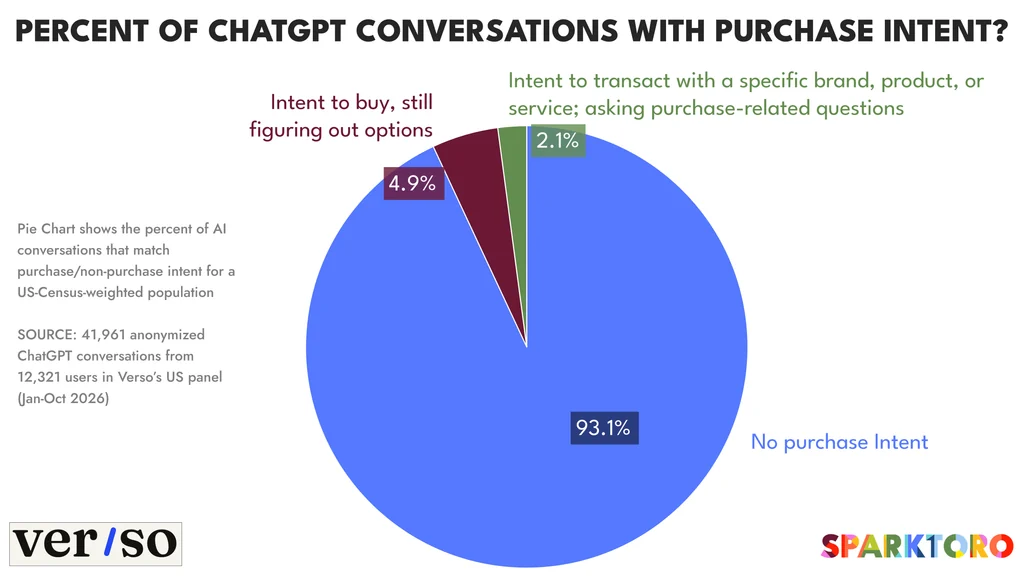
First, SparkToro (November 17) partnered with opt-in panel provider Verso to analyze 118,163 real ChatGPT prompts across 41,961 complete conversations from 12,321 U.S. users between January 1 and October 29, 2026, excluding 131 power users (1% of users who generated 21% of volume) to avoid skew (study). Only 6.9% of consumer ChatGPT conversations showed purchase intent (4.9% researching options, 2.1% asking about a specific brand or product), 93.1% showed no buying intent, and 87.9% mentioned no brand or product at all. Images and visual design (16.1%) and general information/entertainment (14.0%) led usage. Comparing against prior Google query data, SparkToro estimated Google handles about 5.5x more total queries and conservatively 16x+ more purchase-journey queries than ChatGPT—though Verso’s consumer panel excludes enterprise API traffic.
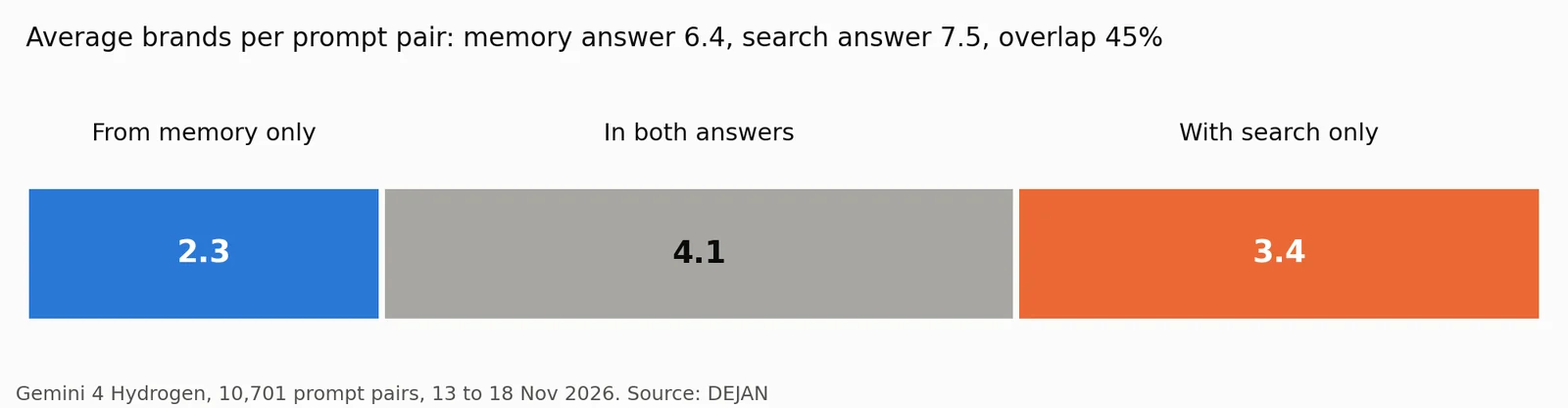
Second, DEJAN (November 18) ran two controlled tests on Gemini 4 Hydrogen, the default model in Google AI Mode. In the first test, without Google Search, Hydrogen failed to name a single real dejan.ai product across 10 attempts (0/10) and guessed from the domain name, whereas larger models Argon and Carbon recalled specific tools; once given search results or the homepage, Hydrogen described the company accurately. In the second test across 10,701 brand questions, switching Google Search on lifted average brands per answer from 6.4 to 7.5, with 45% (3.4 brands) supplied purely by live search and only 1.8% of answer pairs matching exactly. Live search also corrected stale memory: in 70 runs where the model’s reasoning surfaced outdated brand names (such as ESPN BET after its rebrand to theScore Bet), live search overruled them in 69 of 70 final answers.
Third, Seer Interactive (November 18) logged the full reasoning chains and web searches of an OpenAI reasoning model across 20 commercial prompts (study). Fewer than 10% of recommended brands were identified before searching. In Round 1, ChatGPT ran broad discovery queries (49% best/top/review/vs lists, only 13% site:) to build a shortlist; in follow-up rounds, 75% of all queries switched to site: searches targeting candidate websites to verify licensing, certifications, service areas, and pricing. Models typically pruned lists down to five or six options, dropping candidates sitting at position six 90% of the time.
Three additional reports reinforced the practical boundaries of AI visibility metrics:
- AI impressions do not equal revenue: On November 19, Search Engine Land documented London car-hire firm G&M Direct Hire pruning generic informational blog posts in August. Google AI daily impressions plunged 62% (1,535 to 591/day) and Semrush AI citations fell 42.3%, yet actual daily organic clicks rose 14% (235 to 268/day). Informational posts had driven 87% of AI impressions at a 0.27% CTR—much of it from non-convertible U.S. readers—while commercial service pages converted at a 2.1% CTR.
- Silent model swaps jolt ChatGPT citations: Search Engine Land showed on November 16 that OpenAI’s unannounced default model changes repeatedly cut major publishers’ ChatGPT citations by 50%–90% within a week, even for licensed partners. Between April and September, news publishers’ citation share slipped from 28% to 22%, while brand websites rose from 14% to 20%.
- Semrush launches “AI-influenced traffic” (November 18): Semrush added AI-influenced traffic to Organic Rankings 2.0, modeling visits arriving via direct, branded search, or AI referrals within 24 hours of an AI mention (see our November 19 hands-on test of Semrush 2.0). Because it is a probabilistic estimate rather than observed analytics, it should be used for directional prioritization and never added on top of GA4 sessions.
Taken together, these studies keep GEO grounded in SEO fundamentals: organic rankings and third-party comparisons get your brand onto the shortlist, and clear HTML facts on your own website pass the site: verification round.
Google Knowledge Graph drops 10.1% of Person entities as Search Profiles go global
Three related updates highlighted how Google is tightening entity hygiene while expanding user-controlled source signals.
First, Kalicube CEO Jason Barnard reported in Search Engine Land on November 20 that Google’s Knowledge Graph dropped 10.1% of Person entities overnight during its November 15–16 entity refresh (tracking 3,000 people and 3,000 businesses daily), while business entities remained steady. Removals hit sparse, duplicate profiles lacking subtitles or descriptions—18.6% of Person nodes sitting at resultScore 24 disappeared, whereas primary tracked entities anchored to an official entity home retained 100%. Barnard also noted that Google’s Enterprise Knowledge Graph API has removed resultScore altogether.
Second, on November 22, Search Engine Roundtable spotted Google Search Profiles rolling out globally beyond the U.S., Canada, and India, with creators in Spain, Australia, Singapore, Dubai, and Italy able to claim profiles without a VPN. Eligibility still requires at least 10,000 followers on a major social platform (YouTube, TikTok, Instagram, or X), with up to 10 profiles per account. A day later, Google added manual LinkedIn profile management to Search Profiles.
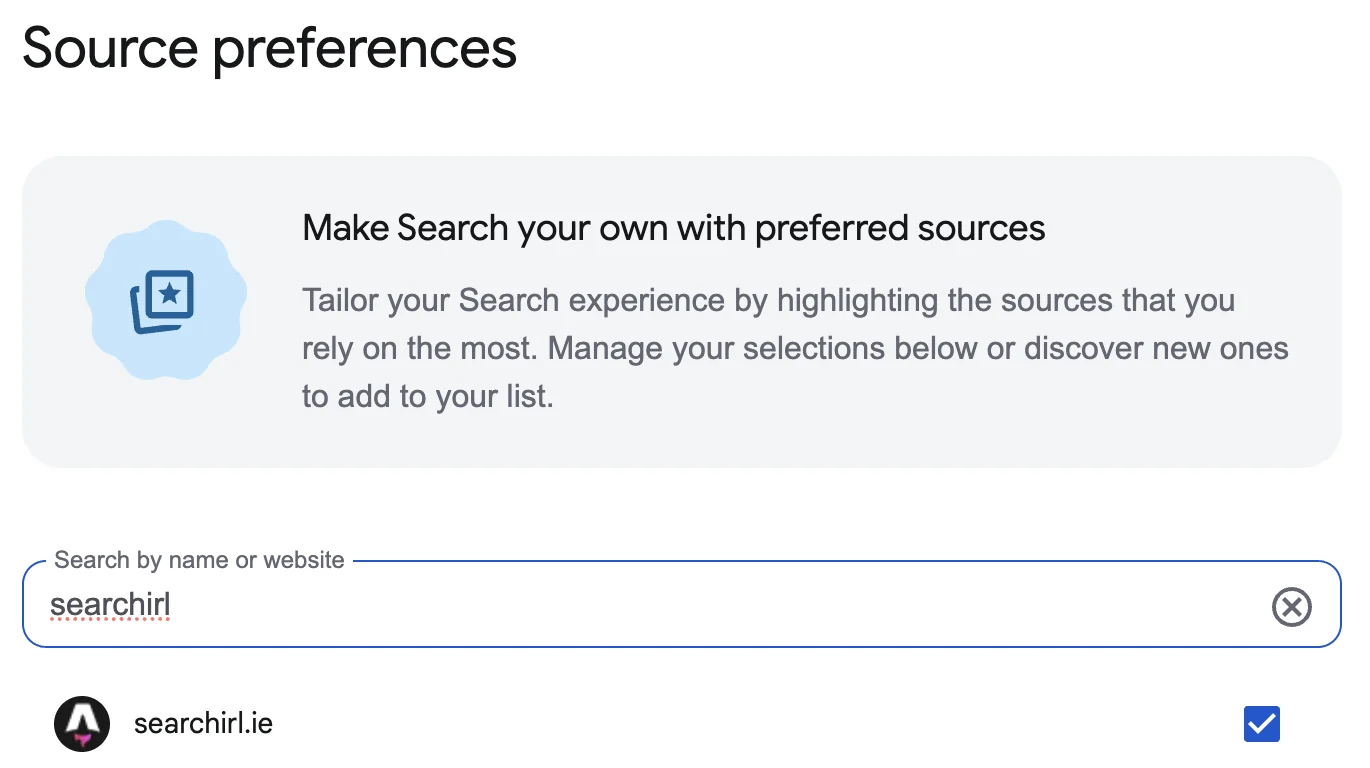
Third, SEO product manager Gus Pelogia published a hands-on guide to Google Preferred Sources on November 19 (featured in SEOFOMO’s November 22 edition). Originally news-only, Preferred Sources now covers any indexed site opted into Search generative AI features, and Google began emailing Search Console subscriber counts in October. Testing 50 to 88 ranking keywords across four domains in AI Mode (udm=50) with Preferred Source toggled on versus off, Pelogia found a clear pattern:
- Total citation counts barely moved (
3fe.com0%,searchengineland.com+3.8%,ge.globo.com+7%,irishtimes.com+20%). - Position 1 placements in the right-hand citation panel surged: #1 citations jumped +216%, +160%, +70%, and +650% across the four sites, with
irishtimes.comlanding #1 on all 30 cited queries (average position improving from 4.16 to 1.0).
The test was small, single-user, and did not pit competing preferred domains against each other, and Pelogia estimated only about one in four CTA clickers actually finished adding the site. Still, because Preferred Sources applies at the domain level immediately on the next page load, brands with loyal readers or newsletter subscribers have a low-effort way to test an invitation link (google.com/preferences/source?q=yourdomain.com).
Bing adds ads to AI Overviews globally as Web IQ and ChatGPT coupons reshape clicks
Outside Google, Microsoft and OpenAI made aggressive moves across AI ads, grounding APIs, and holiday shopping clicks.
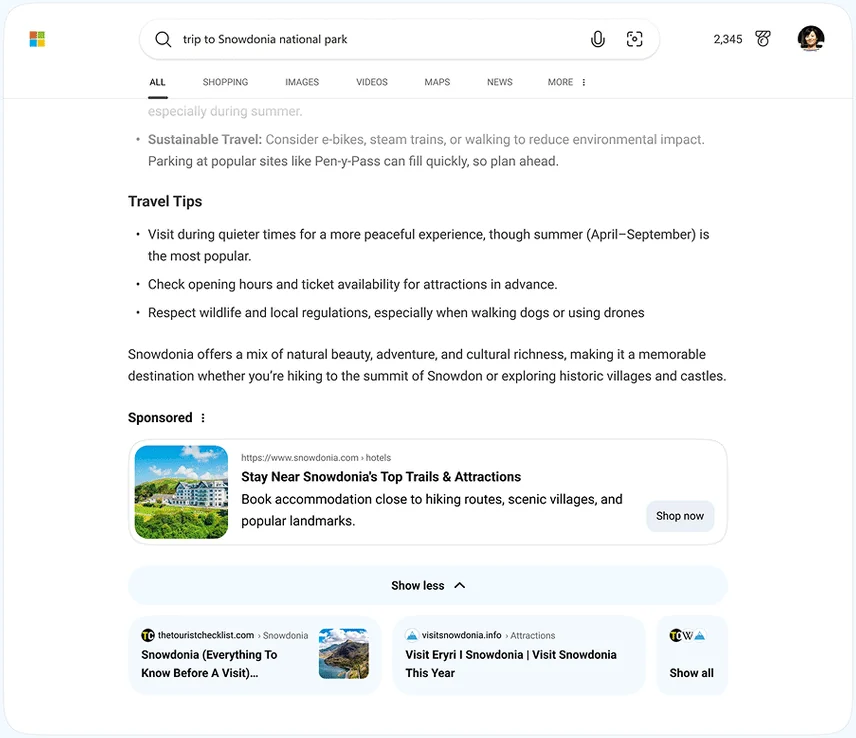
On November 19, Microsoft confirmed that ads are now live inside Bing Search AI Overviews in all markets except China (via Search Engine Roundtable). Advertisers do not need separate campaigns; existing Performance Max and AI Max setups automatically serve alongside research and product-comparison answers, with Microsoft citing a 21% conversion lift when users engage with Copilot. Microsoft Advertising also announced its largest automated bidding model upgrade in over a decade on November 18, followed by AI Max URL inclusion lists and “Made with AI” image labels on November 20.
On the developer side, Microsoft announced at Ignite on November 17 that Microsoft Web IQ is generally available to all Azure customers with lower pricing: $1 per 1,000 calls for /browse, $7 for /web, /news, /images, /video, /places, and private-preview Commerce, $8 for multi-source /auto, and $9 for iterative /auto advanced mode.
Backed by Bing’s index (207 million places and 40 billion structured product offers) with native MCP server support, Microsoft reported an 87.5 score on its FreshSearch benchmark. Crucially, Web IQ Auto focuses on token efficiency by returning concise, cited evidence snippets rather than raw full HTML pages (for broader comparisons, see our Google Search API alternatives guide).
At OpenAI, three interface and commerce updates directly affected referral traffic.
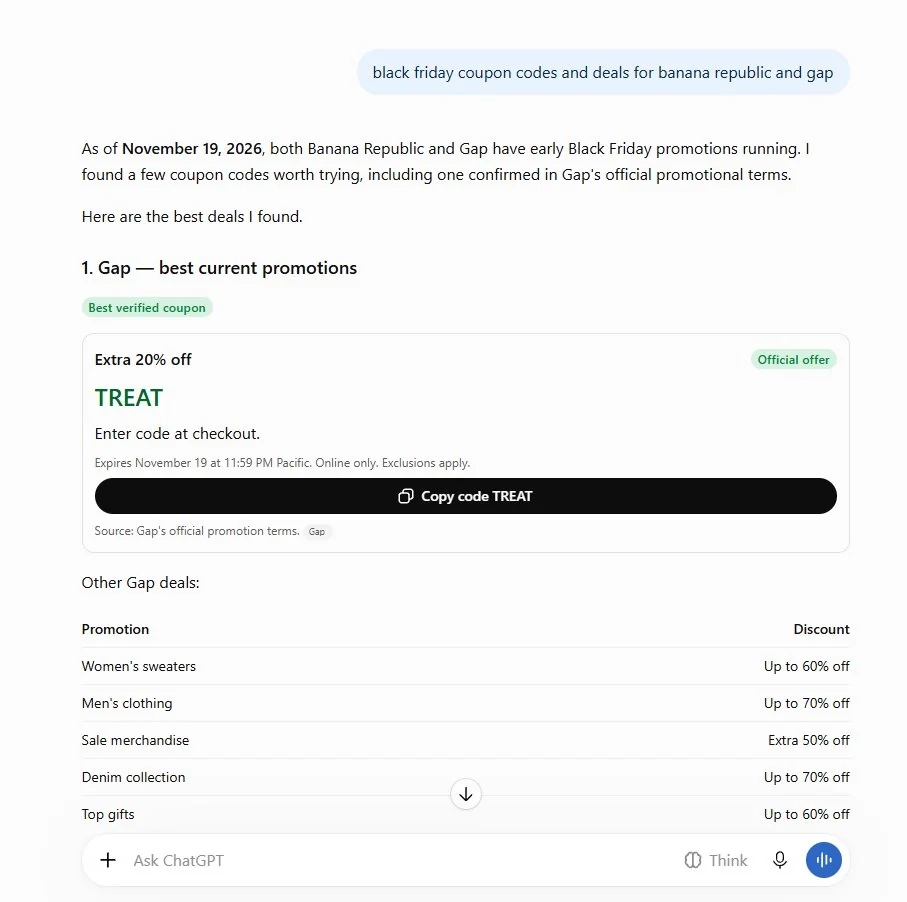
First, Black Friday coupon cards began bypassing affiliates (November 20). Tests shared by Metehan Yesilyurt and Glenn Gabe showed ChatGPT’s free tier rendering interactive promo-code cards with expiration dates and one-click “Copy” and “Get deal” buttons, while Google AI Overviews also surfaced codes directly in answers (via Search Engine Roundtable). Shoppers no longer need to click coupon or affiliate sites to set a commission cookie.
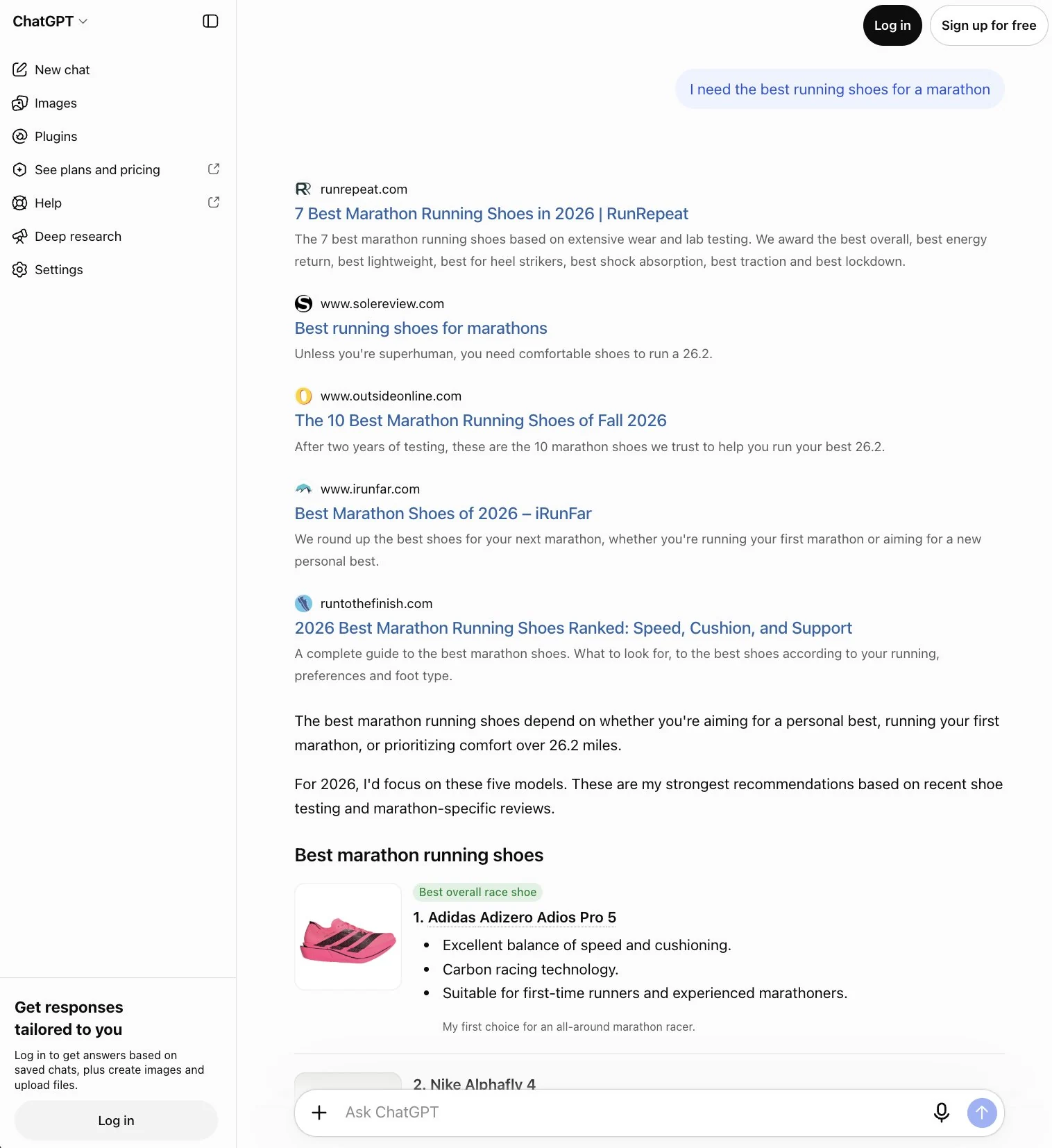
Second, ChatGPT tested five blue links above AI answers (November 16). Logged-out desktop tests spotted by practitioners placed five traditional blue links above ChatGPT’s generated answer, while another variant collapsed the AI summary behind a “See More” button (via Search Engine Roundtable).
Third, ChatGPT Business Agent entered early U.S. tests (November 16–19). Following last week’s Business Hub beta, verified U.S. business profiles began displaying blue checkmarks and “Start chat” buttons (via Search Engine Roundtable). Early tests showed retailers wired up with live product feeds (such as Wayfair) returned interactive product cards, whereas brands without live catalog feeds struggled on specific inventory questions.
Baidu search ads drop below half of core revenue, Tencent shifts to WeChat Xiaowei, DeepSeek waives search tool fees
Quarterly earnings from China’s largest internet platforms and a pricing change at DeepSeek pointed to a clear split between standalone search apps and native ecosystem assistants.
- Baidu Q3 online marketing drops 22% (November 16): In its Q3 2026 earnings release, Baidu reported RMB 30.8 billion in total revenue (-1% YoY). Online marketing fell 22% YoY to RMB 11.9 billion, slipping below half of core business revenue for the first time, while AI Cloud infrastructure surged 94% to RMB 8.2 billion and AI-powered business reached RMB 13.2 billion (53% of general business). Management noted it is prioritizing answer quality over near-term ad monetization during its AI search transition.
- Tencent scales back Yuanbao spending for native WeChat assistant Xiaowei (November 18): Tencent’s Q3 2026 results showed RMB 207.34 billion in revenue (+8% YoY) and 1.449 billion combined Weixin/WeChat MAUs. Even though Tencent had just launched the standalone
so.qq.comYuanbao Search portal on November 11, President Martin Lau acknowledged on the earnings call that Yuanbao had not been as successful as expected and confirmed sharp cuts to standalone acquisition spending (via Sina Finance). Tencent is now betting on Xiaowei, a lightweight AI assistant embedded across more than 30 WeChat touchpoints—Moments, Official Accounts, Channels, Mini Programs, and WeChat Shops—which has already reached 30 million DAU in testing. - DeepSeek drops server-side search tool fees, bills context tokens instead (November 18): Five days after launching its consumer-app API suite, DeepSeek updated its official pricing page: starting November 18 at 12:00 UTC+8, model-triggered server-side web search and URL fetch calls (
web tools, Anthropicweb_search, and Responsesweb_search) no longer incur the separate $0.75 (RMB 5) per 1,000-call tool fee, and Tencent Cloud followed on November 20 with refunds. However, standalone Search API and Fetch API calls remain $0.75 per 1,000 requests, and because server-side search injects retrieved page text directly into the context window, running heavier models or multi-round searches during double-rate peak hours (deepseek-flash$0.30/1M cache-miss input,deepseek-v4-pro$1.32/1M) can easily exceed the old fixed fee—a sharp contrast to Microsoft Web IQ’s snippet-pruning model.
Other Google updates
- Desktop collapsible AI sidebar rolls out globally (November 19): Google Search VP Robby Stein confirmed the global desktop rollout of a left-hand collapsible sidebar so users can jump back into ongoing AI search sessions from the homepage (via Search Engine Roundtable).
- Discover cold-start system “StarSearch” revealed in job listing (November 22): Damien Andell and Barry Schwartz analyzed a Google Discover engineering posting describing
StarSearchas an “intelligent gatekeeper” that bootstraps fresh, niche, and creator supply while rapidly pruning unengaged pages, alongside “zero-history discovery” designed to surface breaking news within minutes and make AIGC a first-class citizen across the stack (via Search Engine Roundtable). - Ask Maps starts calling local businesses for appointments (November 16): On Android and iOS in the U.S., Ask Maps can now call beauty, pet-care, auto, and home-repair businesses to check open slots, with an opt-out toggle in Google Business Profile; Ask Maps also expanded to Europe (via Search Engine Journal).
- AI Overviews expand over local map packs (November 17): Across 480 searches in 12 local service markets, Semrush contributor Chris Shirlow tracked AI Overview presence rising from 38%–60% to 66%–99% within weeks, with AIO business cards pulling details directly from Google Business Profiles (post).
- AI Mode drops model labels and opens Gemini 4 Carbon to Pro users (November 16): Rajan Patel confirmed Google intentionally removed the Gemini model label from AI Mode and rolled out Gemini 4 Carbon to Google AI Pro subscribers (via Search Engine Roundtable).
- Ad pullback, executive advice backlash, and YMYL phone scam warning (November 19–20): Reports in the New York Times and Search Engine Land highlighted small advertisers cutting Google Ads budgets amid rising CPCs and AI-crowded SERPs; Google VP Brendon Kraham’s advice to ditch generic listicles and measure leads drew pushback over limited Search Console attribution (Search Engine Land); and local SEO consultant Andrew Shotland detailed dialing a fraudulent Vanguard support number surfaced by Google AI Overviews, renewing scrutiny over YMYL accuracy (Search Engine Land).
Other industry news
- Behind Adobe’s $1.9 billion Semrush deal (November 19): Former Semrush President Eugene Levin told the Ahrefs Podcast that Semrush had planned to stay independent until Adobe made an unsolicited offer to enter AI search optimization and wire live citation data into Adobe’s enterprise content and personalization stack (via Search Engine Land).
- Perplexity passes $1B ARR and launches Multiagent tools (November 16–17): CEO Aravind Srinivas self-reported passing a $1 billion annual revenue run rate, and Perplexity launched Computer Multiagent (orchestrating up to 16 parallel sub-agents for Max users) alongside its multi-model Orchestrator API.
- Salesforce CEO’s “Goodbye SEO” clashes with Salesforce’s own guide (November 18–20): Promoting AI visibility tool Palmata on X, Marc Benioff declared “Goodbye SEO,” only for readers to point out that Salesforce’s own guide linked from Palmata’s site calls SEO “still the foundation” (via Search Engine Journal).
llms.txtand AI crawler blocking censuses (November 16–18): Shifter checked the top 10,000 websites and foundllms.txtadoption up from 5.9% to 9.3% in six months, even as log audits still show minimal crawler pickup. Dev Toolry audited 496 readablerobots.txtfiles from the top 1,000 domains (highlighted by SERoundtable on November 18): 30.6% block at least one AI crawler, and training bots are blocked nearly twice as often as AI search bots (61% of sites blockingGPTBotstill allowOAI-SearchBot).- Kevin Indig’s Q4 AI search meta-analysis and Forrester layout forecast (November 18–19): Kevin Indig compiled Q4 benchmarks in Search Engine Land, noting that 85% of pages retrieved by ChatGPT never receive a citation and that optimizing titles and meta descriptions outperforms stuffing jargon into body copy. Forrester predicted conversational assistants will trigger the first major shift in website top-nav and search-box layouts in decades.
- DMGT joins anti-scraping coalition SPUR (November 17): The publisher of the Daily Mail and New Scientist joined SPUR, bringing the coalition to more than 80 U.S. and European publishers pushing shared usage standards and enforcement. Elsewhere, the
.seoTLD advanced to ICANN’s final list on November 20, and Anthropic completed its Nasdaq IPO on November 19.
Linus’s notes
Looking across the week as a whole, two shifts hit a turning point at the same time: AI search moved past slogans into measurable mechanics, and ecommerce security pressure moved squarely into the browser frontend.
Start with diagnosing the November core update. Even though Google marked the rollout complete on November 24, I still recommend waiting until early December before making structural changes. Over the past two weeks, four separate variables collided: Black Friday promotional spikes, poisoned SERPs polluting rank trackers, Search Console bot clicks, and Google’s switch to Gemini 4 Hydrogen in AI Mode. Acting on a third-party rank chart right now is an easy way to fix a problem that only exists in a scraper.
With brandedClassification finally live in the Search Analytics API on November 16, the cleaner approach is to compare early December against a November 3–8 baseline across three first-party sources: non-branded Search Console clicks, GA4 organic sessions, and real store orders.
The three AI search studies this week are equally useful as a reality check. After a year of sales decks predicting the end of search, SparkToro shows fewer than 7% of consumer ChatGPT conversations carry purchase intent, meaning Google Search and AI Overviews remain the primary commercial battleground. Meanwhile, DEJAN and Seer Interactive pulled back the curtain on brand selection: mid-sized brands cannot count on model memory. Models build their shortlist through broad search and third-party comparisons, and then send 75% of follow-up queries via site: directly to candidate websites to verify pricing, credentials, and coverage.
Pair that with the London car-hire case—where deleting generic blog posts cut AI impressions by 62% while lifting actual organic clicks by 14%—and the priority is straightforward: stop publishing generic informational filler to pad AI visibility scores, and put concrete prices, specs, certifications, and policies in plain HTML on your commercial pages. As I noted in our Semrush 2.0 hands-on test, Semrush’s new “AI-influenced traffic” figure is a modeled estimate—useful for prioritizing topics, never something to stack onto GA4 revenue reporting.
On the security side, Shopify’s November 19 allowed_sources rule and the November 16 Optimizely script compromise tell the same story. Trusting a third-party vendor’s CDN domain is no longer enough when an attacker can abuse an account workflow to inject card-skimming code into a legitimate tag.
Once December 1 arrives, Shopify merchants should monitor admin warnings closely, remove idle storefront apps after Black Friday, and keep payment collection inside hosted payment iframes rather than custom site forms. WordPress teams should audit Rank Math versions, scan for injected files tied to SEO poisoning, and test WordPress 7.2’s /random/ redirect in staging before December 8 so noindex custom post types do not accidentally surface.
Google’s new Google-Agent documentation adds another operational nuance for WAF and CDN configurations. Because Google-Agent acts on user commands, it ignores robots.txt and moves deeper than landing pages into on-site search, filters, and add-to-cart endpoints. Blanket bot blocks or blanket CAPTCHAs will either break agentic buying or hurt Googlebot crawling. Separate training crawlers from search crawlers, verify user-triggered agents via official IP lists or Web Bot Auth signatures, and test any rule changes with our AI Crawler View and AI Crawler Log Analyzer.
Finally, the entity and platform updates point in one direction. Google clearing 10.1% of sparse Person nodes overnight while expanding Search Profiles globally and rewarding Preferred Sources in AI Mode underscores the payoff of clean, consistent entity homes (worth auditing with the Entity Consistency Checker).
At the same time, ChatGPT’s copyable Black Friday coupon cards, Tencent pulling back on standalone Yuanbao to lean into native WeChat Xiaowei, and DeepSeek charging token bills on full search context all show how fragile thin intermediary traffic shells have become. Owning structured product feeds, verifiable first-party facts, and repeat customer touchpoints matters more than chasing whichever platform offers temporary reach.
What this means for you
- Schedule your core update review for early December: Annotate November 10 (start), November 13 (main volatility), and November 24 (completion) in your reports. Wait until Black Friday noise clears, compare against November 3–8 using the new
brandedClassificationdimension in the Search Analytics API alongside GA4 sessions and actual orders, and avoid structural edits based solely on third-party rank trackers. - Audit Shopify storefront apps and AI checkout controls: Watch for
allowed_sourceswarnings in Shopify admin starting December 1, confirm with app vendors that declarations will ship before January 1, 2027, and uninstall unused storefront apps. Review the new ChatGPT agentic checkout toggle inside Agentic Storefronts and populate product option swatches so AI channels can pull them via the Catalog API. - Run three security and upgrade checks on WordPress sites: Confirm Rank Math and other SEO plugins are fully patched and scan for unauthorized JS or upload-directory spam (guarding against Gootloader-style poisoning). If you run Optimizely or similar A/B testing scripts, audit project JavaScript and user access. Before upgrading to WordPress 7.2 on December 8, check whether any custom post types are exposed to
/random/and disable it withwp_enable_random_content_redirectif needed. - Optimize commercial pages for ChatGPT’s second-round
site:verification: Review key product, service, pricing, and About pages to ensure pricing, specs, certifications, service regions, and return terms sit in plain HTML rather than images or interactive-only widgets. Prune generic informational posts that generate impressions without clicks or conversions. - Configure layered bot and
Google-AgentWAF rules: Manage AI training bots and AI search bots separately inrobots.txtand CDN rules. If you want to accept user-triggered Google agents, verify requests viauser-triggered-agents.jsonand Web Bot Auth signatures, and verify that on-site search, filtering, and cart APIs are not blocked by CAPTCHAs or per-IP rate limits. - Strengthen entity anchors and tighten coupon attribution: Align brand and author bios across your official entity home and social profiles; eligible creators can now claim Google Search Profiles globally, and sites with repeat readers can test a Preferred Sources link in newsletters or blog footers. Brands running affiliate or creator promos should migrate away from public generic coupon codes toward link-bound exclusive codes so AI coupon cards do not strip attribution.
SEO & AI Weekly, Nov 16–22: AI Brand Studies & Shopify Rules
https://www.linusseo.com/en/google-seo-and-ai-newsletter-linus-thoughts-261122/