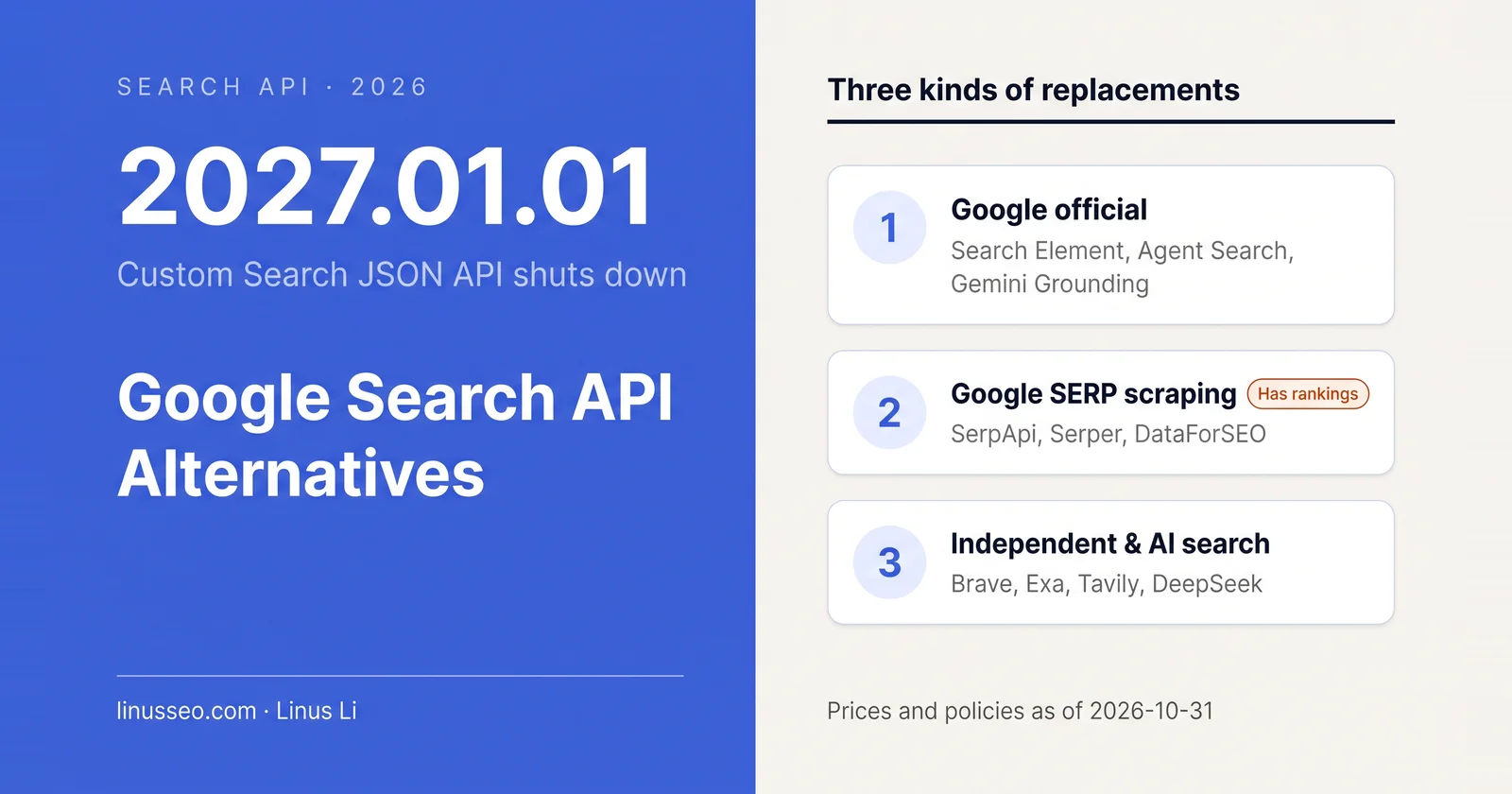
Google Search API Alternatives: How to Get Google Search Results


Years ago during my NeverSec days, I wrote a technical note explaining how to query Google’s Custom Search JSON API. That interface is now closed to new customers and will permanently shut down on January 1, 2027. Recently, developers building SEO tooling, scrapers, and AI applications have been asking the same question: once it shuts down, how do you continue retrieving Google search results?
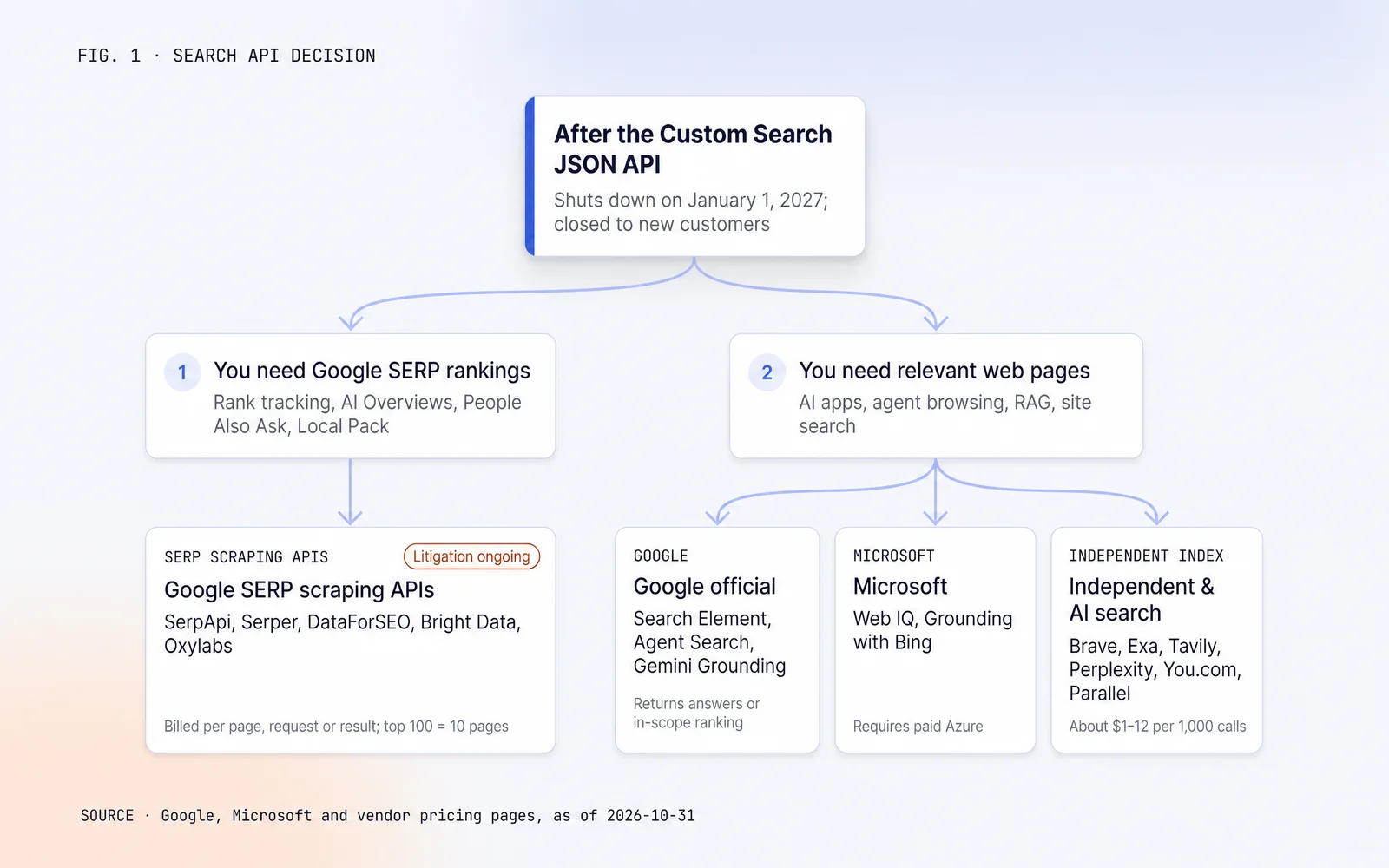
As of October 31, 2026, Google offers no self-service official API that returns full-web search rankings. Many teams only realized after the deprecation notice that while it was named Custom Search, it was widely used as a lightweight SERP interface. Now that Google has closed that door, you face a single architectural fork: do you need real Google SERP rankings, or do you simply need usable web pages?
If you need the former (rank tracking, SERP feature monitoring, competitive share-of-voice), official grounding APIs cannot help. You must use third-party SERP scraping APIs. If you need the latter (AI agent web access, RAG retrieval), independent search indexes are cheaper, faster, and free of scraping-related legal risks.
If you just need to connect an API immediately, skip to the prompt in the next section.
TL;DR: Copy this prompt into your AI coding tool
If you prefer not to write integration code manually, give this prompt to a local AI coding agent such as Claude Code, Codex, or Kimi Code. Fill in the bracketed parameters, and it will set up the environment, configure API keys, write the request script, and export your results to a CSV file.
1 | You are an engineering assistant familiar with search APIs. Google's Custom Search JSON API is closed to new customers and will shut down on January 1, 2027. Help me retrieve search results using a third-party search API and save them to a spreadsheet. |
When running automated search scripts, keep three engineering considerations in mind:
- Scraping APIs return parsed HTML snapshots captured by proxy nodes at a single point in time. When Google’s anti-bot defenses trigger challenges (such as SearchGuard), response structures may omit specific fields. Your parsing logic must handle null values and retry gracefully.
- Automated scripts without rate limiting can burn through a provider’s free tier in seconds. Always limit batch sizes on initial runs.
- Store API keys in a local
.envfile and ensure it is included in.gitignore. Never hardcode secrets in source files or paste them into shared chat threads.
For power users: Direct curl examples
Serper (Google SERP snapshot; gl is country, hl is language):
1 | curl -X POST 'https://google.serper.dev/search' \ |
SerpApi (Google SERP snapshot):
1 | curl --get 'https://serpapi.com/search.json' \ |
Tavily (Relevant web pages and text extracts):
1 | curl -X POST 'https://api.tavily.com/search' \ |
Verify parameter schemas against provider documentation before deploying to production.
Key points
- Custom Search JSON API is closed to new customers and permanently sunsets on January 1, 2027. Google recommends Programmable Search Element, Agent Search (formerly Vertex AI Search), Gemini Grounding with Google Search, or an application-only full web search solution.
- None of Google’s official replacements return rank positions from Google search results pages. Rank tracking, AI Overview detection, and People Also Ask analysis require third-party SERP scraping APIs like SerpApi or DataForSEO.
- SERP scrapers carry vendor and legal risks. Google sued SerpApi in December 2025; a federal court dismissed Google’s initial DMCA circumvention claims for uncopyrightable search results in July 2026, but the litigation remains active under an amended complaint.
- AI applications, agent tool calling, and RAG pipelines generally do not need SERP rank numbers. Providers like Brave, Exa, Tavily, DeepSeek, and Microsoft Web IQ deliver high-quality index retrieval at $0.75 to $12 per 1,000 queries.
- Pricing models vary widely across vendors: per query, per prompt, per SERP page, per credit, or per scraped URL. Normalize billing units before comparing costs.
When does the legacy API shut down?
Google structured the retirement of Custom Search JSON API in two stages. On January 20, 2026, Google announced search product adjustments on the Programmable Search Engine blog. Shortly after, documentation was updated to reject new registrations:
| Date | Event |
|---|---|
| 2026-01-20 | Newly created Programmable Search Engines are restricted to “Sites to search” (up to 50 domains). Engines with “Search the entire web” enabled prior to this date function until 2027-01-01. Full-web users are directed to an interest form. |
| ~2026-02-18 | Official API documentation states Custom Search JSON API no longer accepts new customers. |
| 2027-01-01 | Custom Search JSON API completely shuts down. Existing customers must migrate. |
Legacy users continue under existing pricing until the shutdown date: 100 free requests per day, then $5 per 1,000 requests, capped at 10,000 daily requests. This tier is closed to new projects.
For power users: Official wording and full-web settings
From the API overview page (developers.google.com/custom-search/v1/overview):
The Custom Search JSON API is closed to new customers. Vertex AI Search is a favorable alternative for searching up to 50 domains. Alternatively, if your use case necessitates full web search, contact us to express your interest in and get more information about our full web search solution. Existing Custom Search JSON API customers have until January 1, 2027 to transition to an alternative solution.
The “Search the entire web” toggle: new engines created after 2026-01-20 cannot enable this setting. In the Google support community, a community manager confirmed that once disabled, this option cannot be re-enabled. If your legacy engine still has it active, do not turn it off.
Custom Search JSON API is distinct from the older Site Restricted JSON API, which had its own deprecation schedule.
Clarify your goal: SERP rankings or usable web pages?
Search alternatives fall into two distinct architectural categories.
The first category returns snapshots of the Google search results page. You provide a keyword, country, language, and device type. The API returns organic rankings, sponsored ads, AI Overviews, People Also Ask boxes, and local map packs, each with an exact position index. Rank tracking systems, SERP feature monitors, and competitive intelligence tools require this data. No search engine vendor provides an official API for this use case; it is served exclusively by third-party scraping infrastructure.
The second category returns a set of relevant web documents. The underlying index may belong to Google (Grounding with Google Search), Microsoft Bing (Web IQ), or independent index providers (Brave, Exa, DeepSeek). The ordering reflects the provider’s internal relevance algorithm rather than Google’s organic SERP positions. AI agents, autonomous research workflows, and RAG pipelines use this category.
The practical difference is clear: if you need to know which domain ranks #3 on Google US for “yoga mat”, you must use the first category. If you need an AI assistant to explain “how to clean a yoga mat” with authoritative citations, the second category is cheaper, faster, and legally unencumbered.
During our benchmark of the DeepSeek Search API against Google across 378 queries, the URL Jaccard similarity between the two engines was only 0.006 (virtually zero overlapping URLs), yet blind evaluation of top-5 result relevance resulted in a statistical tie. Google’s organic SERP heavily favors established authority domains (Wikipedia, forums, legacy publications), whereas newer semantic search engines favor direct, clean, long-tail technical documents. For SEO monitoring, Google’s authority ranking is non-negotiable; for AI agents, answer relevance is what matters.
How search works in AI coding agents
Many developers encounter search APIs when configuring AI coding tools like Claude Code, Codex, or DeepSeek Harness. Each tool relies on a different search backend:
| Tool | Default search backend |
|---|---|
| Claude Code | Anthropic search backend (non-configurable) |
| Codex | OpenAI cached index by default (switchable to live web) |
| DeepSeek Harness | DeepSeek internal search engine |
| Gemini CLI | Google Search grounding (synthesized answer with citations) |
| Kimi Code | Moonshot AI search service |
| Pi | No built-in search |
When an AI agent searches, the model formulates a query, the tool dispatches it to a backend, and the returned snippets enter the agent’s context window. To get actual Google SERP rankings inside these agents, you must connect a scraping service via MCP. For detailed configuration steps, see Connecting AI Coding Agents to Google Search: Claude Code, Codex, and DeepSeek Harness.
Google’s four official paths
Google points Custom Search JSON API users toward four products. None of them serve as a direct drop-in replacement for querying full-web Google SERP rankings via code.
| Solution | Best for | Pricing | Returns Google SERP ranks? |
|---|---|---|---|
| Programmable Search Element | In-page website search bar | Free standard tier (with ads) | No |
| Agent Search (formerly Vertex AI Search) | Programmatic search across fixed sites | $1.50 or $4.00 per 1,000 queries | No |
| Grounding with Google Search | Gemini LLM web grounding with sources | Gemini 3: $14 per 1,000 search queries | No |
| Full Web Search Solution | Enterprise web search | Unannounced / Waitlist | Unannounced |
Programmable Search Element: Site search widget only
If your goal is embedding an interactive search box on your website, Programmable Search Element is sufficient. It is a client-side JavaScript widget rendered inside the user’s browser.
The standard tier is free with no daily query cap, but results display Google ads. Eligible non-profits and educational institutions can apply for an ad-free version. The previous $5 per 1,000 queries paid ad-free version (Paid Element) is no longer open to new customers.
Terms of Service mandate that Google branding remain intact, result ordering cannot be modified, and data cannot be stored or combined with other feeds. It is a frontend widget, not a programmatic data API.
Agent Search: Programmatic search over fixed domains
Agent Search (formerly Vertex AI Search) allows developers to query a defined group of domains, such as internal web properties or curated documentation hubs.
Pricing is based on query volume:
- Standard Edition: $1.50 per 1,000 queries;
- Enterprise Edition: $4.00 per 1,000 queries. Website Search requires Enterprise Edition;
- Advanced Generative Answers: adds $4.00 per 1,000 user queries;
- Each billing account receives a 10,000 query free monthly trial (excluding Advanced Generative Answers); index storage incurs separate charges.
Google’s migration guide suggests creating an Enterprise search application with a “Website Content” data store, adding URL patterns, disabling generative responses and advanced indexing, and calling the searchLite endpoint.
Documentation notes two different constraints: official announcements mention a cap of “up to 50 domains”, while Agent Search data configuration guides state 50 URL patterns for basic indexing and 500 for advanced indexing.
Agent Search ranks results according to its internal relevance model across your indexed domains. Result #1 does not represent rank #1 on Google.com.
For power users: Response structure and migration steps
Inside SearchResponse, results[] contains document and derivedStructData (holding title, link, snippets, and extractive_segments). Enabling generative answers introduces summary and citation objects. This schema differs completely from the legacy items[].title / link / snippet structure.
Migration path: Enable Agent Search → Create Search App (Enterprise) → Disable Generative Answers → Create Data Store (Website Content) → Disable Advanced website indexing → Define URL patterns → Call via searchLite (API key) or search (OAuth).
Pricing reference: Standard at $1.50/1k, Enterprise at $4.00/1k, Advanced Generative Answers at +$4.00/1k, free tier at 10,000 queries/month per account.
Grounding with Google Search: Web access for Gemini models
Grounding with Google Search is a tool integrated into the Gemini API. When prompted, Gemini determines search queries, retrieves live web data, and synthesizes an answer with source citations. It leverages Google’s web index, but returns synthesized output and citation links rather than an open result list.
Pricing mechanics shifted between Gemini 2.5 and Gemini 3:
| Model family | Billing metric | Price | Free tier allowance |
|---|---|---|---|
| Gemini 3 and newer | Actual search requests executed by model | $14 per 1,000 requests | 5,000 requests/month shared across Gemini 3; default 1,500 RPD |
| Gemini 2.5 | Grounded user prompts | $35 per 1,000 grounded prompts | 1,500 RPD free tier |
Under Gemini 3, billing tracks actual model-initiated searches rather than user turns. A multi-step query can trigger three or four distinct search calls, multiplying query costs.
Three critical terms of service apply:
- Production user interfaces must display Google Search Suggestions, which must link directly to Google search results without intermediate redirects.
- Results cannot be cached, resold, used to train machine learning models, or crawled to construct a competing index.
- Attributed source links must be visible to end users.
This tool is well-suited for interactive assistants, but terms prohibit headless batch processing and SERP position extraction.
For power users: Grounding metadata and retention policies
The API response returns groundingMetadata containing webSearchQueries (the queries formulated by the model), groundingChunks (source web pages), groundingSupports (segment-level citation mappings), and searchEntryPoint.renderedContent (Google-provided HTML/CSS search suggestions).
Retention policies: Gemini API terms permit storing grounded output in conversational history; Google retains prompts and completions for 30 days for operational maintenance. On Vertex AI Agent Platform, the zero-data-retention policy lists up to 3 days of logging for Google Search grounding.
Full Web Search Solution: Partner-only waitlist
Google’s announcement mentions a “full web search solution” backed by an interest form requiring company name, Programmable Search Engine ID, website, daily query volume, and specific business needs. As of October 31, 2026, Google has not published pricing, quotas, schema definitions, or public customer references.
In September 2026, Search Engine Journal reported that Google briefly published developer documentation for a partner-only Web Search Service supporting REST and gRPC with client ID verification, capped at 20 results per request. The documentation was taken down within weeks without explanation.
This route is restricted to select strategic partners. Developers should not base near-term production migration plans on this option.
Microsoft: Bing Search API retired, two interfaces remain
Microsoft retired the legacy Bing Search API on August 11, 2025, deactivating existing instances and closing new signups. Two alternatives exist within the Azure ecosystem:
| Endpoint | Output type | Pricing | Access requirement |
|---|---|---|---|
| Grounding with Bing Search | Synthesized model response with citations | $14 per 1,000 tool executions | Paid Azure subscription |
Web IQ /web |
Structured web documents with titles, URLs, and snippets | $7 per 1,000 requests | Paid Azure subscription; access subject to approval |
Grounding with Bing Search operates inside Azure AI Foundry agents. Raw search results are not exposed to external programmatic consumers, and terms prohibit using outputs for model training or competing databases.
Microsoft Web IQ, launched in June 2026, returns ranked web documents, URLs, and text snippets without LLM synthesis. Effective October 16, 2026, /web, /news, /images, and /video cost $7 per 1,000 requests; the /browse document extraction endpoint costs $1 per 1,000 requests. Standard throughput is 15 requests per second, and Azure promotional trial credits cannot be applied.
Web IQ is Microsoft’s closest functional equivalent to a standalone search API, but result ordering reflects Web IQ relevance rather than Bing.com organic rankings.
For power users: Bing retirement timeline and Web IQ terms
Microsoft’s lifecycle notice (learn.microsoft.com/en-us/lifecycle/announcements/bing-search-api-retirement) designated 2025-08-11 as the complete retirement date.
Web IQ documentation notes that API access is “subject to review and approval.” Terms require displaying source links alongside AI responses and restrict mass caching or competing database construction.
SERP scraping APIs: The only path to organic rankings
For rank tracking, competitive visibility, and SERP feature monitoring, third-party scraping infrastructure is the only viable method. These providers dispatch requests through residential and datacenter proxies, parse Google’s HTML, and deliver structured JSON:
| Provider | Billing unit | Price per 1,000 units | Free tier | Notes |
|---|---|---|---|---|
| SerpApi | Successful search | $25 (starter) to ~$9.17 (high volume) | 250 searches/month | Comprehensive schema; dedicated parsing for AI Overviews and local packs |
| Serper | Credit (typically 1 per query) | $1.00 to $0.30 | 2,500 credits one-time, no credit card required | Cost-effective; credits expire after 6 months |
| DataForSEO | SERP page (10 results) | Queue $0.60 / Priority $1.20 / Live $2.00 | $1 trial credit, $50 minimum deposit | Balances do not expire |
| Bright Data | Successful request | $1.50 | 5,000 requests/month, no credit card required | Multi-engine support; JSON, HTML, and Markdown output |
| Oxylabs | Successful result | $1.00 (raw HTML) / $1.35 (JS render) | 2,000 trial requests, no credit card required | Enterprise scraping infrastructure |
Three operational realities dictate cost and system reliability beyond headline rates.
Fetching top 100 rankings requires 10 requests and sticky sessions
In September 2025, Google confirmed to Search Engine Land that the num=100 URL parameter is not an officially supported feature. Modern Google searches return approximately 10 results per page.
Tracking the top 100 positions for a keyword now demands 10 consecutive or parallel requests. Under DataForSEO, checking the top 100 positions for 1,000 keywords costs $6 in queue mode or $20 in live mode, compared to one-tenth that cost for top 10 positions.
Furthermore, multi-page retrieval introduces proxy consistency issues: if pagination requests rotate through arbitrary proxy exit nodes, page 1 might originate from a Los Angeles node while page 2 originates from Dallas. Google’s localized personalization causes duplicate entries or missing ranks across pages. Providers must support session-sticky proxies. In practice, tier your keyword portfolio: monitor top 50–100 positions for high-value head keywords, and track top 10–20 for standard long-tail phrases.
SERP results are volatile, dynamic snapshots
A scraping API returns a point-in-time snapshot tied to specific geographic coordinates (UULE), device user-agents, and localization settings. Google continuously runs SERP experiments, while its SearchGuard system issues dynamic JavaScript challenges and browser environment checks. Scraper latency fluctuates between 800 ms and 4 seconds depending on anti-bot friction.
Furthermore, AI Overviews and local packs consume significant above-the-fold space. A URL sitting at “organic position 3” may be pushed below the second fold on mobile devices. Monitor both absolute ranking and presence of SERP layout features.
Google v. SerpApi: Technological protection and public data
On December 19, 2025, Google filed suit against SerpApi in the U.S. District Court for the Northern District of California (Case No. 4:25-cv-10826-YGR). Google alleged that SerpApi bypassed its SearchGuard anti-bot defenses, violating the Digital Millennium Copyright Act (DMCA) § 1201 prohibition against circumvention of technological measures controlling access to copyrighted works.
On July 20, 2026, the court granted SerpApi’s motion to dismiss in part:
- For search results lacking copyrighted content, the DMCA claim was dismissed without leave to amend. Factual search data (URLs, titles, snippets) is not protected by copyright law, and circumventing anti-bot defenses to access uncopyrightable facts does not constitute a DMCA violation.
- For portions containing copyrighted assets (such as third-party licensed images in knowledge panels), Google failed to plead that copyright owners authorized it to deploy SearchGuard to protect those works. The court granted Google leave to amend this portion.
Google filed an amended complaint on August 10, narrowing its claims to protected licensed content; SerpApi filed a renewed motion to dismiss on August 24. As of October 31, 2026, the renewed motion remains pending.
While the ruling reaffirmed that factual search results are public data, scraping SERPs still carries platform risk. Google may pursue contract-based claims or escalate technological countermeasures. In your software architecture, never tightly couple application code to a single vendor’s SDK. Implement a standardized gateway adapter that normalizes inputs and outputs, allowing you to switch scraping providers via environment variables within minutes.
For power users: Court docket and legal background
From the July 20, 2026 ruling (FindLaw): Claims concerning non-copyrightable data were dismissed “without leave to amend.” Claims concerning copyrightable components were dismissed “with leave to amend” due to Google’s failure to adequately plead that SearchGuard was deployed with copyright holder authorization. The court found Google sufficiently alleged facts supporting the inference that SerpApi circumvented SearchGuard.
Subsequent docket entries: Dkt. 45 amended complaint (08-10); Dkt. 49 renewed motion to dismiss (08-24); Dkt. 57 order denying SerpApi motion to compel license agreements (09-15); Dkt. 58 Google opposition (09-15); Dkt. 59 SerpApi reply (09-29); 10-05 order vacating hearing. A docket entry on 10-13 (Dkt. 61) notes a “Statement of Recent Decision.”
Docket number: 4:25-cv-10826-YGR (a clerical error on the cover page of Google’s initial filing read 5:25-cv-10826).
Modern AI-native search APIs: Tavily, DeepSeek, and Exa
If you are building AI agents, RAG pipelines, or autonomous research assistants and do not require exact Google SERP positions, your ideal replacement for Custom Search JSON API is not a traditional SERP scraper, but the new generation of search APIs designed specifically for language models.
The paradigm shift: From blue links for humans to clean chunks for LLMs
Legacy search APIs (such as Google CSE or Bing Web Search) were architected for human clicks. They returned three basic fields: title, url, and a truncated 100-to-150-character snippet.
In modern LLM applications, a 150-character snippet provides insufficient factual context. Having an agent fetch each destination URL manually introduces three critical points of friction:
- Anti-bot interception: Target domains frequently deploy Cloudflare Turnstile, CAPTCHAs, or hotlink protections, causing autonomous scrapers to throw 403 or 503 errors;
- HTML boilerplate extraction: Raw web pages are cluttered with navigation headers, cookie banners, tracking scripts, and advertisements, requiring custom Trafilatura or Readability parsers;
- Latency and token bloat: Secondary fetching adds 2 to 5 seconds of latency per page, while unparsed HTML can easily consume tens of thousands of tokens, exploding model inference costs.
Modern AI-native search APIs (Tavily, DeepSeek, Exa, and their peers) consolidate full-web search, document scraping, markdown sanitization, and relevance reranking into a single API call: you supply a query, and the API returns structured, cleaned text chunks ready for immediate context injection.
| Provider | Retrieval paradigm and index source | Price per 1,000 queries | Free tier | Key architectural strength |
|---|---|---|---|---|
| DeepSeek Search API | Independent web index with two-stage reranker | $0.75 | Pay-as-you-go; free promotional tier in Harness/Codex | Lowest price in market; returns ~1,000-char summaries and rerank_score |
| Tavily | Agent-optimized retrieval with upstream fallback | $8.00 ($0.008/credit) | 1,000 credits/month, no credit card required | Out-of-the-box RAG context; deep integration across agent frameworks |
| Exa | Neural semantic search with vector embeddings | $4 / $7 / $12 (Lite / Auto / Deep) | $10 credit + $10 bonus, no credit card required | Exceptional semantic discovery and find_similar link matching |
| Brave Search API | Independent index (BraveBot), no syndication | $5.00 | $5.00/month (~1,000 queries), credit card required | Genuine Western independent index; clear privacy and data sovereignty |
| Perplexity Search API | Proprietary index and syndicated sources | $5.00 Standard / $1.00 Fast | No public free tier | High recency; returns ranked structured results without LLM synthesis |
| You.com | Independent web and news index | $5.00 | $10 credit (~2,000 queries) | Full-page text extraction; free MCP tier |
| Parallel | Compressed web index | $1.00 / $5.00 | Up to 5,000 queries/month, card may be required | High-density fact compression for minimal token consumption |
Tavily: Purpose-built RAG context engine
Tavily is widely integrated across LangChain, LlamaIndex, and developer agent frameworks. It is designed not as a consumer search engine, but as middleware providing RAG-ready context to LLMs.
- Clean context extraction: Tavily parses target pages server-side, strips navigational boilerplate, and returns structured Markdown text chunks;
- Direct answer generation: With parameters like
include_answer, Tavily synthesizes a concise factual answer alongside source confidence scores; - Billing structure: Billed per credit (1 credit for basic search; advanced depth searches consume additional credits). Developers receive 1,000 free monthly credits without credit card registration.
A key operational nuance is data sourcing and privacy: Tavily’s privacy policy notes that when its internal index and cache miss long-tail queries, it may dispatch searches to third-party providers (including Google). If you handle sensitive or confidential queries, verify these data-handling terms.
DeepSeek Search API: Disruptive pricing and algorithmic transparency
DeepSeek’s Search and Fetch APIs have drawn significant attention in developer communities due to aggressive pricing and unprecedented retrieval transparency.
- Disruptive cost structure: Priced at $0.75 per 1,000 successful queries (5 RMB), with unbilled failed or empty requests. This is roughly one-tenth the cost of competing AI search APIs, making it ideal for high-frequency agent tool loops;
- Direct long-form summaries: Responses include rich text excerpts extending up to 1,000+ characters, eliminating the need for secondary HTML fetch requests;
- Exposing retrieval and reranking scores: Where traditional search engines hide ranking logic behind black boxes, DeepSeek Search API outputs the static host-level label
authority(scores 0 to 4 based on domain authority) and the dynamic cross-encoder scorererank_score(continuous values from 0 to 3). Results are sorted strictly by descendingrerank_score; - Empirical performance: In our 378-query benchmark, DeepSeek exhibited a strong recency bias (59% of trending query results were published within 7 days) and performed exceptionally well on technical documentation, programming syntax, and product queries. However, coverage of Western community platforms (such as Reddit, YouTube, and Medium) and navigational brand homepage queries was noticeably lower than traditional Google search.
For autonomous coding agents and high-throughput multilingual RAG pipelines, DeepSeek offers the lowest operational cost per query available.
Exa: Neural embeddings search
Exa bypasses traditional lexical keyword matching (BM25) in favor of high-dimensional neural vector embeddings.
- Semantic concept discovery: Exa retrieves documents based on conceptual meaning even when the query does not share literal keywords with the target text;
- Similarity search: The
find_similarendpoint takes an example URL and discovers other web pages sharing the same structure, tone, or topic; - Operational tradeoffs: Exa excels at academic exploration, competitive intelligence, and thematic discovery. However, for verbatim code syntax, error strings, or exact navigational domain queries, vector retrieval can occasionally be less precise than traditional inverted indexes.
Architectural recommendations
When selecting an AI-native search API:
- For coding agent loops and high-frequency RAG: Choose DeepSeek Search API (lowest cost, rich summaries) or Tavily (turnkey Markdown context and broad framework support);
- For deep competitive intelligence and semantic exploration: Choose Exa for vector similarity and link discovery;
- For data sovereignty and complete independence from upstream syndication: Choose Brave Search API for its autonomous index.
For power users: Public benchmarks and specialized endpoints
- Parallel benchmarked its engine against Exa, Tavily, and Perplexity using 100 SimpleQA Verified prompts scored by LLMs.
- OpenBenchmarks Labs tested coding agent web search across 100 developer documentation tasks over 3 runs. Exa Deep led in search-plus-scrape workflows, while Perplexity performed best in search-only tests.
- SearchPipe published a 300-prompt SimpleQA benchmark on 2026-10-24 with 95% confidence intervals.
- Artificial Analysis documented search API benchmarking methodologies (
max_results=10, filtering contamination).
Brave also offers an Answers endpoint ($4/1k queries plus token charges); caching results requires specialized subscription tiers. Exa Agent endpoints charge per workflow execution.
Pre-migration checklist
If your systems still rely on Custom Search JSON API, prepare your migration in the following order:
- Export the past 90 days of query logs, error codes, and request volumes from Google Cloud Console.
- Segment queries into three categories: internal site search, fixed-domain search, and full web search. Map each category to a distinct replacement rather than forcing a single API.
- Divide full-web queries into two groups: those requiring Google SERP rankings and those requiring document retrieval. Direct the former to scraping APIs and the latter to independent indexes.
- Build a unified abstraction layer in your codebase that isolates provider-specific parameters, authentication headers, and response mappings.
- Write snapshot unit tests for response payloads, verifying handling of empty snippets, missing titles, and layout shifts.
- Benchmark two or three candidate providers using production queries to evaluate relevance, latency, and actual billing impact.
- Complete production cutover and traffic shifting before mid-December 2026 to avoid last-minute disruption ahead of the January 1, 2027 deadline.
What this means for you
Match your immediate requirement:
- Adding a search bar to your website: Use Programmable Search Element. It is free and handles client-side rendering.
- Monitoring Google rankings and SERP features: Use SERP scraping APIs. Calculate costs based on query depth (top 10 vs. top 100), configure fallback providers, and track Google v. SerpApi court rulings.
- Powering AI agents, chat assistants, or RAG: You do not need Google SERP rankings. If already embedded in the Gemini ecosystem, enable Grounding with Google Search. If you need model-agnostic web retrieval, benchmark Brave, Exa, Tavily, DeepSeek, and Microsoft Web IQ against your workload.
- Searching a curated group of 10 to 50 websites: Use Agent Search Enterprise Edition ($4 per 1,000 queries) with the 10,000 free monthly trial.
- Requiring official Google full-web search without scraping: Submit Google’s interest form, but maintain an operational backup plan given unannounced timelines and pricing.
Appendix: Evidence table
| Fact / Claim | Source type | Reference |
|---|---|---|
| Custom Search JSON API closed to new customers; sunsets 2027-01-01; legacy pricing 100 free/day, $5/1k, max 10k/day | Official documentation | Custom Search JSON API Overview (Updated 2026-02-18) |
| New engines restricted to “Sites to search” (max 50 domains); legacy full-web active until 2027-01-01; interest form for full-web | Official announcement | Programmable Search Engine Blog, 2026-01-20 |
| Disabling full-web search cannot be reversed | Community manager response | Programmable Search Engine Community |
| Search Element standard tier free with ads; Paid Element closed | Official documentation | Product Overview, Ads Policy |
| Agent Search pricing: Standard $1.50, Enterprise $4.00, Advanced Generative Answers +$4.00; 10,000 free monthly queries | Official pricing | Agent Search Pricing |
| Agent Search migration steps; basic index 50 URL patterns, advanced 500 | Official documentation | Migrate from CSE, Prepare Data |
| Gemini 3 grounding billed per search execution ($14/1k after 5k free); Gemini 2.5 billed per prompt ($35/1k) | Official pricing | Gemini API Pricing, Grounding with Google Search |
| Grounding requires displaying Search Suggestions; prohibits caching, training, indexing | Official terms | Google Cloud Service Specific Terms |
| Google published and removed partner-only Web Search Service documentation | Industry reporting | Search Engine Journal, Search Engine Roundtable |
| Bing Search API retired 2025-08-11 | Official announcement | Microsoft Lifecycle |
| Grounding with Bing Search $14/1k, 150 TPS, 1M daily requests | Official pricing | Bing APIs |
| Web IQ endpoint pricing effective 2026-10-16; requires paid Azure subscription and approval | Official documentation | Web IQ Pricing, Web IQ Overview, Announcement |
| SerpApi, Serper, DataForSEO, Bright Data, Oxylabs pricing and quotas | Vendor pricing pages | SerpApi, Serper, DataForSEO, Bright Data, Oxylabs |
Google does not officially support num=100 parameter |
Industry reporting | Search Engine Land |
| Google v. SerpApi: filed 2025-12-19; partial dismissal 2026-07-20; amended complaint 08-10; second motion pending | Court documents | 2026-07-20 Order, CourtListener Docket |
| Brave, Exa, Tavily, Perplexity, You.com, Parallel pricing, quotas, index policies | Vendor documentation | Brave, Exa, Tavily, Tavily Privacy, Perplexity, You.com, Parallel |
| Public search API benchmarks | Vendor and third-party benchmarks | Parallel, OpenBenchmarks Labs, SearchPipe, Artificial Analysis |
| DeepSeek vs. Google Jaccard similarity 0.006, top-5 relevance tie across 378 queries | Author’s benchmark | Internal benchmark data, full report forthcoming |
Google Search API Alternatives: How to Get Google Search Results