Yandex SEO vs Google SEO: Key Differences You Need to Know
This article was originally published in Chinese on 2023-08-25 and has been translated into English. Read the Chinese version.
I’ve recently been doing some SEO for the Russian market, and doing SEO in Russia essentially means doing SEO for Yandex. Compared with Google SEO there are quite a few differences, although the overall algorithms and logic are broadly similar. Based on my own research and publicly available information, this article compares how Google and Yandex handle indexing and ranking, giving you an overview across content, backlinks, indexing, algorithms, advertising and more. If you have any questions about anything below, you can find me on my WeChat Official Account, Zhihu or CSDN. You’re very welcome to reach out!
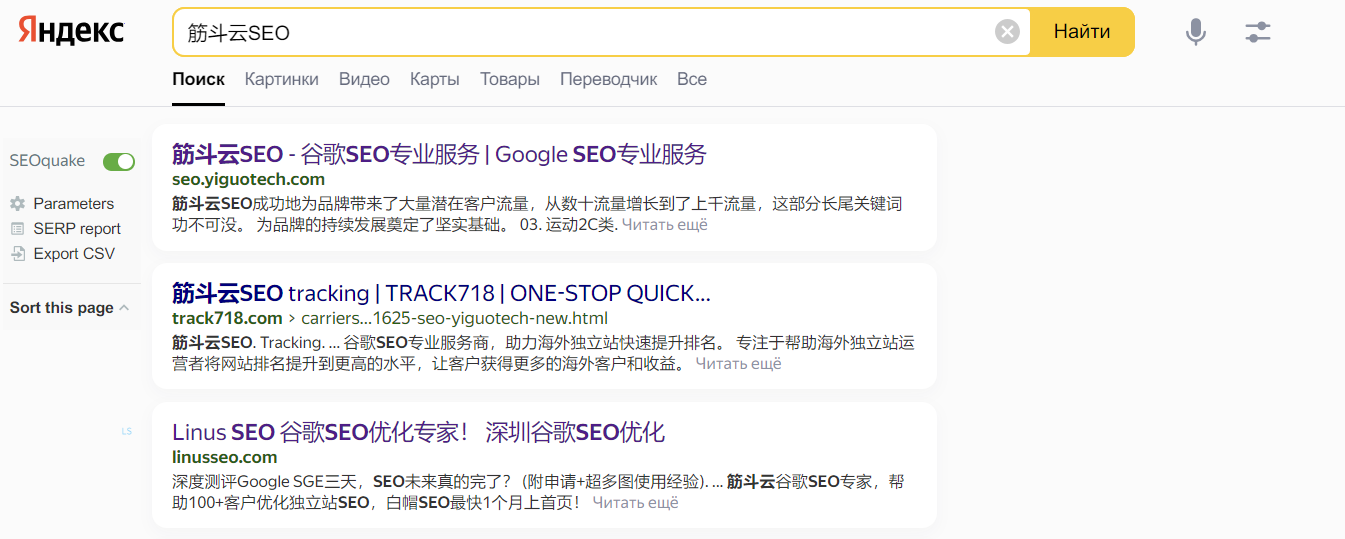
What Is Yandex: From a Contested Market to a Regional Powerhouse
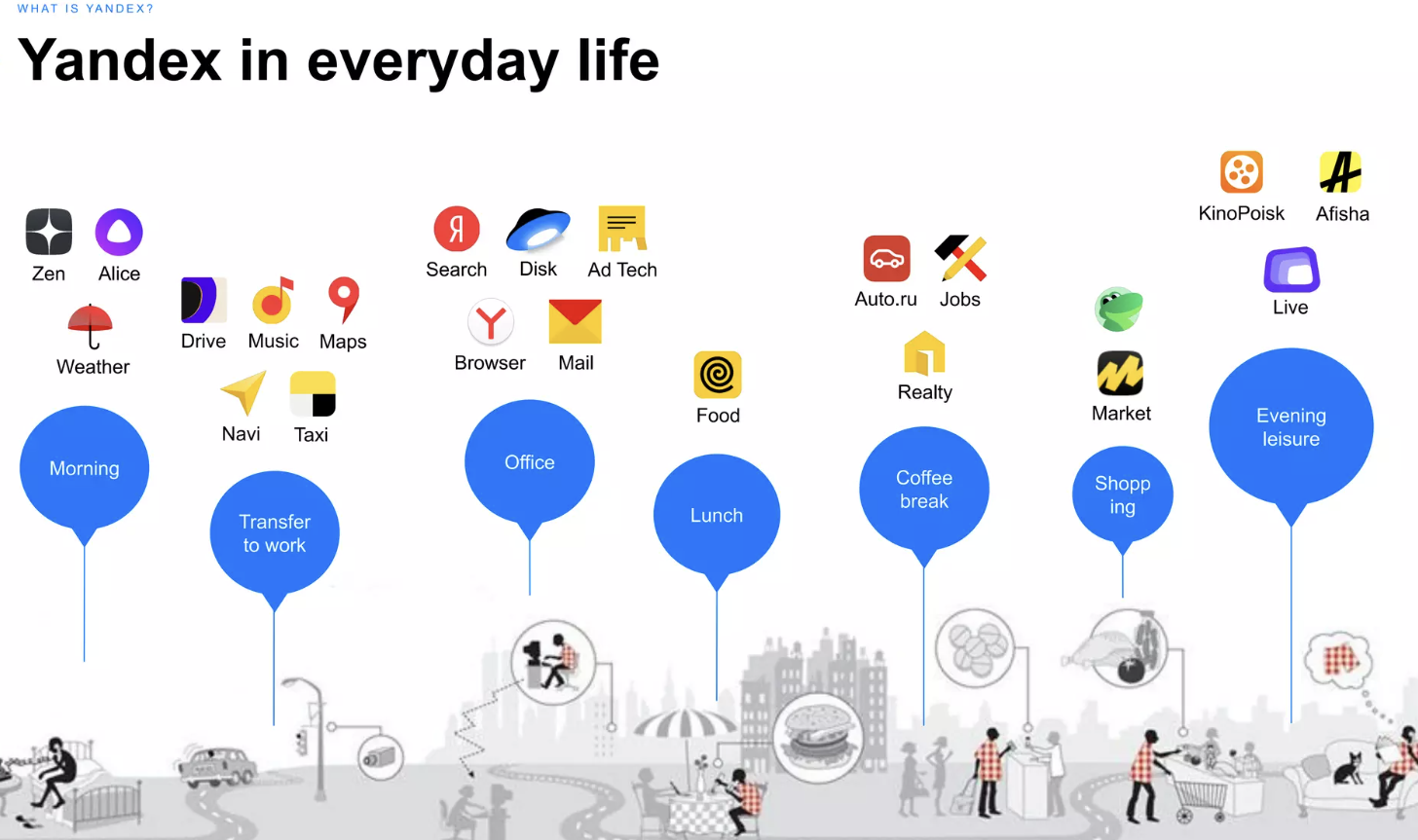
Yandex is often called “the Google of Russia.” It is also the largest Russian-language internet search engine, holding a position similar to Baidu’s in China. But Yandex goes further: it offers far more services than Google abroad, or Baidu, Alibaba or Tencent in China. Thinking about it, I’d say it is roughly the equivalent of Baidu, DiDi, Taobao, Meituan food delivery, Amap, iQIYI, a podcast app, a web browser, a webmail service and more, all rolled into one, with Yandex Search as the main entry point.
I found a very illustrative graphic showing how a person in Russia might use Yandex products over the course of a single day:
According to a Reuters report from Moscow on February 15: Russian internet giant Yandex announced on Wednesday that its 2022 revenue grew 46% to 521.7 billion roubles (about US$7.05 billion), as its dominance in online advertising strengthened after its main competitor, Google, pulled out of the market last March. So if you’re targeting the Russian market, there’s no avoiding Yandex ads and Yandex SEO. For the differences between Google Ads and Yandex ads, see the end of this article.
However, at the end of January 2023, the source code for most of Yandex’s products was leaked, which opens up many more possibilities for analysis. After all, the last search engine data leaks you could point to were probably AltaVista’s public code back in the 2000s and, in 2015, a former Yandex employee selling code on the black market… but let’s set that aside for now.
According to observations by various experts on Twitter, around 70% of Yandex and Google search results are the same (partly because many people in Yandex’s search division came from Google). So studying Yandex is, give or take, like studying Google. As you can imagine, Yandex’s code is well worth studying. However, even though the code has leaked, understanding and running search engine code is extremely difficult for most ordinary people. It’s usually a complex software engineering system that requires specialist knowledge and infrastructure to run or interpret.
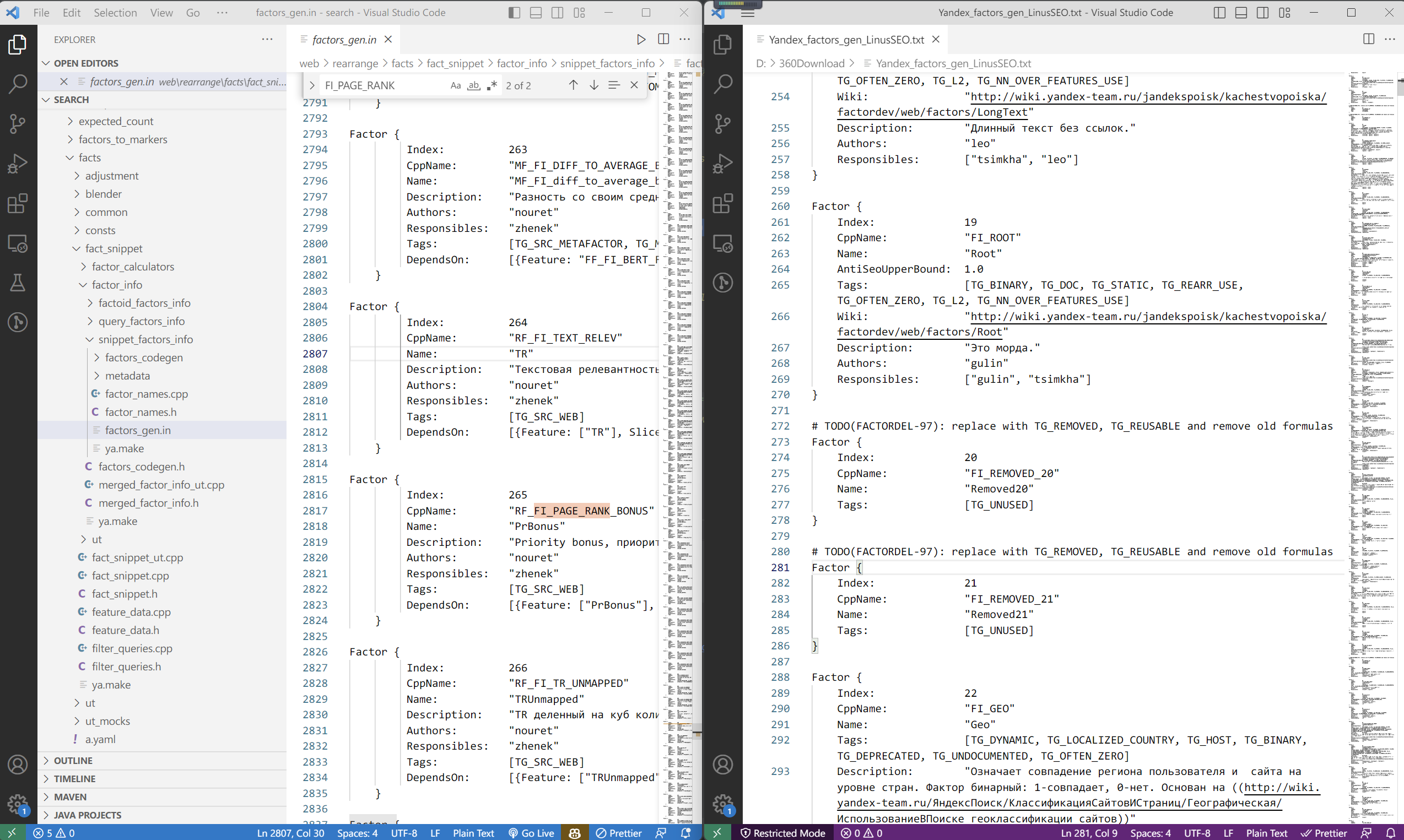
But what a coincidence! With my background in cybersecurity and programming, I happen to be able to read it, and the SEO algorithm research group at Yiguo Technology has enough resources to analyze it, so we downloaded all the code to take a look. That said, page after page of mixed C++ and Python gave me a real headache 🤯. The leak happened almost half a year ago, and I’ve squeezed in a good amount of analysis in my spare time. In a few days (or a few weeks…) I’ll share my findings. Yandex has 1,800+ ranking factors, so stay tuned. (The image below shows the ranking factor code I analyzed.)
Now let’s look at the similarities and differences between Google SEO and Yandex SEO:
Local Market: Regional Differences and Localization
I’ve covered a lot above, but the core point is this: Yandex has a near-monopoly on search in Russia and the former Soviet republics (including Ukraine), and its main focus is serving the local market. Google, by contrast, is a global search engine that has to account for each country’s situation, the languages to optimize for, cultural gaps, and the complexity and diversity of users and content.
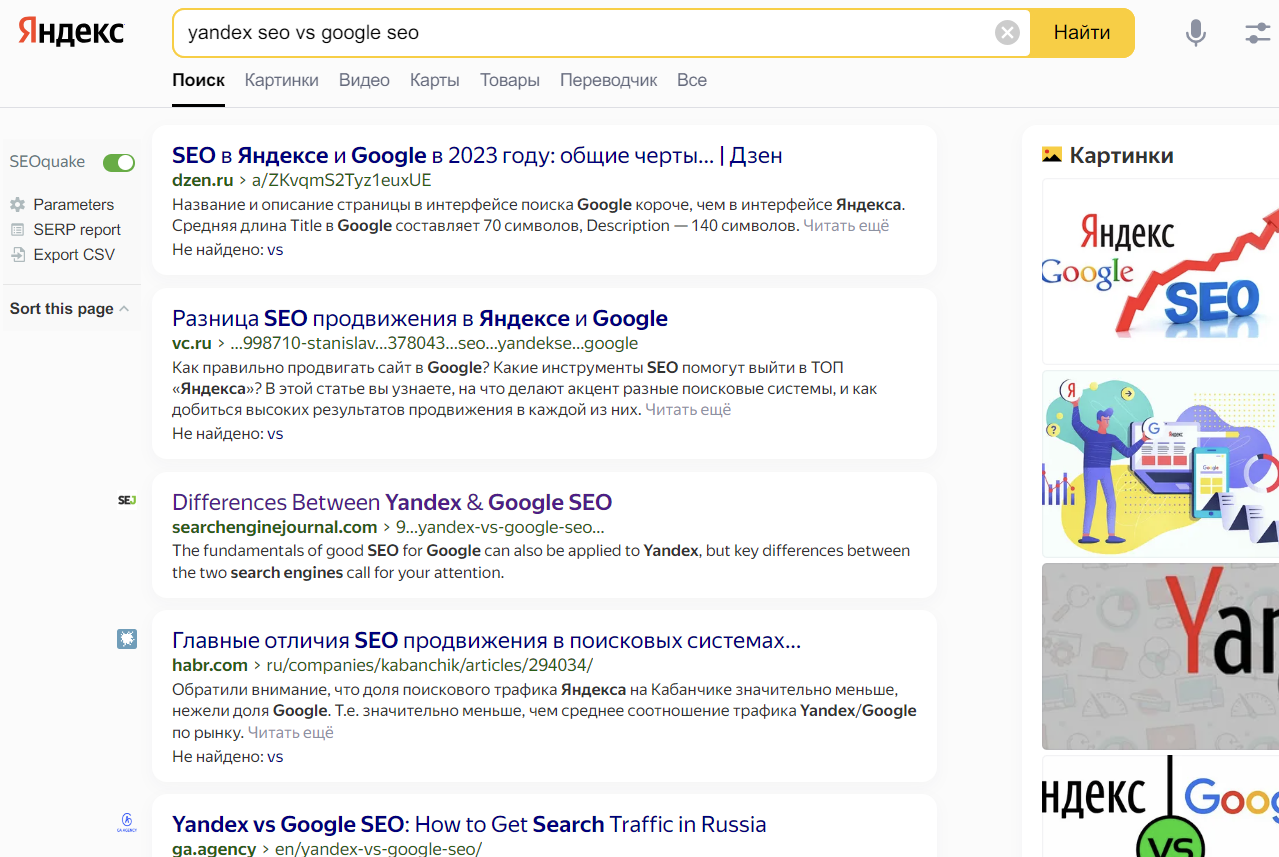
Google certainly prioritizes localization too, but Yandex essentially ignores websites that lack Russia-specific targeting and appeal. It always puts its audience first during optimization and development. That means English-language sites and non-.ru domains are at a natural ranking disadvantage. It doesn’t mean you can’t rank, but it may take more effort. For example, as shown below, searching in English still returns Russian results.
So here are some localization tips. Especially now, with wartime nationalism running high, make sure you avoid these pitfalls:
- Make sure your site includes contact information, and that pages like About Us show a Russian address and phone number. In particular, remember to use a .ru email address. If you don’t have one, find a way to register one; don’t cut corners.
- Create Russia-specific pages and content for Russian users, with localized vocabulary, such as recommendations for XXX in Moscow.
- Translate your pages into Russian, or buy a .ru domain.
- If you run a B2C site, be sure to price products in Russian roubles rather than US dollars or any other currency.
- Be sure to spend some budget on Yandex ads, unless your industry isn’t allowed to advertise.
- If you don’t speak Russian, hire a translator or a local. Don’t rely on machine translation; far too many things go wrong.
- Some customers have an inherent aversion to companies or products from outside the Russian market. So from a business perspective, consider whether you intend to keep investing in the Russian market. I won’t go into more detail here.
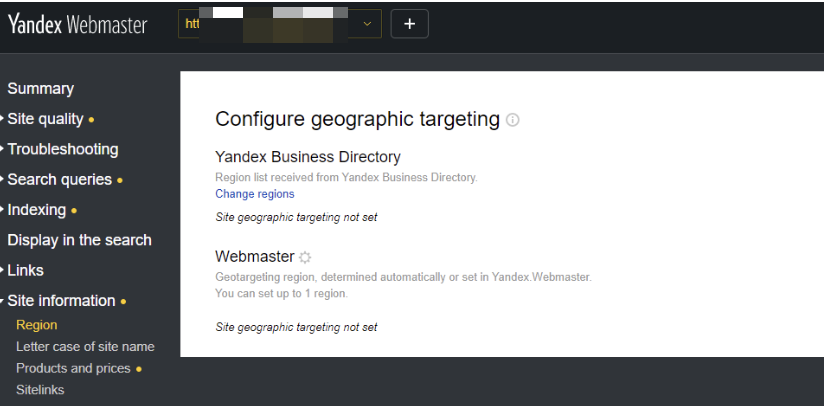
- Set up regional binding in Yandex Webmaster (Yandex’s equivalent of Google Search Console). This helps Yandex show your pages in the right geographic SERPs and ensures they’re seen by your target audience. (But this is for very localized markets. If you’re targeting the whole country, don’t mess with it.)
Indexing: How Fast Pages Get Indexed
Yandex indexes new or updated pages much faster than Google. Much like Bing’s IndexNow, Yandex, as a relatively niche search engine, has a similar fast-indexing mechanism.
In some cases, Yandex can index new content within minutes or hours. Google’s crawler usually takes days or even weeks to discover and index new pages, especially for new sites with low authority. That said, once a site has been run well consistently, Google’s indexing can actually be very fast.
Yandex’s fast indexing creates a potential SEO opportunity: if you update content frequently, you can gain rankings faster. For example, new product launches, blog posts, videos and other dynamic content will start to show results sooner on Yandex once published.
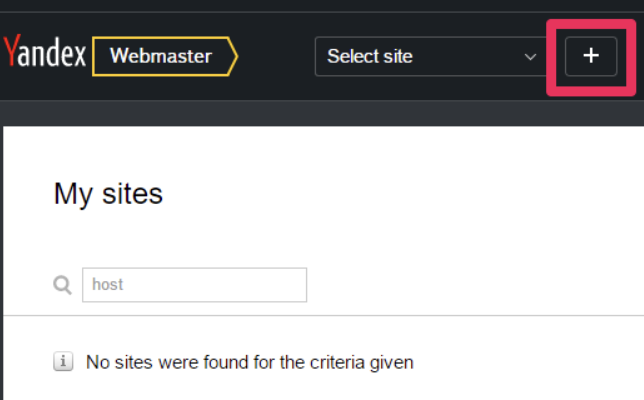
So having a proper URL structure and sitemap is even more important for guiding Yandex’s crawler. You can check for errors in the Yandex Webmaster dashboard, which works almost the same way as Google Search Console:
Backlinks: You Know How It Is
Yandex is known to have algorithms similar to Google’s for combating link manipulation, and has had them since the Nepot filter in 2005. In this area it’s much the same as Google. Based on the source code leak and the general reaction to it, Yandex’s evaluation of link building may involve the following:
- Backlinks that grow naturally in varying quantity and frequency
- Anchor text using brand terms and commercial keywords
- The age of the linking site and how long the link has existed affect link quality
- Topical relevance, and whether the link is contextually relevant
- Link relevance, taking into account the quality and topic of each link
- The percentage of inbound links with high-quality (long-tail) keywords
Some points to watch out for, which are general knowledge:
- The ratio of good to bad backlinks, i.e. the proportion of spam
- Whether links to the site are being built too frequently
- Whether links come from PBNs or are sponsored
Backlinks are actually quite complex, and the Jindouyun SEO service at Yiguo Technology, where I work, faces plenty of challenges here too. While Google has a bulk disavow tool and Bing lets you disavow individual links, Yandex has no disavow tool at all. So if you’re hit by spammy backlinks, my personal view is the same as that of SEO expert SEO Xiaoping: as of now (2023), the effect of spammy backlinks is most likely zero, not negative. So the key is still to build high-quality backlinks. But what counts as a high-quality backlink is another big topic in itself…
Keywords: Minor Differences
Understanding how keywords work in each search engine is very important. Google’s advanced algorithms take context and intent into account, so they can merge variants and related terms, and Google uses the BERT model to interpret what users type. Yandex, by contrast, prefers exact keyword matches, so you know what that means. Beyond that there’s not much difference; it’s all standard SEO research work. The only difficulty is that you may not know Russian, but with translation software in hand, the world is yours 😈
Content: Still King
Both search engines are increasingly focused on the usefulness of content and the usability of search and websites. Google has already unveiled the generative AI interface it will use in the future, the SGE I mentioned before. Many people have already received invitation emails for targeted testing, although it hasn’t been fully rolled out yet.
Yandex hasn’t introduced a similar interface yet, but it has launched a new version of search that likewise takes context into account and predicts user needs, and may return different results for consecutive queries with history. For example, the system remembers requests and serves material on related topics or potentially interesting products and services.
AI-powered search will make SEO promotion more commercial and more complex, and many people wonder whether it will hurt professional SEO. But according to Google and the prevailing view, generative AI answers will, for the next few years, remain an add-on feature rather than the main one, used only to assist queries. What will change is a shift away from exact keywords toward the usefulness and usability of content, as well as the site’s quality, authority, expertise and trustworthiness.
But above all, what matters most is whether the content is useful to users, gets to the point, and satisfies their search intent.
This is consistent with Google’s E-E-A-T. Yandex’s site quality index (the SQI, or IKS score; see the links at the end of this article) and its Proxima algorithm follow the same idea, as does Yandex’s AGS algorithm for low-quality and duplicate content, which corresponds to Google’s Penguin algorithm. Since the Penguin equivalents are broadly similar, let’s move on to the other algorithms:
Algorithms: Google PageRank vs Yandex Proxima
You’re probably fairly familiar with Google’s PageRank. It’s an algorithm for evaluating links and is one part of the search engine’s algorithms, alongside various others such as Penguin. Sometimes people also use “PageRank” to mean Google’s ranking factor algorithm as a whole, but that’s no big deal; just interpret it from context.
The Yandex Proxima algorithm is a Yandex search quality metric that takes a site’s quality and relevance into account. It’s especially important for sites in the YMYL category (Your Money or Your Life):
- Whether visitors can solve their problem on the site
- How loyal users are to the site, and what the dwell time and bounce rate are
- The ratio of “useful” to “advertising” content, and whether there are too many ad pages
- How the site compares with other relevant sites for the query, and so on
Analytics: Google Analytics vs Yandex Metrica
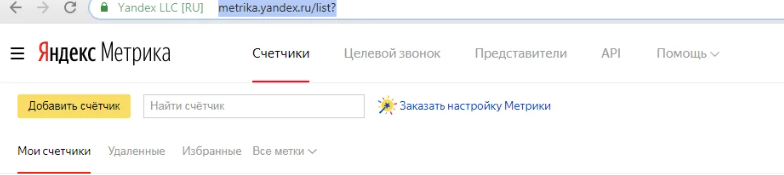
Yandex Metrica is a free Yandex service designed to help every site owner analyze their website’s parameters and metrics; in short, it’s the analytics tool in the Yandex ecosystem. You can go to metrika.yandex.ru to connect your site, and you can also use it to review your ads, since, like GA, it has built-in advertising settings.
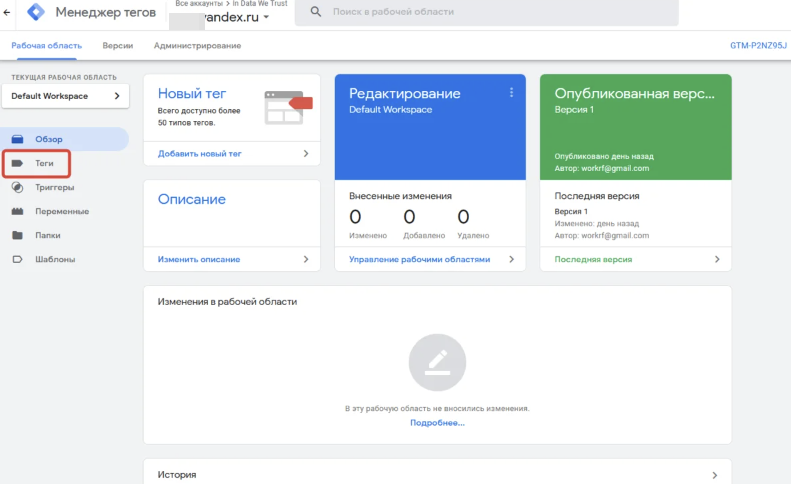
The steps are simple and almost identical to setting up GA. If you want to use it, just follow the screenshots step by step:
- Create a new Yandex Metrica counter
- Configure the Yandex Metrica counter
- Install the Yandex Metrica code on your site, or install Yandex Metrica via Google Tag Manager
- Check that Yandex Metrica is installed correctly; you can verify the installation with the Yandex Metrica Debugger extension for Google Chrome
A notable difference is that Yandex has a heatmap feature, and it’s free, which is actually pretty good:
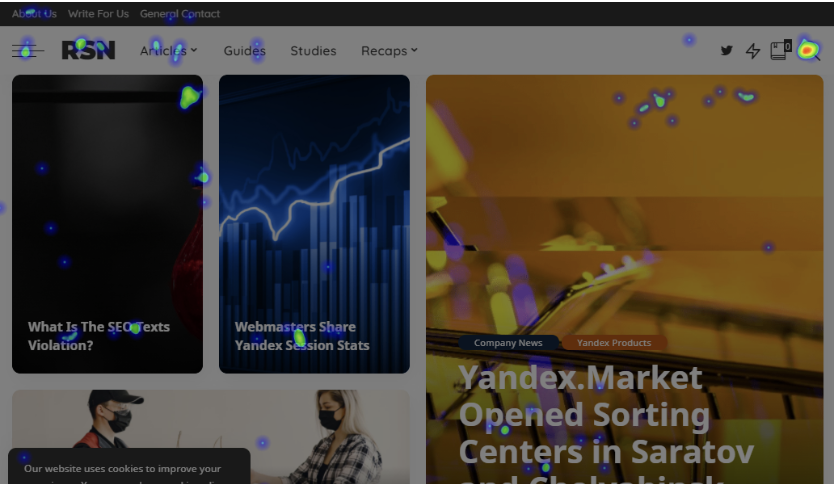
Other SEO?
General practices, such as mobile optimization, performance optimization, meta descriptions, a sensible navigation structure, breadcrumbs, 404 pages, heading tag structure and so on, are valued by every search engine. So if you build a site well, it will naturally tend to get indexed by all search engines, as long as you haven’t added a disallow in robots.txt.
There are a few other small points. Some examples:
- Meta keywords still seem to be used as a signal by Yandex, so add them to your site too, although Google ignores them.
- On Google, titles average 70 characters and descriptions 140 characters. On Yandex, it’s 80 and 170 characters respectively. Meta tag length doesn’t actually affect performance, but if you want to target both search engines at once, you should stick to Google’s limits.
- Probably due to performance constraints, Yandex indexes and supports JavaScript-rendered pages rather poorly. Although Yandex claims its 2019 Vega algorithm (AI pre-rendering, somewhat complicated) improved support for single-page apps, in my tests it’s still mediocre. Google has tiered crawlers and actually devotes more resources to this. For some sites, even without server-side rendering, pages sometimes get indexed correctly, but it depends on the nature of the site, and this is a rather tricky issue. Still, I strongly recommend making pages static whenever you can: take on the hard work yourself and make things easy for search engine crawlers.
Differences Between Yandex Ads and Google Ads
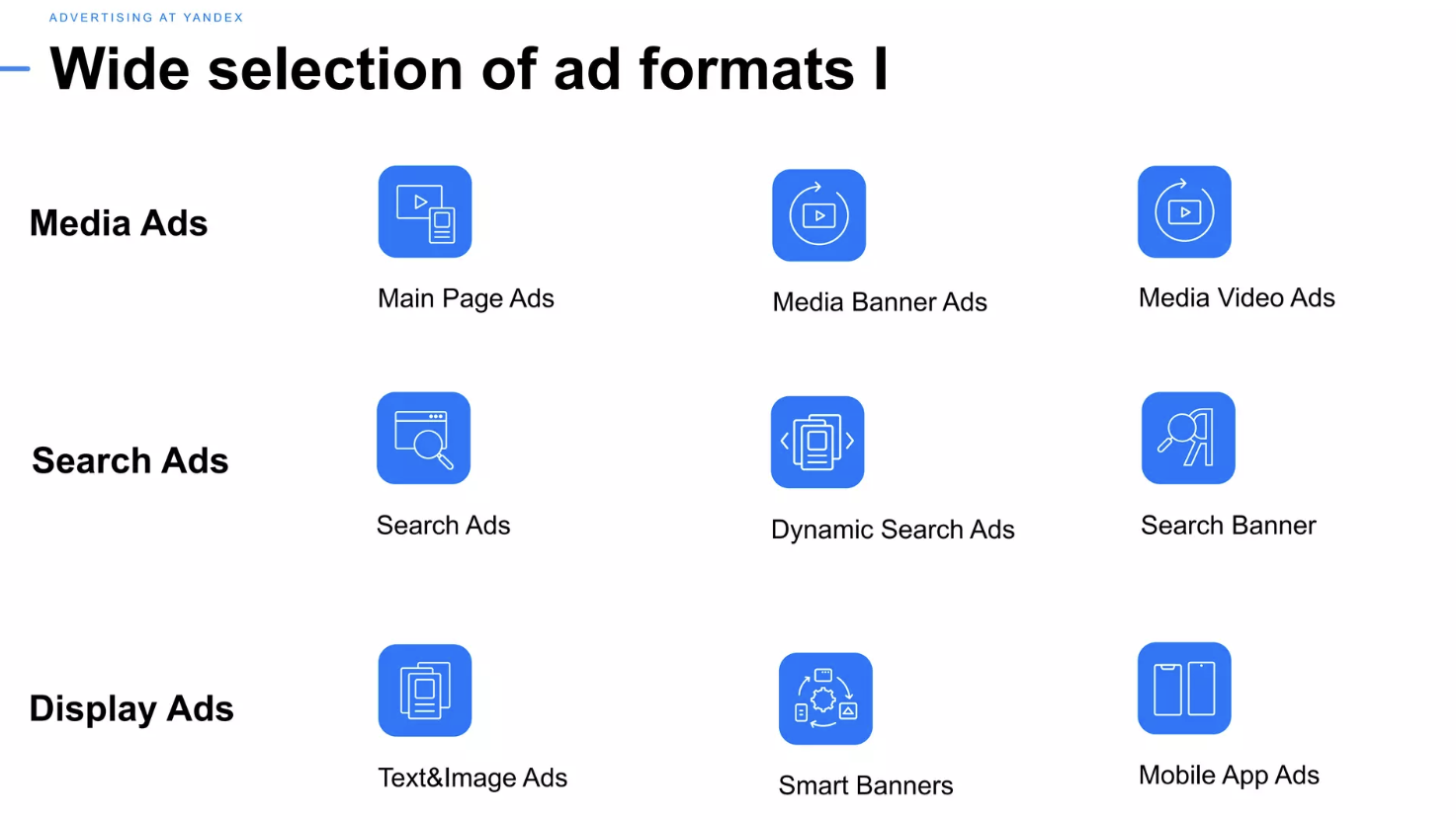
Now we’re into advertising, which isn’t my strongest area. But based on some public data and conversations with a few people who run ads in Russia, ad placement is similar to Google’s: up to three ads at the top and four at the bottom.
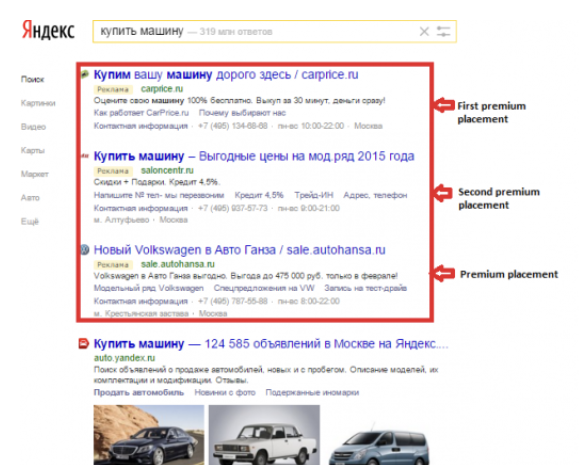
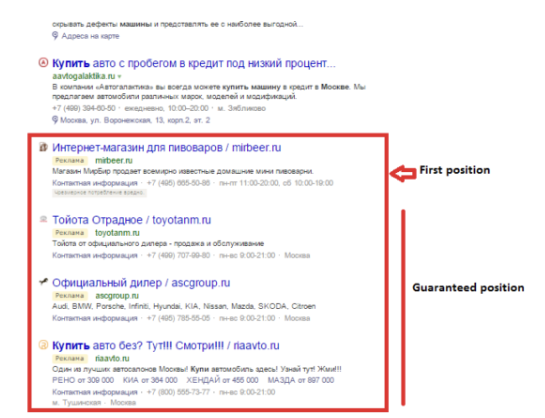
Yandex’s advertising tool is called Yandex Direct. Its main differences compared with Google AdWords are:
- Market share: As of August 2021, Google had a 54.73% market share in Russia, with Yandex close behind at 43.02%. However, as of August 2023, Google has exited the market and Yandex is now the dominant search engine in Russia.
- Ad format: Yandex Direct recently increased the character limit for the main ad headline, allowing up to 56 characters including punctuation. Google Ads, on the other hand, allows three separate headline parts of up to 30 characters each.
- Keyword matching: Google Ads uses three types of keyword matching: broad match, phrase match and exact match. Yandex Direct uses operators for keyword matching.
- Campaign costs: Google Ads has no minimum budget, whereas Yandex Direct requires a minimum budget of 1,000 roubles per day (shared account). Both platforms use similar systems for calculating cost per click (CPC). For details, see https://yandex.com/support/direct/payments/shared-account.html?lang=zh
- Ad position: Both platforms use quality-related metrics to determine ad position: Google uses Quality Score and Yandex uses a quality coefficient.
- Premium ads: On Yandex, high-performing ads become premium ads displayed directly below the search query. Google Ads has no equivalent pricing system, though better-performing ads do get higher positions.
- Image-based ads: Google Ads uses the Google Display Network and Google Shopping for image-based ads, while Yandex Direct uses a system called brand awareness ads.
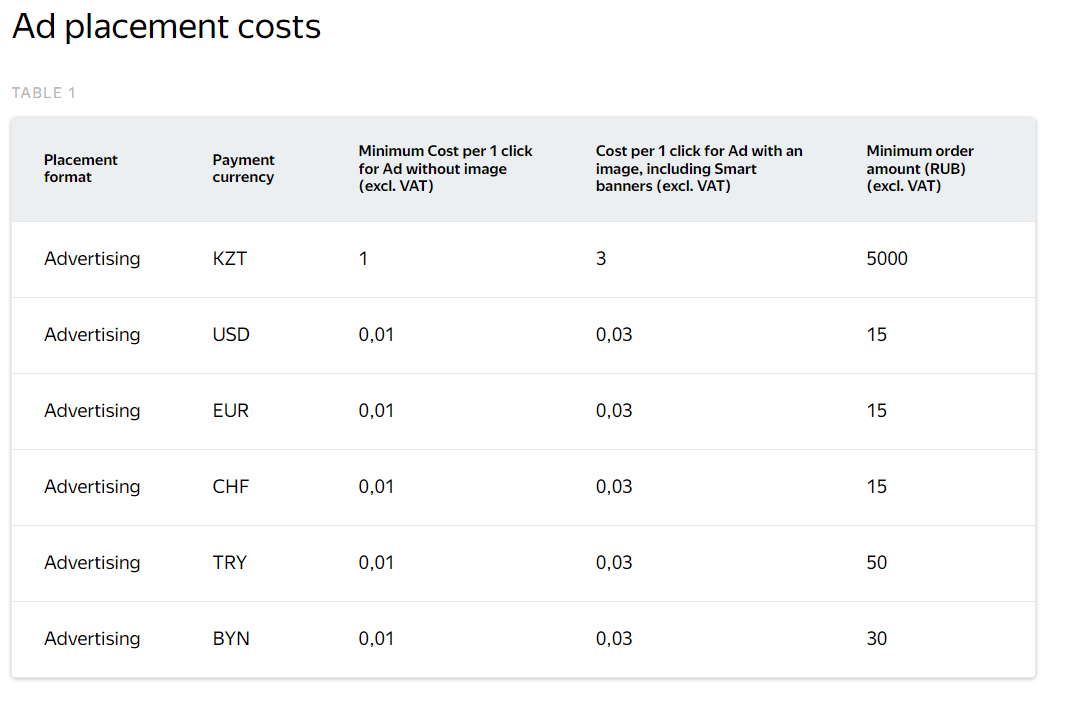
Here’s Yandex’s pricing, for a quick look:
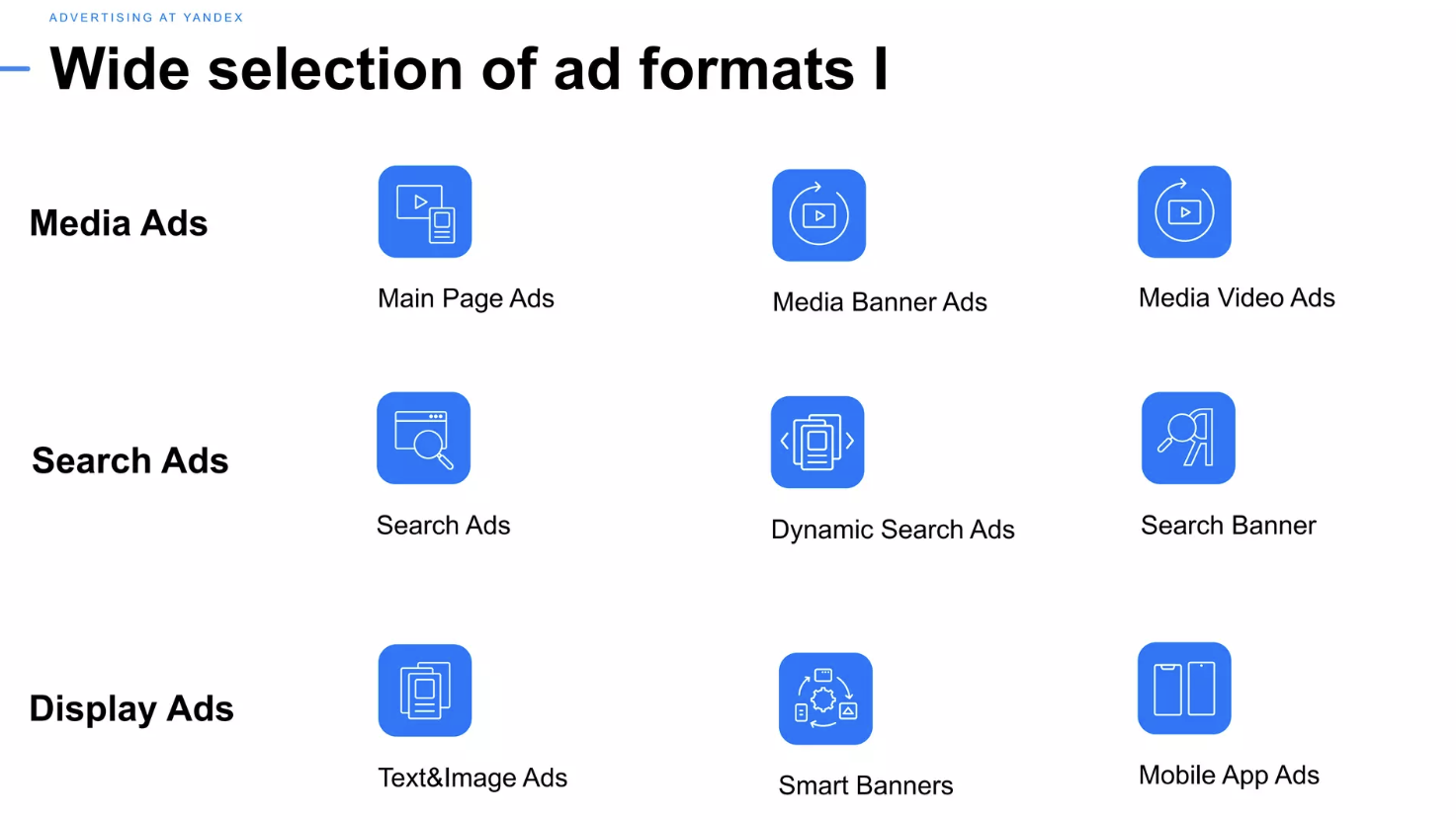
You’re probably more familiar with Google Ads. If you want to learn more, I recommend reading Yandex’s official documentation: https://yandex.com/adv/products/search
Last word🤔
When it comes to other requirements, filters and penalties, search engine rules are similar in nature. A site may be demoted by similar algorithms for issues such as thin text content, lack of originality, keyword stuffing or low-quality content, lack of a clear topic, links from undesirable and spammy sites, and attempts to manipulate the algorithm. Google, Yandex and indeed all search engines judge these in the same way.
Overall, as long as we follow Google’s guidelines, add localization, and use Yandex Webmaster Tools, we’re effectively doing ranking optimization for Yandex. Consistently building high-quality content and backlinks is always the right approach to SEO.
Finally, keep improving, and let’s keep pushing forward together! Feel free to add LinusSEO on WeChat and follow my WeChat Moments for my SEO and overseas marketing notes, and let’s swap ideas on how to win overseas traffic in the age of AIGC. Follow me to learn more about Google SEO🧀.
*Postscript: I may have mixed up some concepts, as I’m not especially familiar with Yandex. If my views or knowledge change later, I’ll share my new findings with you.
References
- 36Kr - Former employee “defects” and leaks 44.7 GB of source code from old employer: https://m.36kr.com/p/2107373037586562
- Yahoo Finance - Russia’s Yandex beats FY revenue target after Google pulls advertising: https://finance.yahoo.com/news/russias-yandex-beats-fy-revenue-100009812.html
- SlideShare - Yandex Ecosystem: https://www.slideshare.net/AngelinaAngieIsenov/yandex-ecosystem
- Yandex Advertisement: https://yandex.com/adv/products/search
- Yoast - How to add your website to Yandex Webmaster Tools: https://yoast.com/help/how-to-connect-your-website-to-yandex-webmaster-tools/
- RussiaSearchNews - What Is Yandex Proxima?: https://russiansearchnews.com/articles/what-is-yandex-proxima/
- SEJ - 10 Biggest Differences Between Yandex & Google SEO: https://www.searchenginejournal.com/9-biggest-differences-yandex-vs-google-seo/168628/
- SEJ - Yandex’s Artificial Intelligence & Machine Learning Algorithms: https://www.searchenginejournal.com/yandex-artificial-intelligence-machine-learning-algorithms/332945/
Yandex SEO vs Google SEO: Key Differences You Need to Know