Gemini 4 Hydrogen in Search: AI Citations & Tracking


On November 24, 2026, Google completed its November core update, pre-announced a December core update 59 minutes later, and launched a 7-page Search Ranking Hub (1 hub landing page plus 6 new guides). Two days later, when I tested multi-constraint commercial and local queries in a logged-out US English browser, the regular Google Search page (All tab) skipped the “Show more” button and expanded AI Overviews in full. Pinned to the bottom-left of each AI Overview was an Ask anything input box whose + menu showed a locked 4 Hydrogen • Everyday help option. Putting that UI shift alongside DEJAN’s API experiments and Google’s new documentation clarifies how conversational fan-out retrieval is moving onto the main results page and why traditional single-keyword tracking needs an overhaul.
Key takeaways
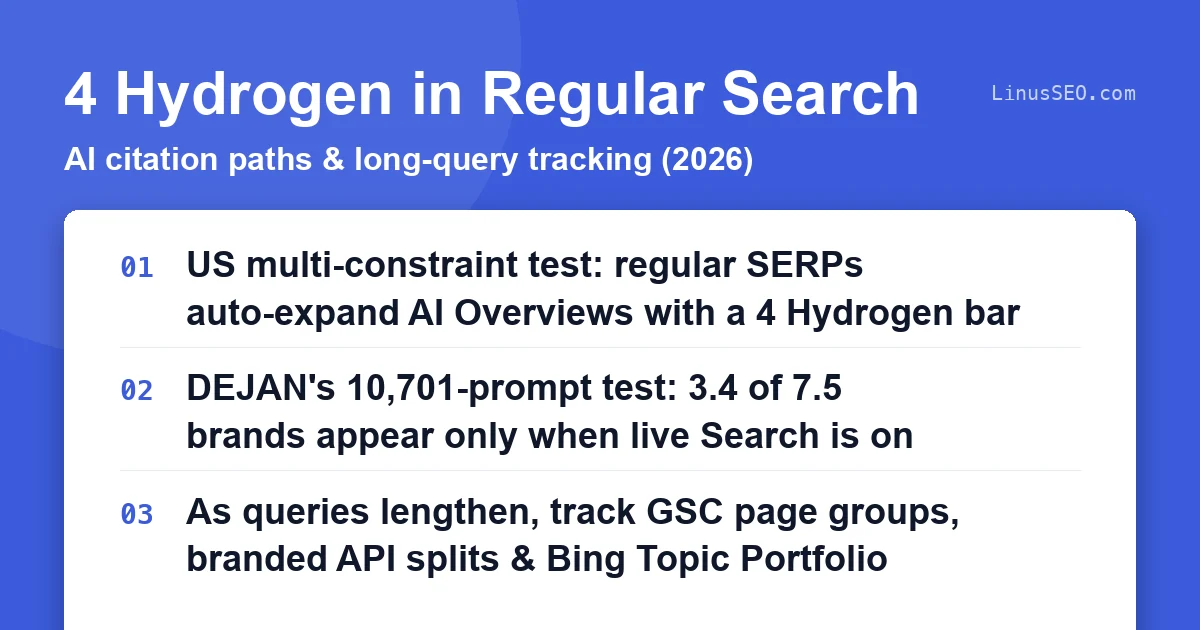
- Merged front-end surfaces: US multi-constraint test: regular SERPs auto-expand AI Overviews with a 4 Hydrogen bar, synthesizing sale product cards, retailer deep links, and a 5-column spec table above the fold; meanwhile, Google’s click-oriented Web Guide has stayed inside Search Labs for 16 months without a default rollout.
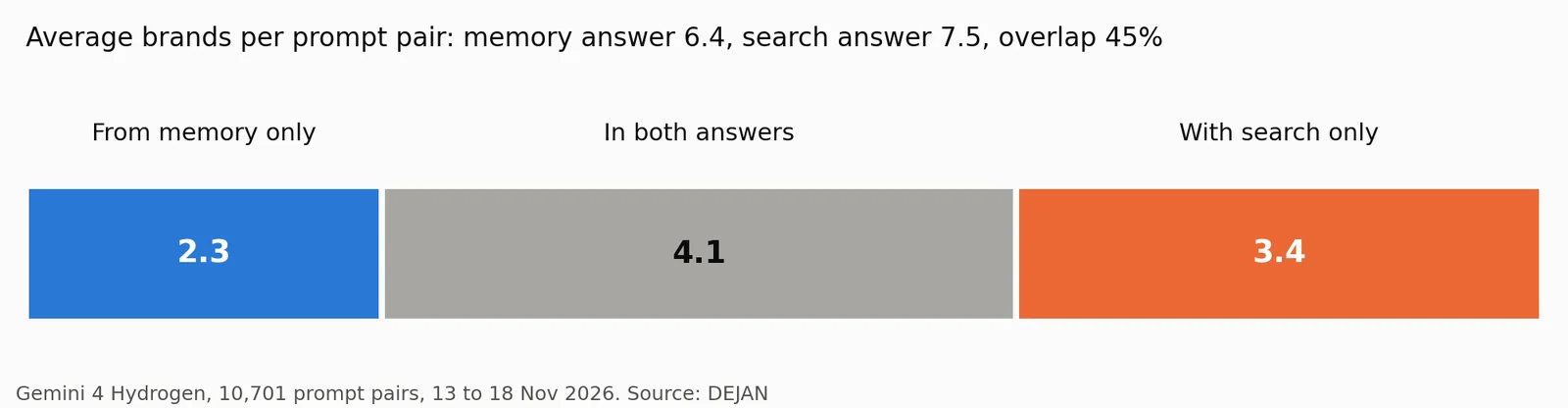
- Heavy reliance on live retrieval: DEJAN’s 10,701-prompt test: 3.4 of 7.5 brands appear only when live Search is on, memory-only and search-grounded answers overlap by 45%, and live search overruled outdated brand names in 69 of 70 runs (98.6%).
- Split wording in Google’s attribution rules: The November 24 documentation specifies checking ranked results as “the first step” only for AI Overviews in Web Search; I infer AI Mode and complex prompts lean harder on concurrent fan-out sub-queries, aligning with year-end core updates around templated subfolders and complex questions.
- Reporting moves from exact queries to page groups and topics: As queries lengthen, track GSC page groups, branded API splits & Bing Topic Portfolio, then verify impact against actual store orders.
What changed above the fold: Web Guide stays in Labs while 4 Hydrogen enters the main SERP
When Google Search VP Robby Stein announced on November 12 that Gemini 4 Hydrogen had rolled out globally in Search, most commentary focused on the standalone AI Mode tab. On November 26, I tested two multi-constraint queries (best espresso machine under 800 small kitchen quiet grinder comparison and a Boston-to-Cambridge neighborhood commute query) in a logged-out US English session (hl=en&gl=us). Four changes stood out directly on the default All tab.
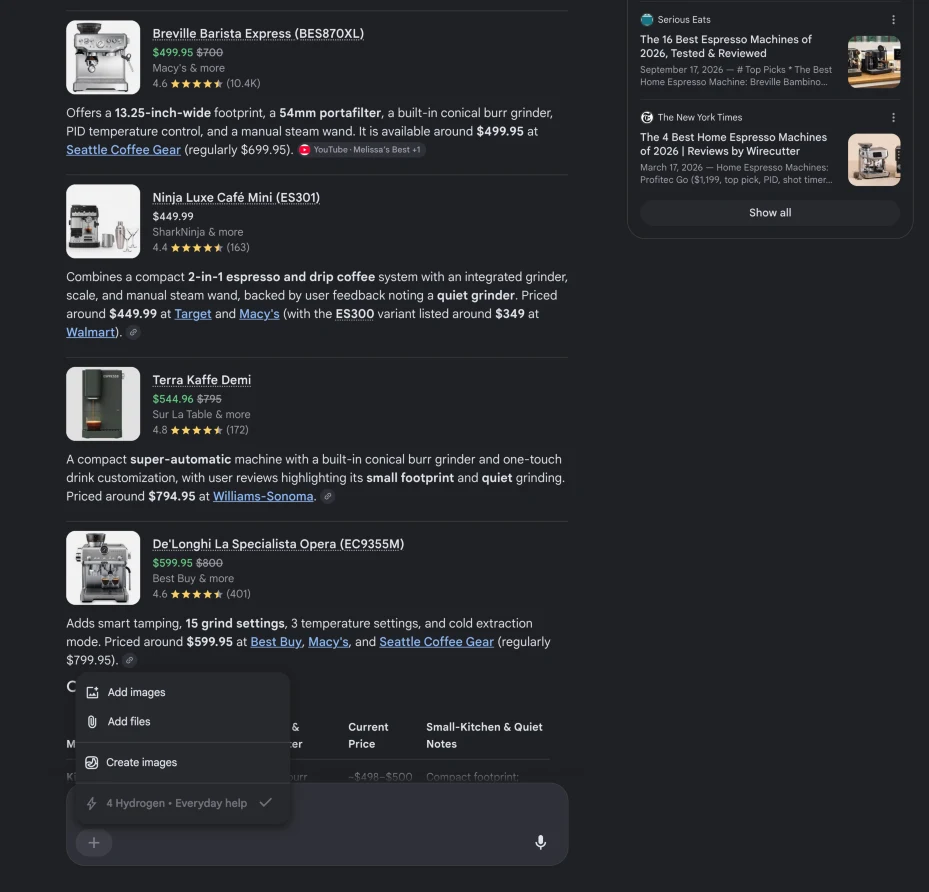
First, both multi-constraint queries bypassed the “Show more” toggle on the regular All tab and rendered the full AI Overview immediately. The #1 traditional organic blue link sat below the product cards, comparison table, and follow-up composer—two to three screens down.
Second, the commercial product query synthesized Google Shopping cards, merchant deep links, and a 5-column spec table directly inside the regular AI Overview. In the espresso screenshot above, Google rendered discounted Shopping cards with review counts, pulled out exact query constraints (13.25-inch-wide, 54mm portafilter, quiet grinder, plus an inline YouTube · Melissa's Best +1 chip), linked directly to product pages on Seattle Coffee Gear, Target, Macy's, Walmart, and Best Buy, and appended a 5-column comparison table underneath.
Third, the right-hand desktop citation rail dropped its earlier bottom fade effect and displayed the top 3 citation cards in full (the cropped screenshot shows cards #2 and #3 from Serious Eats and The New York Times), collapsing the remaining 6 cited sites behind Show all.
Fourth, a sticky Ask anything bar stayed pinned to the bottom-left of the AI Overview. Clicking + opened an in-place menu rather than navigating away, displaying a pre-selected, non-removable 4 Hydrogen • Everyday help radio item (dropping the “Gemini” prefix and differing from the standalone AI Mode menu only by omitting Canvas). Typing a follow-up constraint continues directly into a multi-turn thread.
Same query fan-out, opposite fate: Web Guide remains opt-in after 16 months
Contrasting this layout with Web Guide shows Google’s product trade-off clearly. Google introduced Web Guide in Search Labs on July 24, 2025: it also pairs a custom Gemini model with query fan-out, but instead of writing a long answer that satisfies the user on the SERP, it clusters external web links by subtopic to encourage outbound clicks. Starting December 10, 2025, opted-in Labs users could trigger Web Guide inside the All tab.
Sixteen months after launch, Web Guide still has not rolled out to default Search users, and none of the 7 pages in the November 24 Search Ranking Hub mention it. My inference comes down to monetization: Web Guide spends comparable inference and fan-out retrieval compute while sending users off Google, whereas embedding fan-out synthesis inside 4 Hydrogen AI Overviews and AI Mode lets Google keep Shopping cards and multi-turn Sponsored ads on-page.
Third-party panels capture how far AI Overviews have expanded across commercial queries. Semrush’s tracking study of 400 US desktop commercial keywords found AI Overview trigger rates climbed from 45.75% in September 2025 to 88% in August 2026 (97.08% weighted by monthly search volume), reaching 96.12% on Best X for Y modifiers.
Click losses concentrate in the top three organic positions. iPullRank’s analysis of 151 billion Search Console impressions from March 2025 through July 2026 showed average unbranded position #1 CTR dropping from 7.1% to 5.2%, which the author noted likely stems from AI summaries and SERP layout shifts.
Counter-experiment: ChatGPT tests 5 traditional blue links above its AI answer
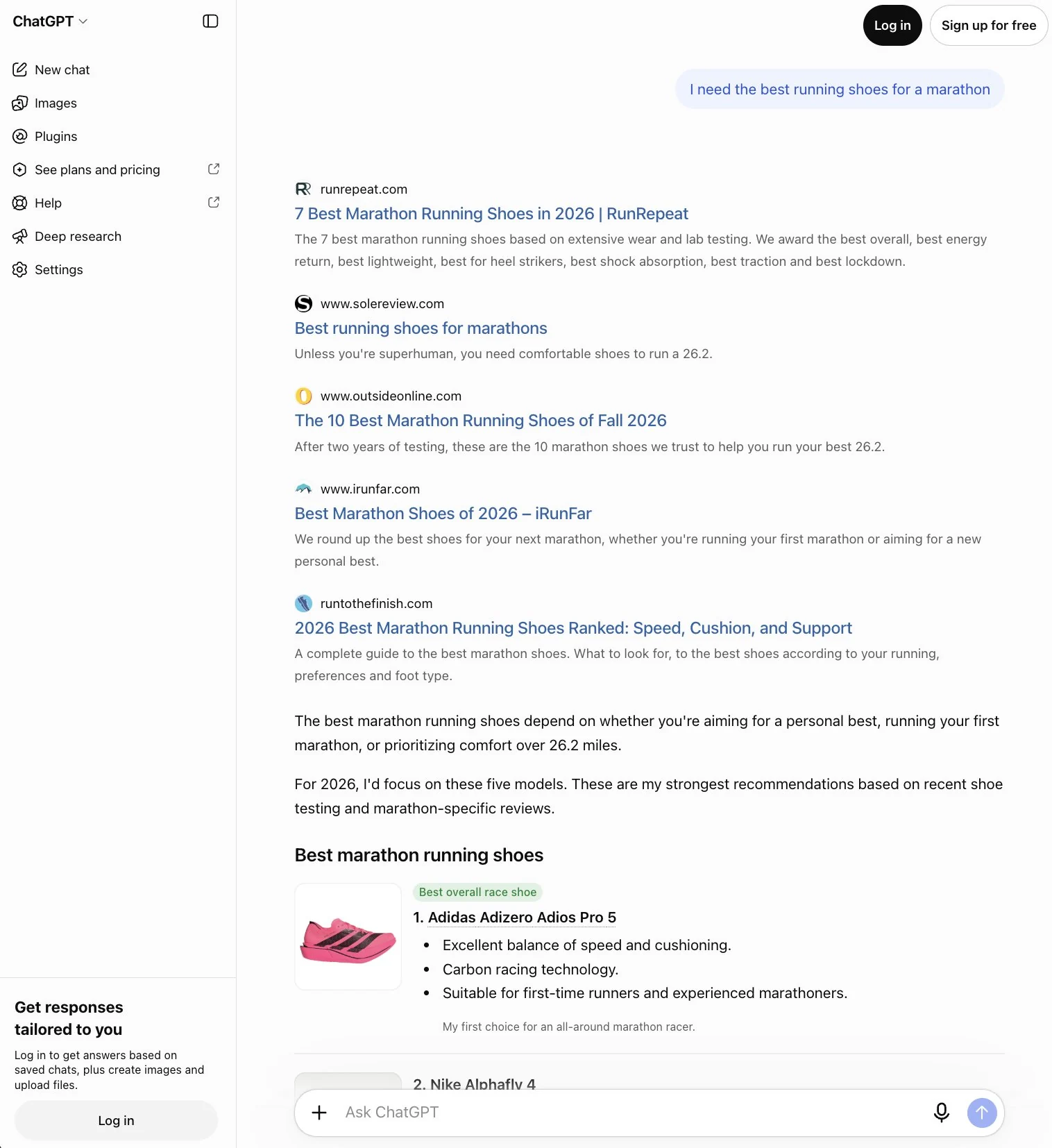
During the same mid-November window that Google embedded a chat composer inside regular search results, OpenAI ran an experiment in the opposite direction for logged-out visitors. On November 16, practitioners captured logged-out desktop ChatGPT search layouts that placed 5 traditional blue web links with favicons and snippets (runrepeat.com, solereview.com, and others) directly above the AI recommendation and product cards for a marathon shoe query, while another variant collapsed the AI summary behind a See More button.
SparkToro’s November 17 study of 118,163 ChatGPT prompts across 12,321 US users found that only 6.9% of consumer ChatGPT conversations carried purchase intent. I infer both platforms are balancing user retention against per-query inference cost: Google auto-expands comparison tables and follow-up boxes to keep high-intent shoppers from leaving, while OpenAI tests top blue links on logged-out traffic to route quick navigation queries out without spending full reasoning tokens.
Logged-out US test comparison between regular All tab and standalone AI Mode
In the same November 26 session (hl=en&gl=us, logged out), I also compared the regular All tab against standalone AI Mode (udm=50) on the non-ecommerce query moving to boston commute to cambridge under 4000 neighborhood comparison:
- Regular
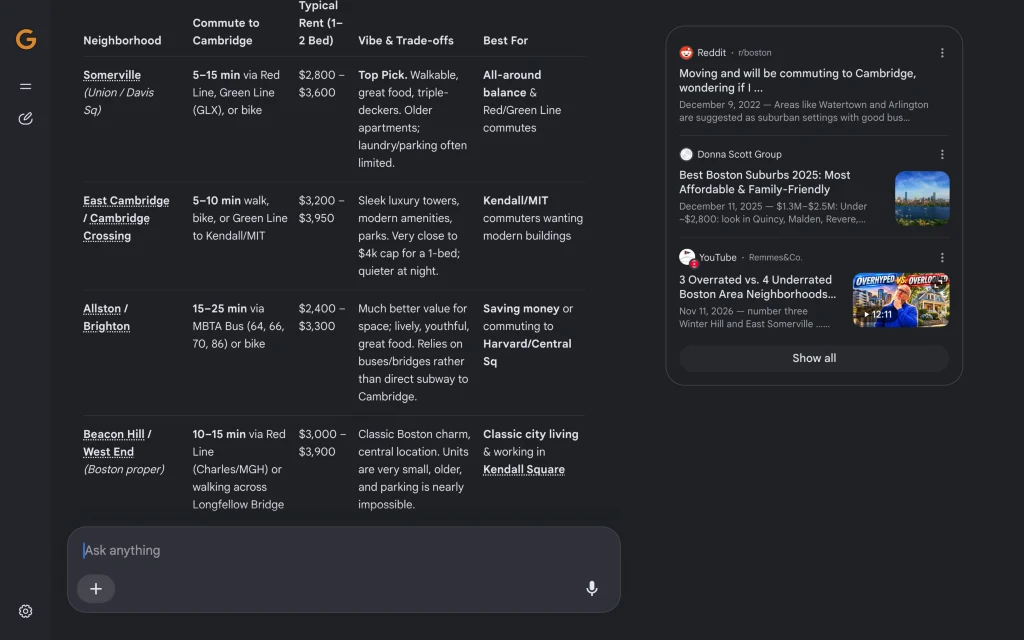
Alltab: The AI Overview expanded in full with the same sticky4 HydrogenAsk anythingbar at the bottom, formatted its neighborhood breakdown as nested bullet lists without a table, and cited 6 sites (the 3 visible right-rail cards wereReddit · r/boston,Donna Scott Group, andStreet Property Team). - Standalone
AI Modetab: Rendered a structured 5-column × 5-row comparison table (Neighborhood,Commute to Cambridge,Typical Rent (1–2 Bed),Vibe & Trade-offs,Best For) and cited 10 sources in total (including 3 YouTube videos and 2 Instagram Reels), withReddit · r/boston,Donna Scott Group, and a 12:11YouTube · Remmes&Co.video card occupying the top 3 visible slots.
Why Hydrogen is the default: fast execution paired with live search dependence
Role split across the Gemini 4 search lineup
Google switched the Gemini 4 family to chemical element names, splitting models by latency, reasoning depth, and per-turn compute cost:
| Model | Search rollout & access | Operational role | Key metrics (DeepMind announcements & third-party benchmarks) |
|---|---|---|---|
| Gemini 4 Argon | Oct 13 in AI Mode for Pro / Ultra subscribers | General frontier reasoning (medium default thinking tier) |
Shares unified 1M-token context window (supports background long decode); Artificial Analysis Intelligence Index 50 |
| Gemini 4 Carbon | Nov 10 for Ultra; Nov 16 expanded to Pro | Heavy deep reasoning (architecture, math, security) | Highest reasoning depth with longer time-to-first-token and higher per-turn cost; paid tiers only |
| Gemini 4 Hydrogen | Nov 12 global default in AI Mode for all users, plus complex AI Overviews | High-speed tool-calling & multi-step execution engine | Finishes tasks 2.5x as fast as Gemini 3.8 Flash at default high thinking; Intelligence Index 51; fabricated claims reduced by over 80%; Terminal-Bench 4.1 up from 18.2% to 57%; unified 1M-token context window |
From Google I/O in May until early November, AI Mode defaulted to Gemini 3.5 Flash. According to Google DeepMind’s Hydrogen model post, Hydrogen raises multi-step tool-calling speed while cutting fabricated claims.
On November 16, Google VP of Engineering for Search Rajan Patel confirmed on social media (via Search Engine Roundtable) that Google intentionally removed the model badge from the AI Mode header while expanding Carbon access to Pro subscribers.
DEJAN’s controlled tests: 3.4 of 7.5 recommended brands appear only with live Search on
Between November 13 and 18, SEO research firm DEJAN (Dan Petrovic) ran three API studies on gemini-4-hydrogen comparing its ungrounded memory against responses grounded in live Google Search:
- November 13, 2026 (52,923 ungrounded requests): DEJAN’s brand memory graph test disabled Search and scored associations across 239,000 brands in parametric memory. Top scores concentrated among household giants such as Apple (100), Microsoft (94.3), and Google (90.9), plus sub-brands like Windows and Android boosted by parent-company links.
- November 18, 2026 (single-domain blind memory test): In a second test with Search off, Argon and Carbon recalled real
dejan.aitools from memory, whereas Hydrogen failed 10 out of 10 times (0/10) and guessed from the domain name. Switching Google Search on or supplying the homepage allowed Hydrogen to list the company’s products accurately. - November 18, 2026 (10,701 prompt pairs): DEJAN’s third experiment ran identical brand-recommendation prompts with Search off versus on. Memory and grounded answers showed a 45% overlap, with exact-match pairs at just 1.8%; grounded answers averaged 7.5 brands, of which 3.4 (about 45.3%) appeared only when live Search was enabled. Across 70 runs where the model’s reasoning surfaced outdated brand names (such as ESPN BET after its rebrand to theScore Bet), live search overruled them in 69 of 70 final answers (98.6%).
DEJAN tested the developer API rather than Google’s full production AI Mode stack. Even with that caveat, the results undercut claims that small and mid-sized brands should optimize primarily for pre-training memory: when live retrieval supplies nearly half the brands in grounded answers and overrides stale memory 98.6% of the time, getting indexed and ranking on specific fan-out sub-queries remains the primary lever. Seer Interactive’s November 18 trace of ChatGPT reasoning chains across 20 commercial prompts showed a parallel pattern on OpenAI’s side: fewer than 10% of brands were named before searching, 49% of round-one searches targeted review listicles, and 75% of round-two and later queries switched to site: searches on candidate brand domains to verify credentials, regions, and pricing.
Notes on Gemini 4 API benchmarks and third-party study details
- DeepMind benchmark scope: The 2.5x task-completion speed, over-80% drop in fabricated claims (“fabricated claims drop by more than 5x”), and Terminal-Bench 4.1 jump (57% vs. 18.2%) come from DeepMind’s developer migration notes comparing Hydrogen ($1.50 / $7.50 per 1M input/output tokens) against Gemini 3.8 Flash (Argon is priced at $2 / $10). They measure model API performance rather than web ranking quality.
- Argon rollout timeline: Google first previewed Argon to security defenders on September 30, 2026, then announced on October 13 availability in the Gemini app and AI Mode for Google AI Pro and Ultra subscribers.
- SparkToro URL typo: SparkToro’s article title and methodology state
118,163prompts (118,000), while its published URL slug omitted a zero (11800-chatgpt-prompts).
Rereading the November and December core updates alongside retrieval changes
My Jindouyun SEO post on Google’s November 2026 core update completion, December pre-announcement, and Search Ranking Hub rules (in Chinese) already covers the rollout timestamps, the UK Competition and Markets Authority (CMA) six-month compliance timeline, the 7 Ranking Hub pages, and the standard five-step audit checklist. Here I focus on two cross-source connections not unpacked there.
Google has completed three broad core updates so far in 2026 (March, May, and November) and pre-announced a fourth for December. While the March core update followed two days after a 19.5-hour spam update, both the May and November core updates launched in the exact same week that AI Mode switched default models (Gemini 3.5 Flash on May 19; Gemini 4 Hydrogen on November 12). Google has never tied core updates to model swaps, yet generative answers and organic rankings draw from the same underlying search index.
Official documentation states a “first step” only for AI Overviews in Web Search
Google’s new November 24 guide, Attribution and factuality in Search generative AI features, lists four components involved in selecting links (Search index results, related searches / fan-out, grounding and corroboration, and display), with a notable difference in wording:
- AI Overviews in Web Search (stated in official docs): The page explicitly defines “the first step” as checking top-ranked results returned for relevance and passing their snippets to the model, while describing related searches (query fan-out, in Chinese) as “may also run.”
- AI Mode (my inference): The guide omits any “first step” statement for AI Mode. Paired with Robby Stein’s emphasis on Hydrogen’s wider query fan-out, I infer AI Mode and complex prompts rely more directly on concurrent sub-queries pulling candidates across narrower slices of the index.
This hybrid retrieval setup aligns with two external datasets. Ahrefs data cited by Search Engine Land shows the share of AI Overview citations also ranking in the organic top 10 for the head query fell from 76% in July 2025 to 38% in March 2026.
Long-tail community threads have gained citation share over the same period. AirOps tracked Reddit’s share of Gemini citations rising from 2.3% to 6.6% on November 16, four days after Hydrogen launched (compiled in Marie Haynes’s changelog).
Subfolder demotions, complex-query ranking, and Preferred Sources data
In my September 2026 spam update review, I argued that anti-spam enforcement and content quality evaluation are converging. During the November core update, Lily Ray shared 6 fast-dropping subfolders and subdomains characterized by single templates repeated thousands of times (dictionaries, area-code pages, and programmatic X vs Y pairings) where core product pages held steady while both organic rankings and AI citations to those content folders dropped together. In my view, once 4 Hydrogen builds 5-column comparison tables directly on the SERP, thin programmatic X vs Y folders neither earn clicks nor add clean facts during sub-query grounding.
Two November case studies quantify the trade-off between broad traffic-play blogs and loyal source preference:
- Deleting off-topic blog posts vs. real organic clicks: Search Engine Land’s November 19 case study on London car-hire firm G&M Direct Hire (a voluntary August content prune unrelated to the November core update) showed daily Google AI impressions falling 62% (1,535 to 591) while actual daily organic clicks rose 14% (235 to 268). Broad informational posts had generated 87% of AI impressions at a 0.27% CTR, whereas commercial service pages converted at a 2.1% CTR.
- Preferred Sources boost in the top 3 citation cards: Google’s December core update pre-announcement specifically highlights “longer and more complex questions” (even with low-latency multi-vector retrieval designs such as the MuVERA paper, in Chinese, production ranking weights still adjust as prompts grow longer) alongside “personalized results.” On the personalization front, Gus Pelogia’s November 19 controlled AI Mode test across 4 sites found that being selected as a Preferred Source changed total citation counts by only 0% to 20%, but lifted #1 visible right-rail card placements by 70% to 650% (
irishtimes.comranked #1 in all 30 citations). With desktop rails showing only 3 cards beforeShow all, securing slot #1 directly shifts click share.
How to measure performance when queries lengthen and “yes” appears in GSC
Why standard query tables drop long prompts while logging follow-up fragments
Pinning a follow-up bar to regular SERPs while boosting complex and personalized queries introduces two measurement blind spots into everyday rank reports.
The first distortion sits inside Google Search Console. Practitioners including Anastasia Kourou and Ross Tavendale (via Search Engine Roundtable) spotted single-word entries such as "yes", "yes please", and "yes, pricing" in standard Web query reports.
According to Google’s AI features documentation and John Mueller’s confirmation, Search Console’s dedicated Generative AI report aggregates impressions only by page, country, device, and date without queries or clicks (Gary Illyes reiterated on November 2 that query splits are not imminent); meanwhile, every follow-up prompt or confirmation reply typed inside AI Mode is logged as a standalone new query in the regular Web performance report. Conversely, 12-to-20-word first-turn prompts typically fall below Search Console’s privacy anonymization threshold, disappearing from the Queries table while still counting toward Pages totals.
The second distortion comes from external rank trackers. As Search Engine Land detailed in its November 20 Poisoned SERPs overview, automated scrapers have received tampered organic results since mid-September (peaking at 68.6% in Nozzle’s tracking on November 2, and doubling per-task API cost once DataForSEO added udm=14 cross-checks on November 16). Combined with stronger personalization, unpersonalized scraper positions represent fewer real buyer screens.
Combining Google, Bing, and OpenAI dashboards around page groups, topics, and branded return
Recent updates to Microsoft’s and OpenAI’s webmaster tools abandon verbatim prompt logs in favor of grouped topics and page-level metrics.
Bing Webmaster Tools reports grouped Grounding Queries (retrieval phrases used by the model rather than verbatim user chat logs; see my background note on Bing’s AI citation metrics, in Chinese).
On October 13, Microsoft launched Topics Portfolio Beta (labeled Topic Portfolio in the UI), clustering phrases into topics with estimated Topic Size, Sites Cited, Queries, Your Citations, and Opportunity Queries where other sites earn citations and yours does not (single-query Citation Share remains in the June query view).
OpenAI’s ChatGPT Business Hub public beta (chatgpt.com/business-hub, opened November 10) similarly skips raw user prompts, reporting the top 5 Discovery Topics, URL-linked mentions, and website clicks.
Combining these first-party endpoints gives ecommerce and B2B teams a practical four-layer measurement stack:
| Tracking layer | First-party tool & Nov parameters | Business question answered | Verification caveats |
|---|---|---|---|
| 1. Page-group impressions & clicks | Google Search Console Pages tab + BigQuery bulk export |
How many impressions and clicks /collections/, /products/, and buying guides actually earn |
Bypasses Queries privacy filtering and 1,000-row UI caps; when a page appears in both an expanded AI Overview and organic links, its average position fluctuates |
| 2. Branded return & multimodal | Nov 16 Search Analytics API (brandedClassification, type=webMultimodal) |
How many buyers search your brand name or use Google Lens after seeing AI recommendations | Similarweb’s June study (via SEJ) found 55.9% of US desktop visits following a ChatGPT mention arrived via branded search; BRANDED history starts 2026-02-21 and cannot combine with a query filter |
| 3. Topic coverage & sub-query gaps | Bing AI Performance → Topic Portfolio + GSC long-query regex sampling |
Which grounding phrases your pages cover and which spec or compatibility questions are missing | Bing topics reflect Microsoft AI surfaces only and do not measure Google directly, but work well as a gap checklist for product pages |
| 4. Sessions, agents & real orders | GA4 + ChatGPT Business Hub + Microsoft Clarity Agent Activity + store admin orders | Whether visibility turns into human sessions, AI shopping-agent visits, and paid orders | Clarity’s Nov 4 Agent panel identifies bots browsing product pages; Shopify Direct Checkout orders from AI channels do not fire client-side GA, so reconcile against store orders |
Search Analytics API parameters and GSC custom regex filters
- Three Search Analytics API additions (November 16, 2026):
- Automatic brand split: pass
brandedClassification(BRANDEDorNON_BRANDED) in dimensions or filters on eligible top-level properties; backfill starts2026-02-21. - Web multimodal search: set
type=webMultimodalto isolate Google Lens, Android Circle to Search, and image-upload queries (also included in BigQuery bulk exports). - Multi-country and multi-device lists: pass
filterListsto combine multiple ISO country codes or device types in one call.
- Automatic brand split: pass
- GSC Custom Regex sampling patterns:
- Surface visible queries with 8 or more words to mine buyer constraints (dimensions, budgets, compatibility):
^(\S+\s+){7,}\S+ - Isolate conversational confirmation fragments (filter queries first, then switch to
Pagesto see which URLs appear in multi-turn threads; stick to pure confirmation replies to avoid matching ordinary searches):^(yes|no|okay|ok|please|go on)\b
- Surface visible queries with 8 or more words to mine buyer constraints (dimensions, budgets, compatibility):
What this means for your site
For baseline date selection between the November and December core updates (excluding early-November bot clicks, the November 9–11 Generative AI report logging bug, and Black Friday spikes) and freezing URL structures before December’s rollout, follow the five-step checklist on our company blog (in Chinese). Specific to 4 Hydrogen on regular SERPs and longer queries, prioritize four actions:
First, publish key buying constraints as server-rendered HTML tables on core product and category pages. As the espresso test shows, regular-tab AI Overviews extract exact dimensions, portafilter sizes, noise notes, and live prices into 5-column tables. Consolidate or noindex off-topic programmatic blog folders that lack original testing, put concrete spec tables, compatibility limits, explicit non-use cases, and shipping/return terms into plain HTML on revenue pages, and verify machine readability with our AI Citability Checker and Product Schema Checker.
Second, compete for the 3 visible desktop citation cards with hands-on YouTube videos and Preferred Sources links. Film concise comparison or test videos for flagship products with thorough descriptions and manual chapter timestamps (Ahrefs’s November Top 50 citation report puts youtube.com first at 24.5% of AI Overview share among top domains, matching the timestamped video card in slot #3 of our AI Mode screenshot). Add https://www.google.com/preferences/source?q=yourdomain.com to post-purchase emails, manuals, and in-depth guides so returning logged-in buyers elevate your domain into slot #1.
Third, rebuild weekly and monthly reporting around page groups and branded search splits. Pull brandedClassification via the Search Analytics API to track branded return clicks separately from non-branded discovery, and review Bing Webmaster Tools Topic Portfolio monthly alongside GSC 8-word regex samples to spot missing product specs. Leave Search Console’s new generative AI control on its default Include setting for commercial pages where you want product synthesis and top-3 card visibility, reserving max-snippet tests for standalone tools or gated pages.
Fourth, audit CDN and WAF bot rules so verified Googlebot and Google-Agent traffic is not blocked during peak sales. On November 17, Google published Google-Agent allowlisting guidance for user-triggered browsing and shopping agents that operate like browsers and do not read robots.txt. Allowlist Google’s published user-triggered-agents.json IP ranges (or RFC 9421 signatures) alongside Googlebot IPs so CAPTCHAs or 403 blocks do not break live grounding or agentic cart flows, then verify critical URLs with the AI Crawler View tool.
Frequently asked questions
Why does “4 Hydrogen” appear inside a regular Google Search page? On November 12, 2026, Google made Gemini 4 Hydrogen the default model in AI Mode and began routing complex AI Overviews queries to it. In my November 26 logged-out US tests on two multi-constraint queries, the regular All tab auto-expanded AI Overviews in full and pinned a sticky Ask anything bar at the bottom-left whose + menu shows a pre-selected 4 Hydrogen • Everyday help item.
How do AI Overviews in Web Search and AI Mode differ when picking source links? Google’s November 24 “Attribution and factuality in Search generative AI features” page states a “first step” only for AI Overviews in Web Search—checking top-ranked results for relevance and passing their snippets to the model—while labeling query fan-out as “may also run.” The page omits that first-step wording for AI Mode, which I infer relies more heavily on concurrent fan-out sub-queries.
Why do single-word queries like “yes” show high-ranking impressions in Search Console? Per Google’s official documentation and John Mueller’s public confirmation, each follow-up reply a user types inside AI Mode (such as "yes" or "yes, pricing") is logged as a brand-new standalone query in the standard Web performance report, attributing impressions and positions for cited pages in that turn to that short string.
How should online stores track SEO and GEO when queries get longer and anonymized? Replace fixed short-keyword rank tracking with a four-layer check: monitor page-group impressions and clicks in Search Console’s Pages tab, split branded search return traffic via the November 16 Search Analytics API brandedClassification field, review grouped Grounding Queries and Opportunity Queries in Bing Webmaster Tools Topic Portfolio, and reconcile GA4 sessions with store orders.
Sources and notes
Below are the official announcements, third-party studies, and personal inferences referenced in this post so you can inspect each source directly:
| Claim in this post | Source type | Source link |
|---|---|---|
| Nov 2026 core update ran Nov 10–24; Dec 2026 core update pre-announced 59 minutes later (targeting complex questions & personalization) alongside 7 Search Ranking Hub pages | Official status page & docs | Nov core update incident, Dec core update pre-announcement, Google Search Ranking Hub |
| Gemini 4 Hydrogen became the global AI Mode default for all users on Nov 12, 2026, and powers hard AI Overviews questions | Official blog | Google Search blog (Robby Stein, 2026-11-12) |
Hydrogen completes tasks 2.5x as fast as Gemini 3.8 Flash at default high thinking, cuts fabricated claims by over 80%, and shares a 1M-token window; Argon entered Pro/Ultra AI Mode on Oct 13 |
Official blog (API benchmarks) | DeepMind Hydrogen post (2026-11-12), Argon post (2026-10-13) |
Two multi-constraint US logged-out queries auto-expanded AI Overviews on the regular All tab with a sticky 4 Hydrogen • Everyday help bar and 3 unfaded right-rail cards |
Author’s live test | Nov 26, 2026 logged-out US English (hl=en&gl=us) screenshots |
Web Guide entered Search Labs on Jul 24, 2025, and expanded to the All tab for Labs users on Dec 10, 2025, remaining opt-in as of late Nov 2026 |
Official blog & trade press | Google blog (2025-07-24), SER coverage (2025-12-10) |
| US commercial AI Overview coverage rose from 45.75% to 88% across 400 keywords (97.08% volume-weighted); unbranded #1 CTR fell from 7.1% to 5.2% across 151B impressions | Third-party data studies | Semrush commercial study, iPullRank CTR study (2026-11-12) |
| Logged-out desktop ChatGPT tested 5 top blue links; 6.9% of 118,163 consumer ChatGPT prompts showed purchase intent | Press screenshots & panel study | SER test roundup (2026-11-16), SparkToro prompt study (2026-11-17) |
| Google removed the AI Mode header model badge and opened Carbon to Pro users; Artificial Analysis scored Hydrogen at 51 and Argon at 50 | Trade press & benchmark | SER on Rajan Patel confirmation (2026-11-16), Artificial Analysis leaderboard |
DEJAN API tests: Hydrogen named 0/10 dejan.ai products ungrounded; across 10,701 pairs, memory and Search overlapped 45%, 3.4 of 7.5 brands required live Search, and 69/70 stale names were overruled |
Third-party API tests | DEJAN brand graph (11-13), Blind memory test (11-18), 10,701-pair study (11-18) |
Seer Interactive traced 20 commercial ChatGPT prompts: <10% of brands came from memory and 75% of round-two+ queries used site: on brand domains |
Third-party API test | Seer Interactive study (2026-11-18) |
Web Search AI Overviews check ranked results as “the first step” with fan-out labeled “may also run”; GSC generative control supports Exclude without demoting web rankings |
Official documentation | Attribution and factuality, Control generative AI content (2026-11-24) |
| MuVERA multi-vector retrieval paper reported 90% lower retrieval latency | Academic paper (production weight unconfirmed) | Google Research MuVERA paper (NeurIPS 2024); see company MuVERA note (in Chinese) |
| AIO citation overlap with organic top 10 fell from 76% to 38%; AirOps tracked Reddit share in Gemini rising to 6.6%; YouTube held 24.5% of Top 50 AIO share | Third-party data studies | SEL citing Ahrefs (2026-11-06), Marie Haynes changelog, Ahrefs Top 50 domains |
| Lily Ray’s 6 templated subfolder drop examples; G&M Direct Hire’s -62% AI impressions vs. +14% organic clicks; Preferred Sources +70%–650% #1 card boost | Practitioner case studies & small-sample test | SEJ completion report (11-24), SEL case study (11-19), Gus Pelogia guide (11-19) |
Follow-up replies like "yes" in AI Mode log as standalone Web queries in GSC; Poisoned SERPs peaked at 68.6% and doubled DataForSEO cross-check cost |
Official docs & trade press | Google AI features docs, SEL Poisoned SERPs report (2026-11-20) |
Search Analytics API added brandedClassification, type=webMultimodal, and filterLists; Bing launched Topics Portfolio Beta; OpenAI opened Business Hub; Google published Google-Agent docs |
Official blogs & docs | Search Central blog (11-16), Bing blog (10-13), OpenAI post (11-10), Google-Agent docs (11-17) |
| AI Mode relies more directly on concurrent fan-out sub-queries, templated subfolders degrade Hydrogen table synthesis, and both platforms balance retention vs. inference cost | Author’s inference (unconfirmed) | Inferred from the official documentation and empirical tests above |
Gemini 4 Hydrogen in Search: AI Citations & Tracking
https://www.linusseo.com/en/gemini-4-hydrogen-google-search-updates/